Visual decision benchmark questions and images
200 questions from the October 15, 2026 benchmark. The public gallery includes 221 tested image files; six charts are referenced but withheld pending third-party terms review. Gold answers remain private. Open this file locally after cloning the repository to browse the images.
VB0001 Connectivity and reachability
In the diagram each arrow runs from one numbered circle to another. Following arrows only in the direction they point, what is the smallest number of arrows needed to get from node 1 to node 6?
An arrow ends where its arrowhead touches a circle. Where two lines cross in open space without ending at a circle, they are not connected. Moving against an arrowhead is not allowed.
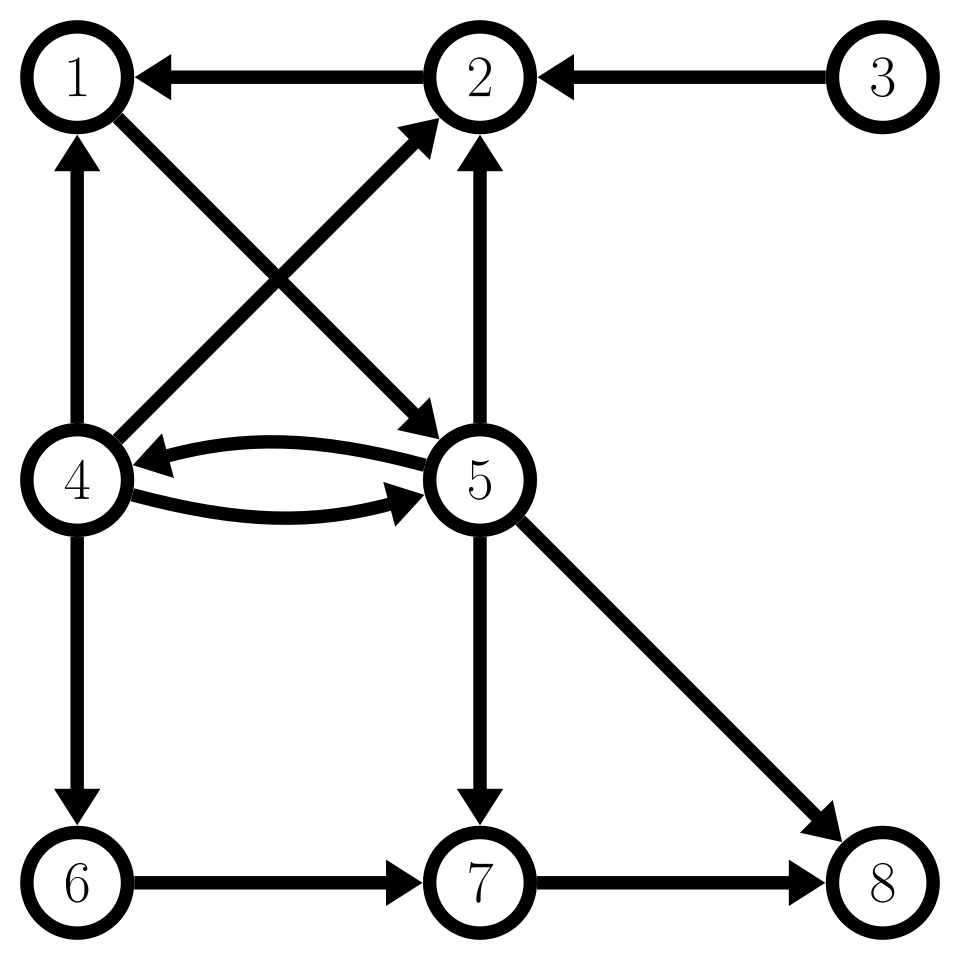
Dimitris131, Public domain, via Wikimedia Commons (File:Directed graph example el.svg); credit: Own work, Public domain. Prepared model input from the cited source; see original source for its unmodified file. Re-encoded for the tested C1 input variant.
- Option 1: 2 arrows
- Option 2: 3 arrows
- Option 3: 4 arrows
- Option 4: 5 arrows
- Option 5: Node 6 cannot be reached from node 1
VB0002 Connectivity and reachability
Starting at node h and following arrows only in the direction they point, how many of the other seven nodes can be reached? (Do not count h itself.)
Only arrows count. The shaded regions and dotted outlines are decoration and do not connect or separate anything. A pair of curved arrows between two nodes means each can reach the other.
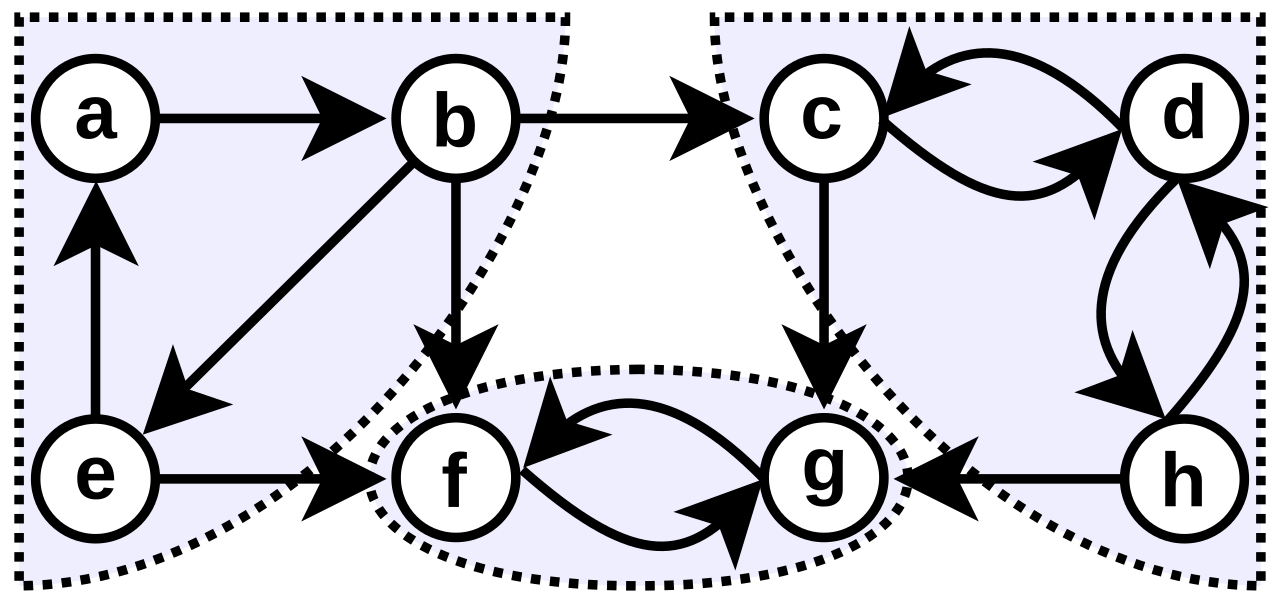
Д.Ильин: vectorization, CC0, via Wikimedia Commons (File:Scc-1.svg); credit: File:Scc.png by ℚuackor, CC0. Prepared model input from the cited source; see original source for its unmodified file.
- Option 1: 2
- Option 2: 3
- Option 3: 4
- Option 4: 5
- Option 5: 6
VB0003 Connectivity and reachability
Following the arrows from the box labelled a:main, how many of the other nine boxes can be reached?
An arrow points from a caller to the box it calls. A box that has an arrow pointing out of it does not become reachable from a:main for that reason alone. A looping arrow that returns to its own box adds nothing.
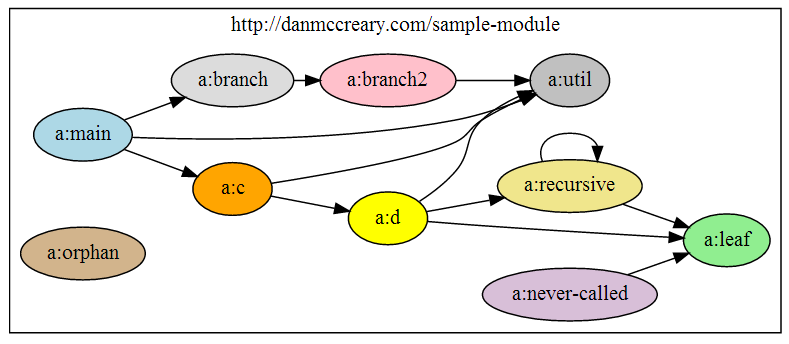
Dmccreary, CC BY-SA 3.0, via Wikimedia Commons (File:Sample-single-module-call-graph.png); credit: Own work, CC BY-SA 3.0. Prepared model input from the cited source; see original source for its unmodified file.
- Option 1: 5
- Option 2: 6
- Option 3: 7
- Option 4: 8
- Option 5: 9
VB0004 Connectivity and reachability
In this call graph, which box is the end point of arrows that come from two different boxes?
Numbers beside the arrows are call counts and do not change which arrows exist. Count only arrowheads that touch the box.
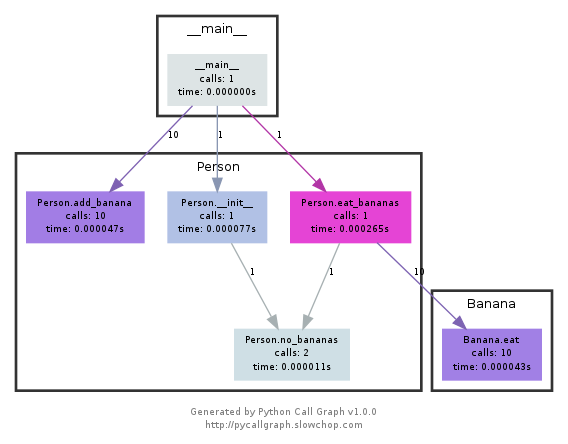
GeraldKaszuba, CC BY-SA 3.0, via Wikimedia Commons (File:A Call Graph generated by pycallgraph.png); credit: Own work, CC BY-SA 3.0. Prepared model input from the cited source; see original source for its unmodified file.
- Option 1: Person.no_bananas
- Option 2: Person.add_banana
- Option 3: Person.eat_bananas
- Option 4: Person.__init__
- Option 5: Banana.eat
VB0005 Connectivity and reachability
Following arrows only in the direction they point, what is the largest number of arrows on a path from tgmath.h to nlib.h that never visits the same box twice?
An arrow ends at the box where its arrowhead touches. Two boxes can have arrows in both directions between them, but a path may not return to a box it has already visited.
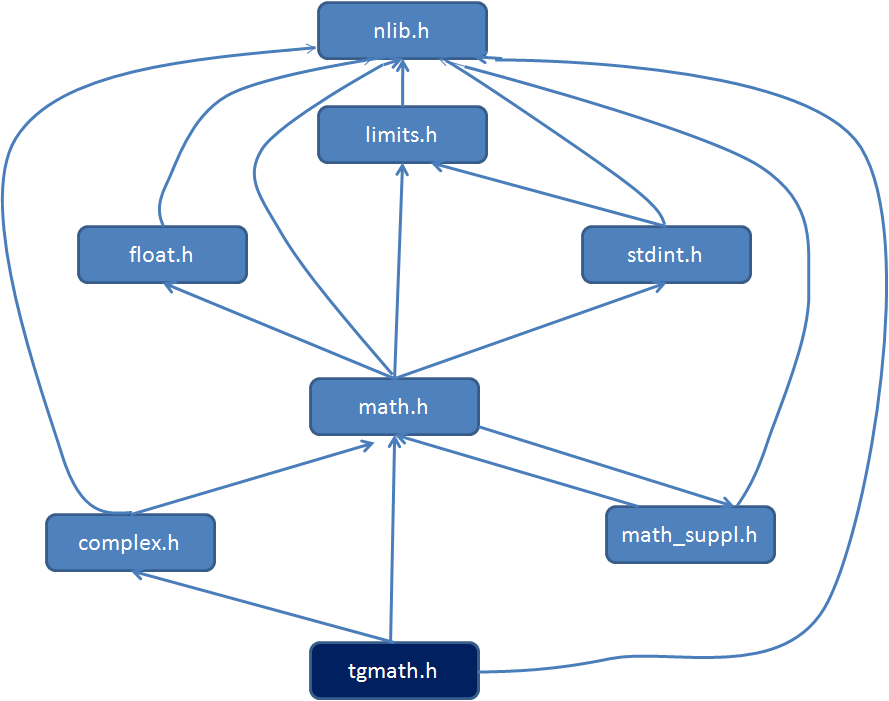
Jobin RV, CC BY-SA 3.0, via Wikimedia Commons (File:Dependency Graph for tgmath.h.png); credit: Own work, CC BY-SA 3.0. Prepared model input from the cited source; see original source for its unmodified file.
- Option 1: 3
- Option 2: 4
- Option 3: 5
- Option 4: 6
- Option 5: 7
VB0006 Connectivity and reachability
The dotted link between F and K is out of service (it carries a red X) and may not be used. Ignoring the bold highlighting, what is the smallest number of links on a route from F to Q?
Each line between two circles is one link. Count every link on the route. Lines meet only at circles.
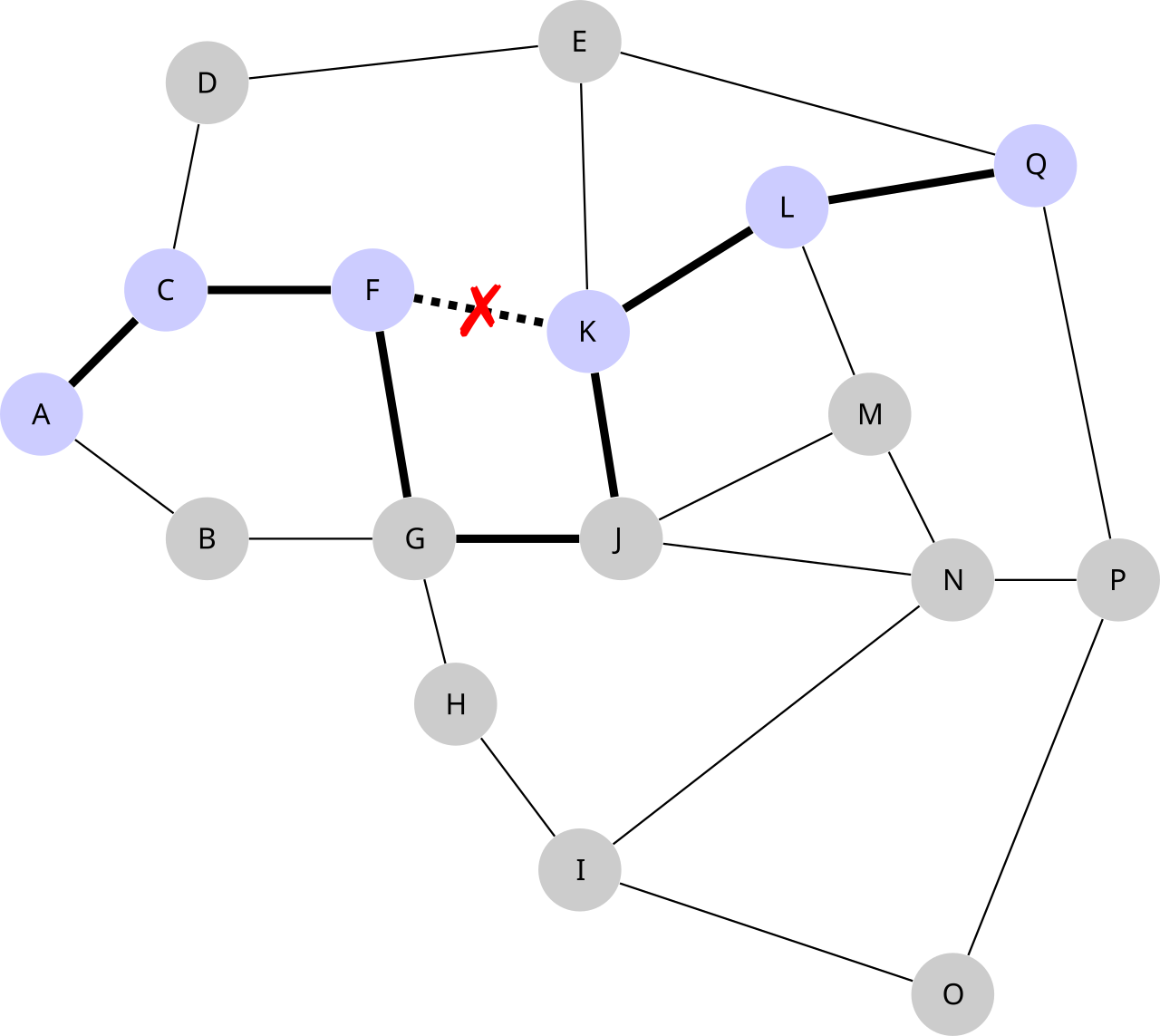
Kjerish, CC BY-SA 4.0, via Wikimedia Commons (File:17 node network with a single link failure.svg); credit: Own work, CC BY-SA 4.0. Prepared model input from the cited source; see original source for its unmodified file.
- Option 1: 3
- Option 2: 4
- Option 3: 5
- Option 4: 6
- Option 5: 7
VB0007 Connectivity and reachability
Following arrow directions, how many different routes lead from the bottom circle labelled read_graph to the circle labelled count?
Rectangles and circles are both stops on a route. Two routes are different if they differ in at least one arrow. Arrows keep their direction and lines meet only where they end.
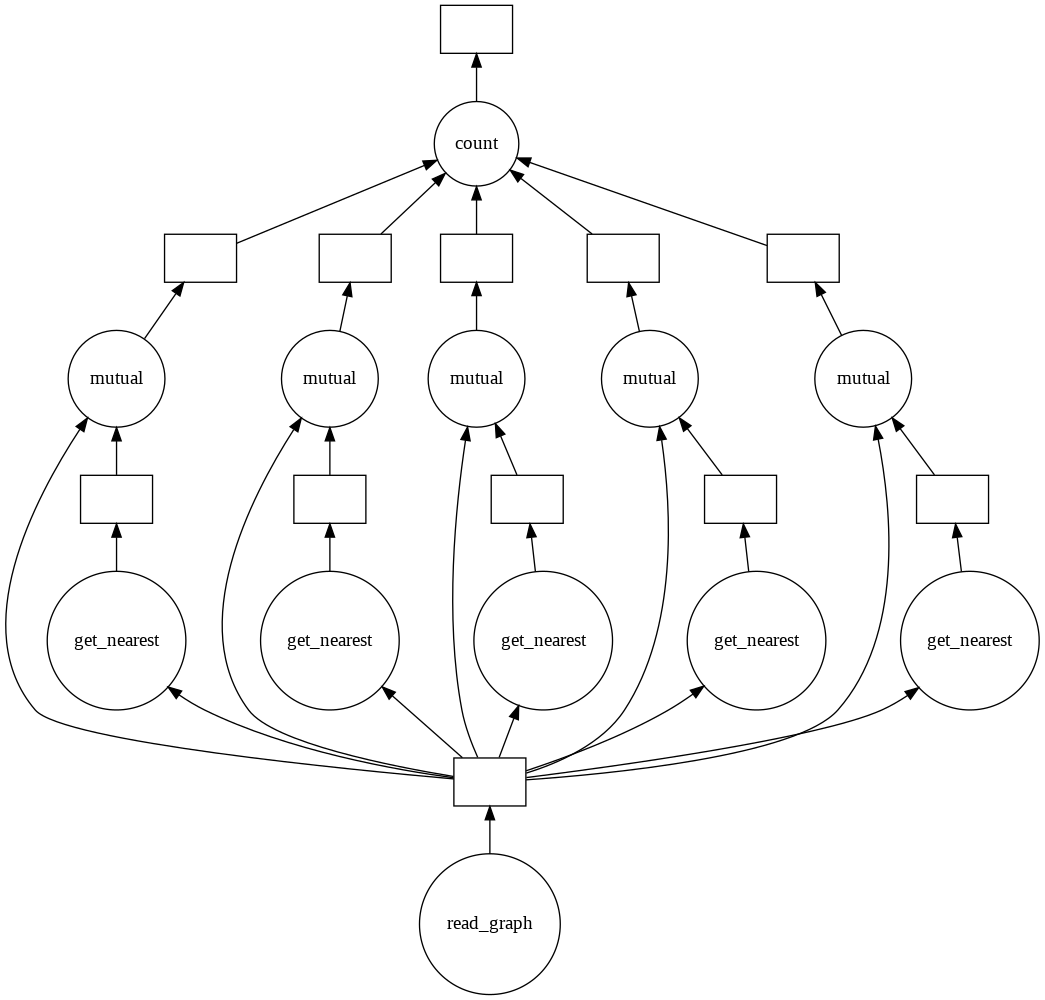
Daniee N H, CC BY-SA 4.0, via Wikimedia Commons (File:Example DASK.png); credit: Own work, CC BY-SA 4.0. Prepared model input from the cited source; see original source for its unmodified file. Re-encoded for the tested C1 input variant.
- Option 1: 5
- Option 2: 6
- Option 3: 10
- Option 4: 15
- Option 5: 25
VB0008 Connectivity and reachability
Starting at the circle labelled with the symbol for the caesium frequency (the top circle, written as a Greek letter followed by a subscript 'Cs') and following arrows only in the direction they point, how many other circles can be reached?
Arrows point from one circle to another; a circle with only outgoing arrows cannot be reached from elsewhere. Count each reached circle once.
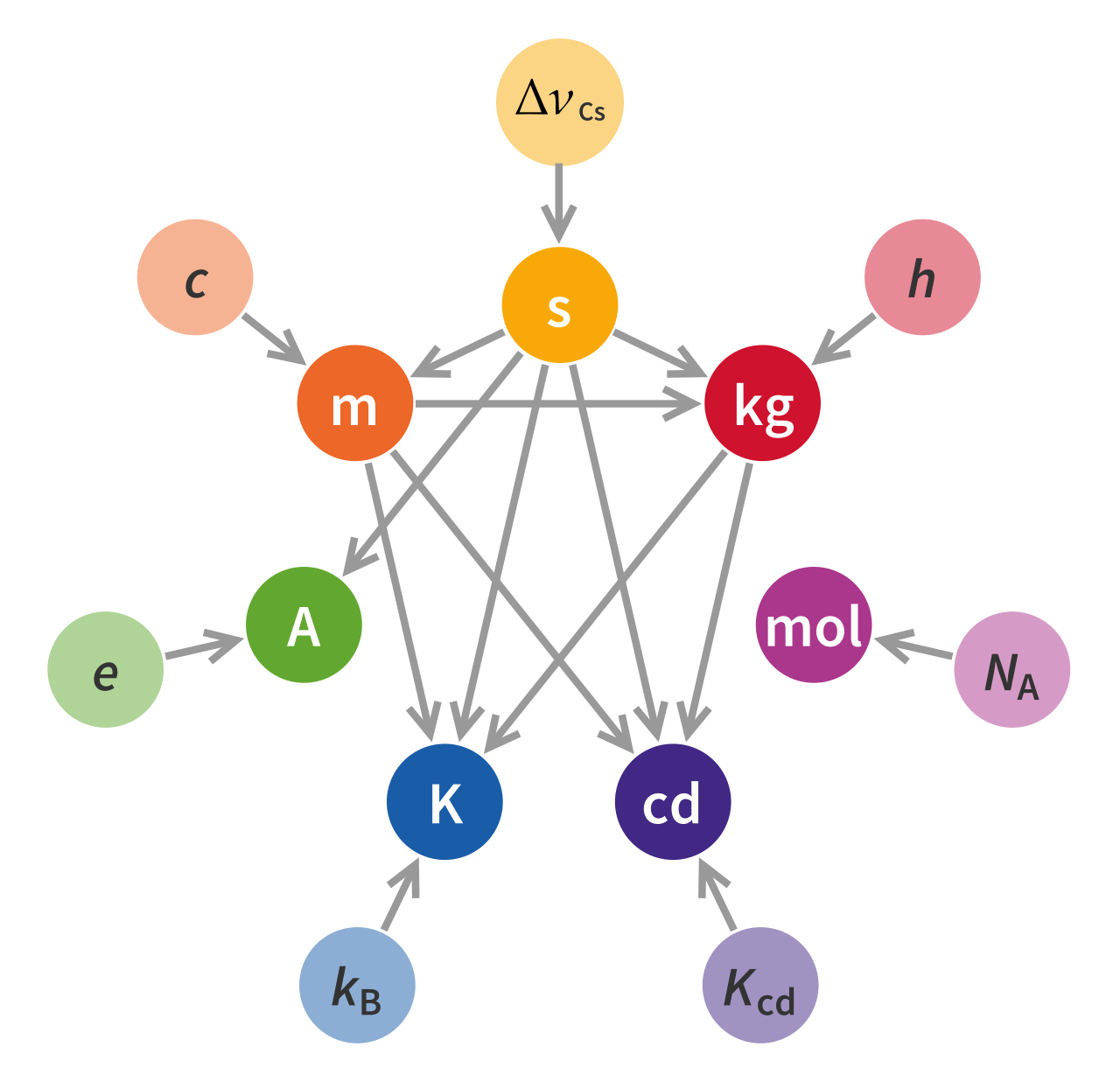
Emilio Pisanty, CC BY-SA 4.0, via Wikimedia Commons (File:Unit relations in the new SI.svg); credit: Own work, CC BY-SA 4.0. Prepared model input from the cited source; see original source for its unmodified file.
- Option 1: 4
- Option 2: 5
- Option 3: 6
- Option 4: 7
- Option 5: 8
VB0009 Connectivity and reachability
The orange line starts at the box labelled 'Call A.add'. At which box does the arrowhead of that orange line point?
Lines may cross in open space without connecting. Each line keeps its colour from start to arrowhead.
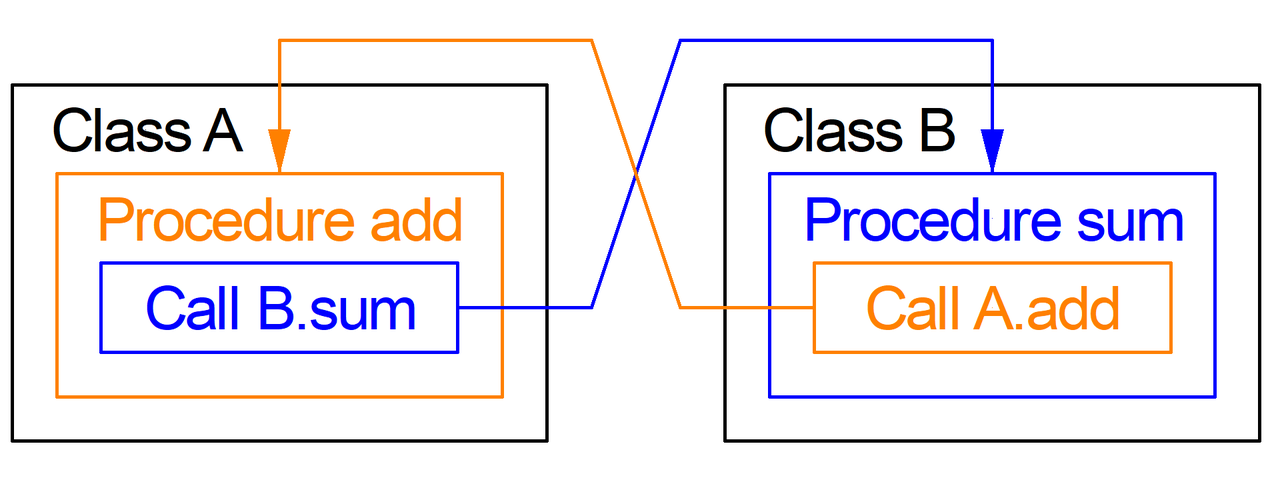
Bautsch, CC0, via Wikimedia Commons (File:Zyklischer.Import.png); credit: Own work, CC0. Prepared model input from the cited source; see original source for its unmodified file.
- Option 1: Call B.sum
- Option 2: Class A
- Option 3: Procedure sum
- Option 4: Procedure add
- Option 5: Class B
VB0010 Connectivity and reachability
Starting at node G and following arrows only in the direction they point, how many other nodes can be reached?
Do not count G itself. The coloured rounded boxes and their letters (X, Y, Z, W, V) are decoration and do not connect or separate anything. Where two curved arrows run between the same two nodes in opposite directions, each node can reach the other.
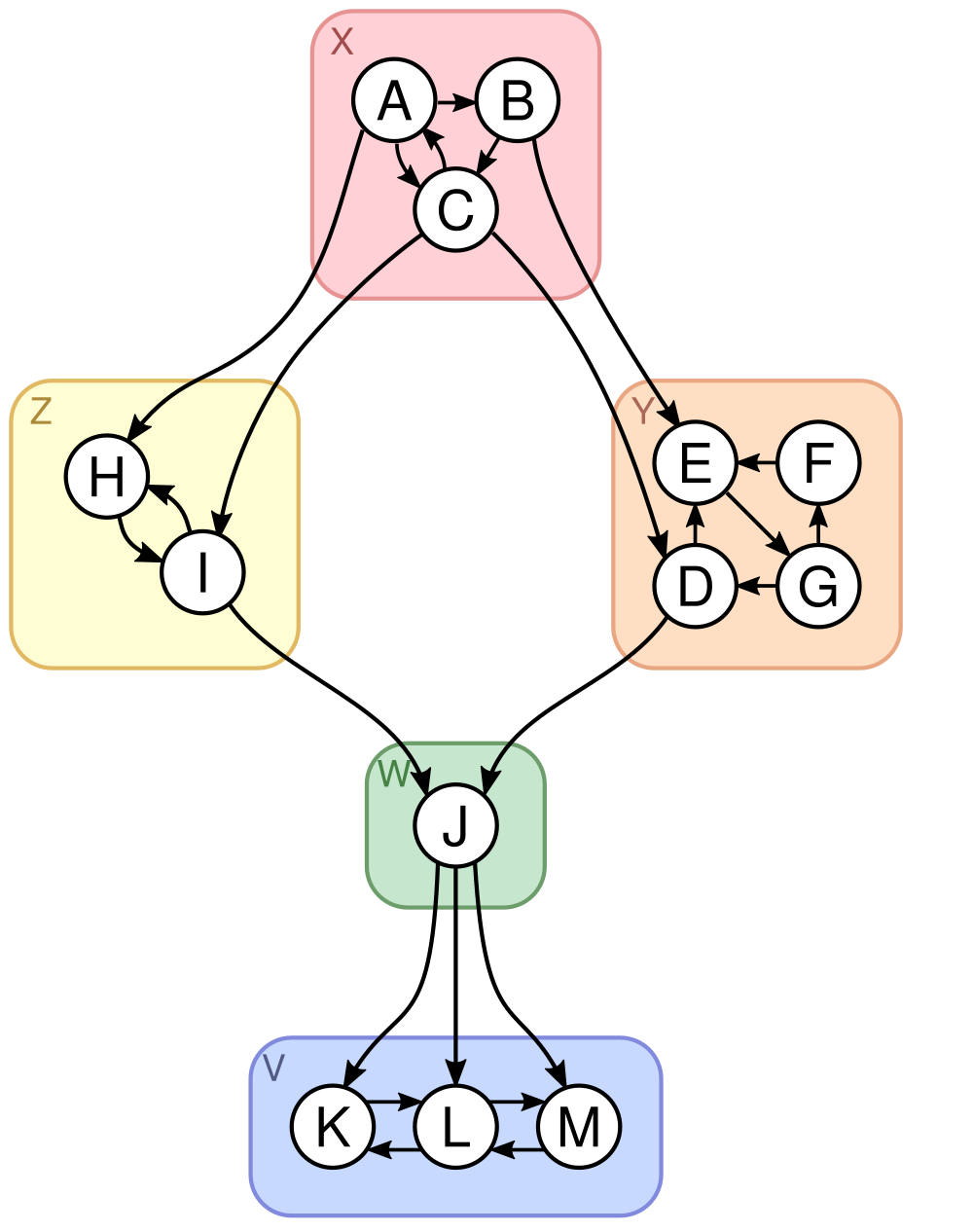
RaspberryJamWikipedian, CC BY-SA 4.0, via Wikimedia Commons (File:Kosaraju stack after first pass.svg); credit: Own work, CC BY-SA 4.0. Prepared model input from the cited source; see original source for its unmodified file.
- Option 1: 3
- Option 2: 4
- Option 3: 5
- Option 4: 6
- Option 5: 7
VB0011 Navigation and planning
On this Bucharest metro diagram, at which station should a rider change lines to travel from Preciziei (west end of the red line) to Tudor Arghezi (south end of the blue line) with the fewest changes of line?
Use only solid line segments; ignore dotted or striped segments. A station drawn as two circles joined by a white link, or as one shared circle, is an interchange. Two stations that are merely close together without a link are not an interchange.
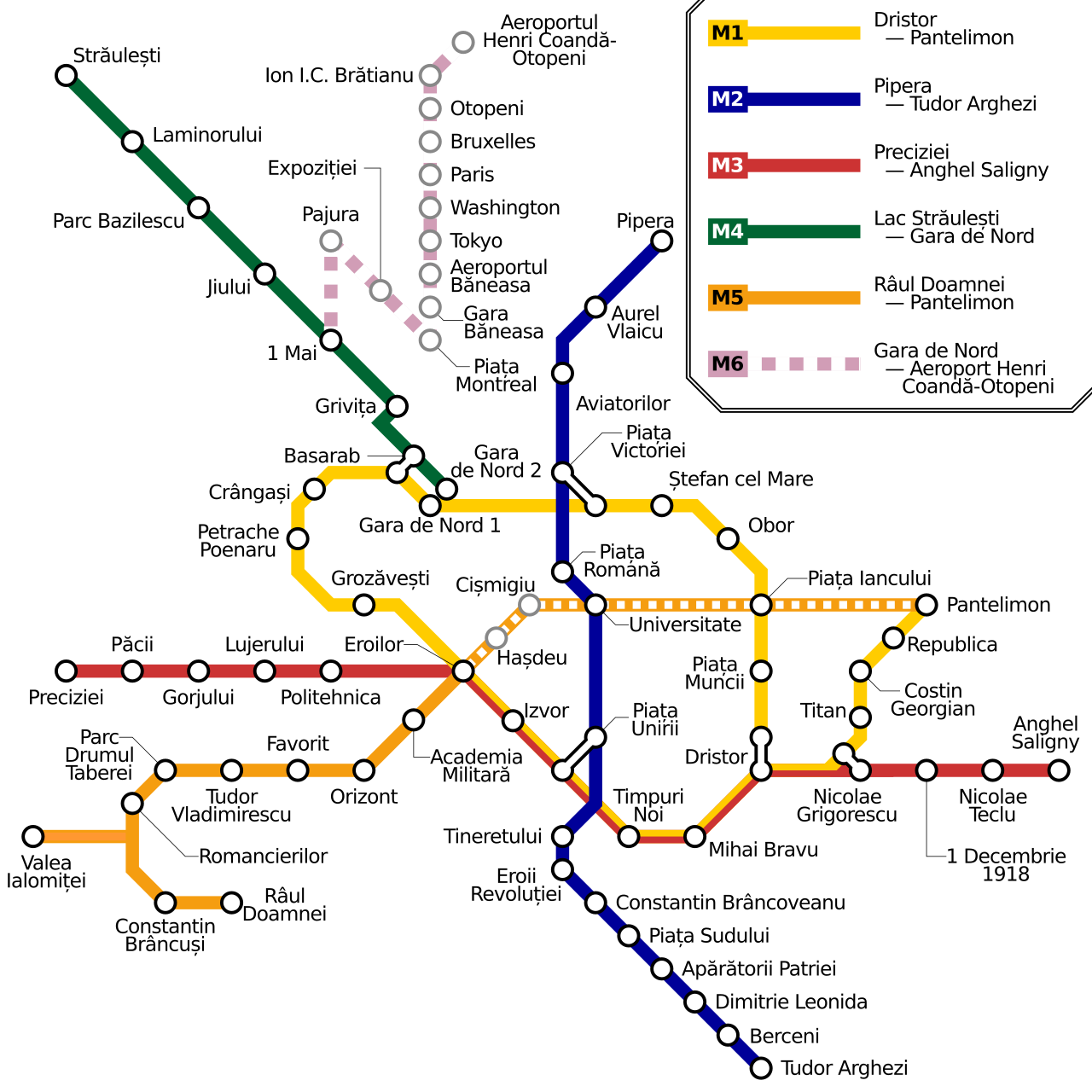
Mliu92, CC BY-SA 4.0, via Wikimedia Commons (File:Metro București.svg); credit: Own work, inspired by sources listed below with station names and rough routing from Harta reţelei de metrou din municipiul Bucureşti. Metrorex (April 2016). Archived from the original on 5 January 2017. Retrieved on 5 January 2016., CC BY-SA 4.0. Prepared model input from the cited source; see original source for its unmodified file.
- Option 1: Piața Victoriei
- Option 2: Dristor
- Option 3: No single change is enough; at least two changes are needed
- Option 4: Eroilor
- Option 5: Piața Unirii
VB0012 Navigation and planning
Using this Prague metro plan, what is the smallest number of station-to-station moves from Nemocnice Motol to Letňany?
Count one move between adjacent station symbols, including departures from and arrivals at the lettered square terminal markers. Changing lines at a shared station costs no moves. Ignore the dotted dark-blue line and the pale-blue river. Minimize moves, regardless of the number of line changes.
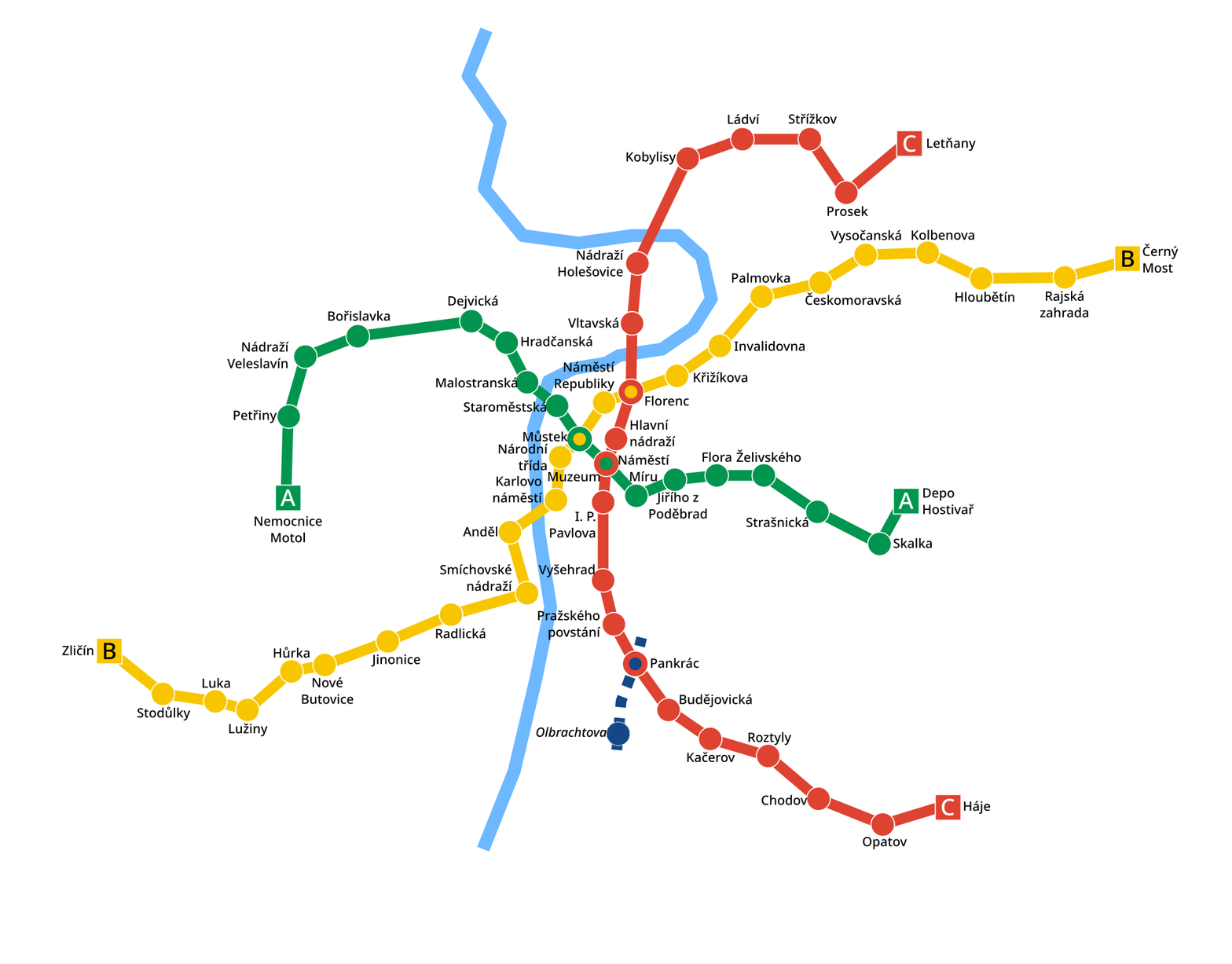
Bilykralik16, CC BY-SA 4.0, via Wikimedia Commons (File:Prague metro plan 2022.svg); credit: Own work with the base of File:Prague metro plan 2015.svg, CC BY-SA 4.0. Prepared model input from the cited source; see original source for its unmodified file. Reviewed crop or preparation replaces the original source framing.
- Option 1: 16
- Option 2: 17
- Option 3: 18
- Option 4: 19
- Option 5: 20
VB0013 Navigation and planning
What is the smallest total distance for a trip from Maldon to Dunwich?
Numbers beside the lines are distances. A route's length is the sum of the numbers on the lines it uses. Lines that cross in open space without a circle do not connect. A trip may pass through other towns. If two routes tie for shortest, the question is about the common length.
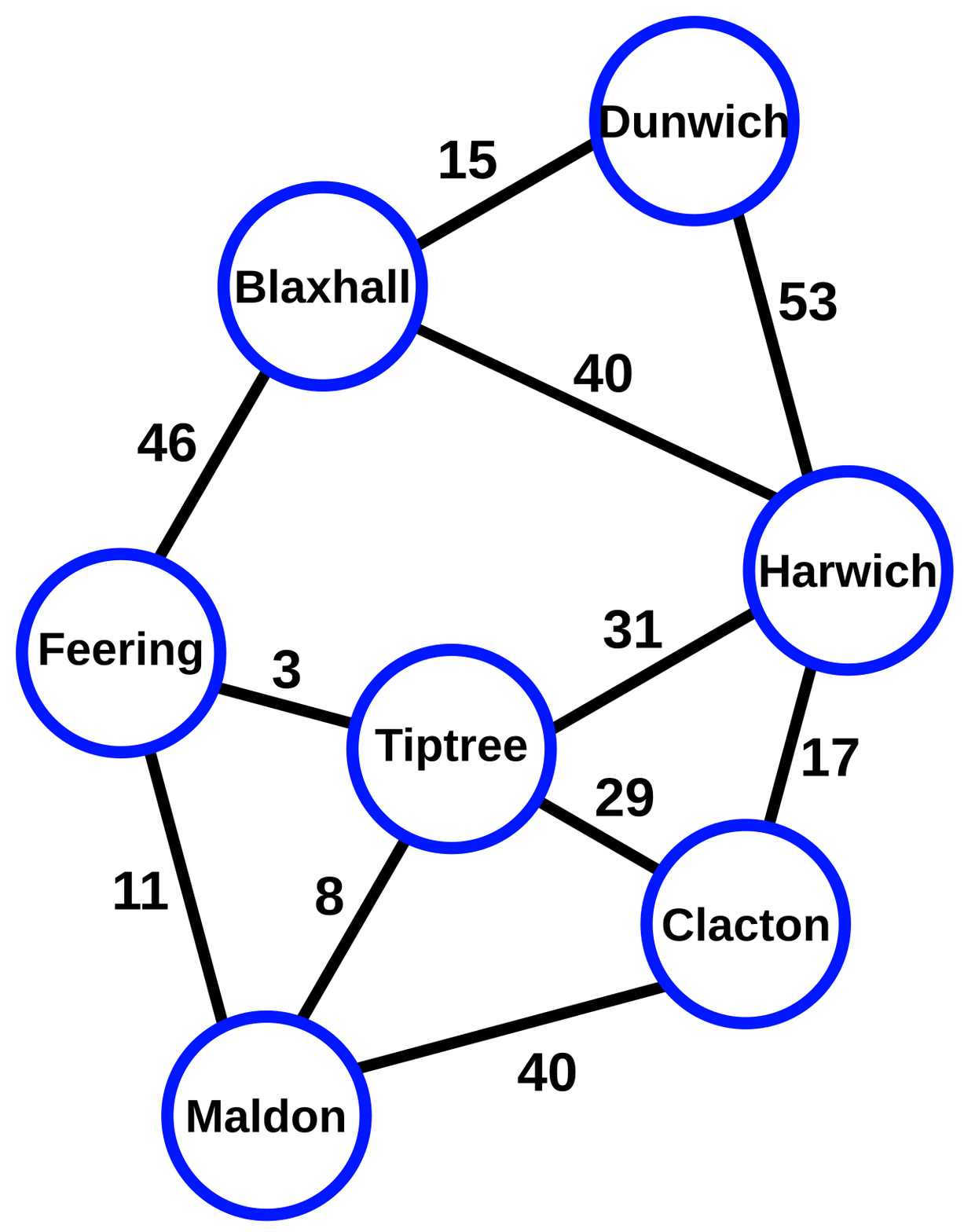
Pluke, CC0, via Wikimedia Commons (File:CPT-Graphs-undirected-weighted.svg); credit: Own work, CC0. Prepared model input from the cited source; see original source for its unmodified file. Reviewed crop or preparation replaces the original source framing.
- Option 1: 66
- Option 2: 72
- Option 3: 78
- Option 4: 92
- Option 5: The least distance is not established by the image
VB0014 Navigation and planning
What is the smallest total distance from node 6 to node 7?
Numbers beside the lines are distances. A route's length is the sum of the numbers on the lines it uses. Lines that cross in open space without a circle do not connect.
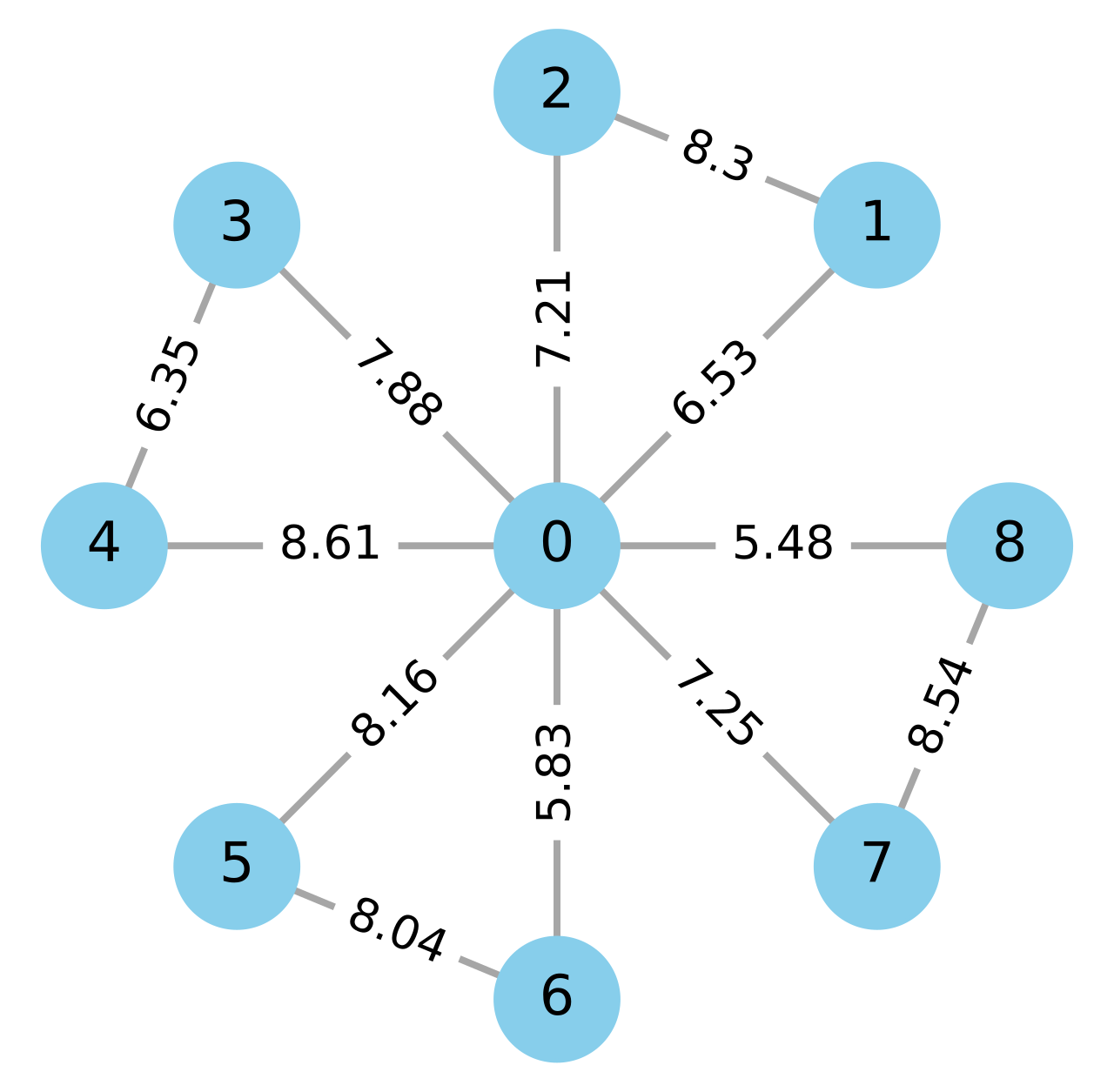
BagLuke, CC0, via Wikimedia Commons (File:Weighted friendship graph.svg); credit: Own work, CC0. Prepared model input from the cited source; see original source for its unmodified file.
- Option 1: 12.34
- Option 2: 19.85
- Option 3: 23.45
- Option 4: 15.14
- Option 5: 13.08
VB0015 Navigation and planning
To travel from Odivelas (north end of the yellow line) to Cais do Sodré (south end of the green line) with as few changes of line as possible, at which station do you change?
Use only solid line sections; dotted sections are under construction (see the legend) and cannot be used. A white circle marks a station where lines meet (common station). Choose the single station that allows the fewest changes.
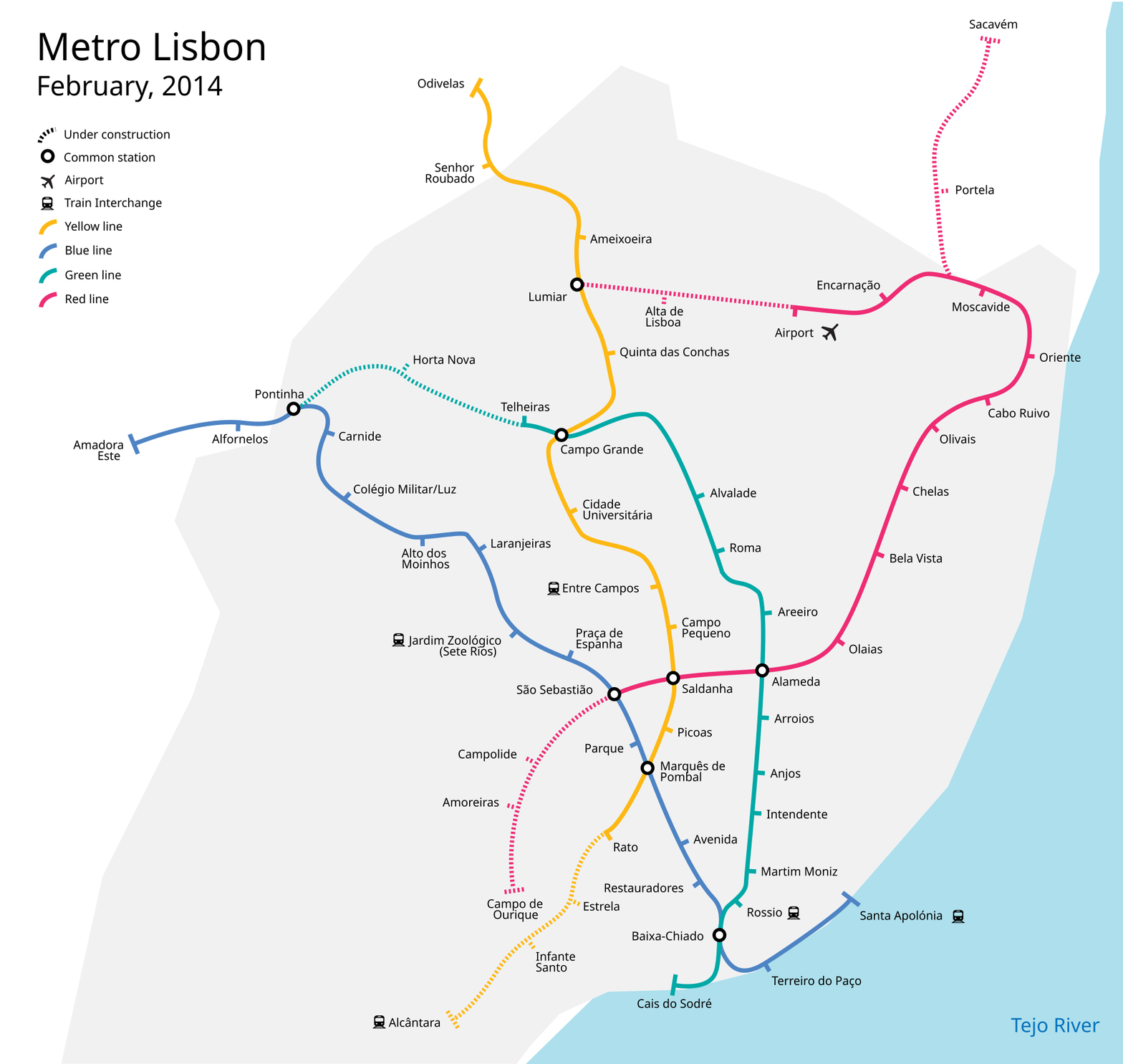
Laura Sun, CC BY-SA 3.0, via Wikimedia Commons (File:Lisbon metro.svg); credit: Own work, CC BY-SA 3.0. Prepared model input from the cited source; see original source for its unmodified file. Reviewed crop or preparation replaces the original source framing.
- Option 1: Lumiar
- Option 2: Campo Grande
- Option 3: Marquês de Pombal
- Option 4: Saldanha
- Option 5: Alameda
VB0016 Navigation and planning
How many stops must a passenger travel from Tempelhof to reach Grenzallee, counting Grenzallee but not Tempelhof?
The line has one branch. A stop is any black square on the route. The route takes the branch to the right at the junction. Ignore the notes beside the open markers (they are not on this route).
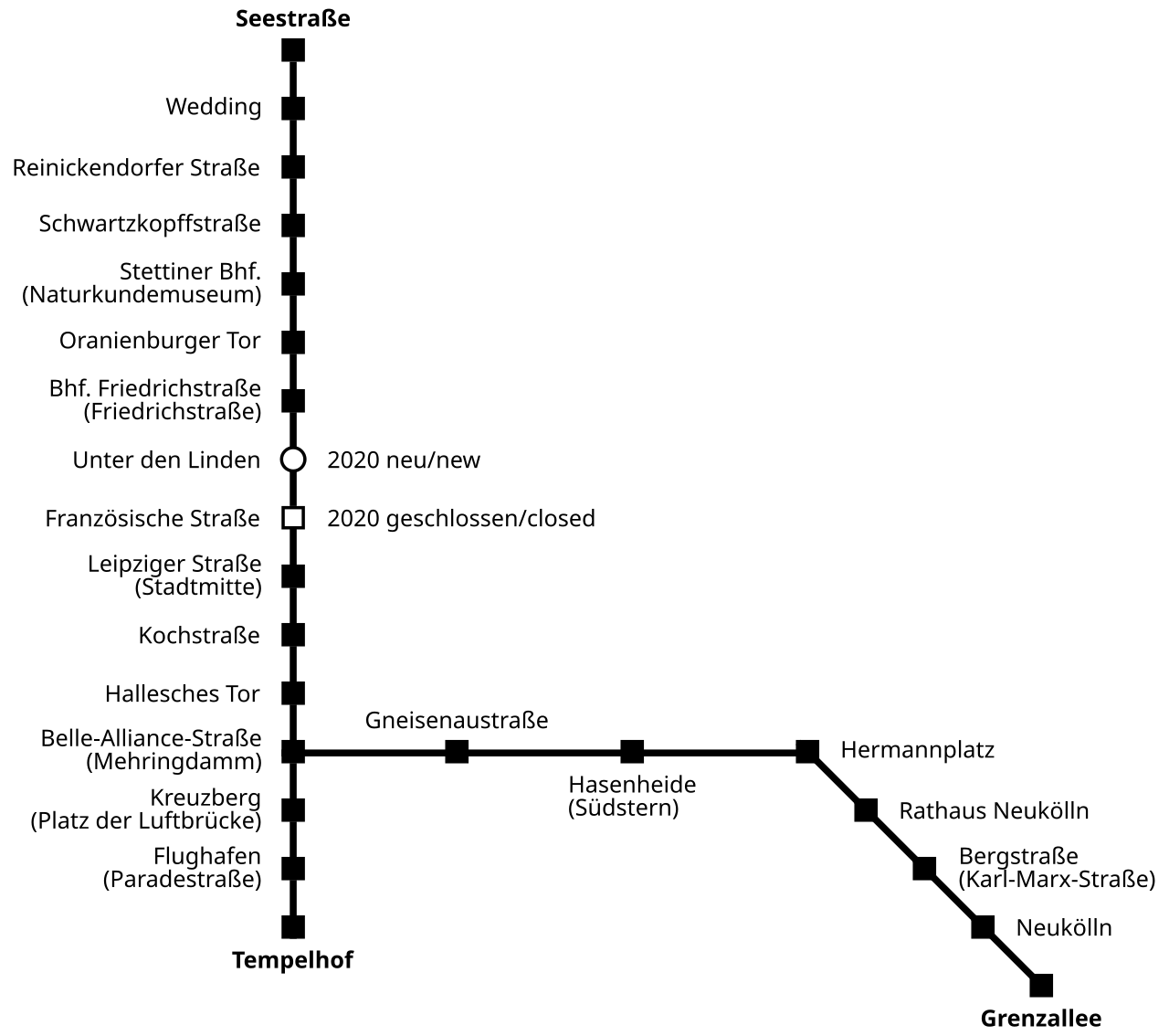
Grummelbacke, CC0, via Wikimedia Commons (File:Nord-sued-u-bahn berlin karte 1930.svg); credit: Own work, CC0. Prepared model input from the cited source; see original source for its unmodified file. Re-encoded for the tested C1 input variant.
- Option 1: 8
- Option 2: 9
- Option 3: 10
- Option 4: 11
- Option 5: 12
VB0017 Visual rule application
Apply the Game of Life rules to the pattern in the picture two times in a row. How many live cells are there after the second generation?
Black squares are live cells, white squares are dead cells, and every cell outside the picture is dead; the grid is unbounded in all directions. Rules: a live cell with 2 or 3 live neighbours (the 8 surrounding cells, diagonals included) stays alive, otherwise it dies; a dead cell with exactly 3 live neighbours becomes alive. All cells change together in each generation.

Sarang, Public domain, via Wikimedia Commons (File:Game of life 3x3 cell pento-R.svg); credit: Own work, Public domain. Prepared model input from the cited source; see original source for its unmodified file. Re-encoded for the tested C1 input variant.
- Option 1: 4
- Option 2: 5
- Option 3: 6
- Option 4: 7
- Option 5: 8
VB0018 Visual rule application
The picture is a Turing-machine state diagram. The machine starts in state A. The tape is infinite in both directions and every cell holds 0 except the single cell under the head, which holds 1. When the machine reaches the halting state H, how many cells on the tape hold 1?
An arrow label 'x/P,D' means: if the symbol under the head is x, write 1 (P), move the head one cell in direction D (L = left, R = right), then go to the state the arrow points to. The arrow from 'start' only marks the initial state. H is the halting state.
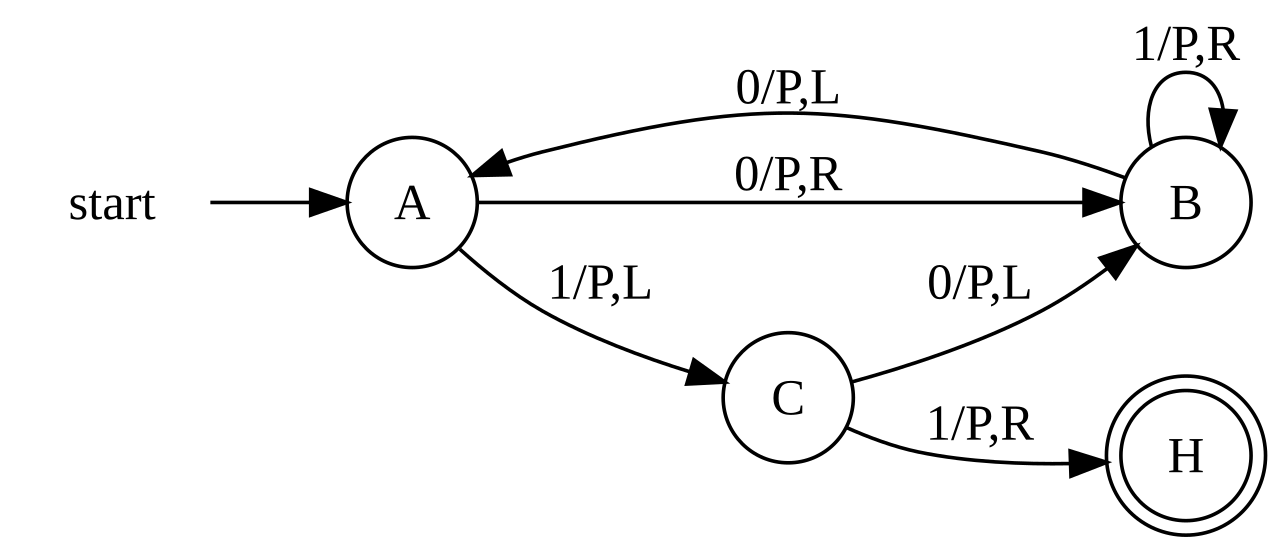
Diego Queiroz, CC BY-SA 3.0, via Wikimedia Commons (File:State diagram 3 state busy beaver 2B.svg); credit: Own work, CC BY-SA 3.0. Prepared model input from the cited source; see original source for its unmodified file. Re-encoded for the tested C1 input variant.
- Option 1: 4
- Option 2: 5
- Option 3: 6
- Option 4: 7
- Option 5: 8
VB0019 Visual rule application
The machine starts in state a (the state with the entering arrow). Which one of these input strings does it accept?
A string is read left to right, one symbol per arrow, following the arrow labelled with that symbol. It is accepted if, after the last symbol, the machine is in a state drawn with a double circle.
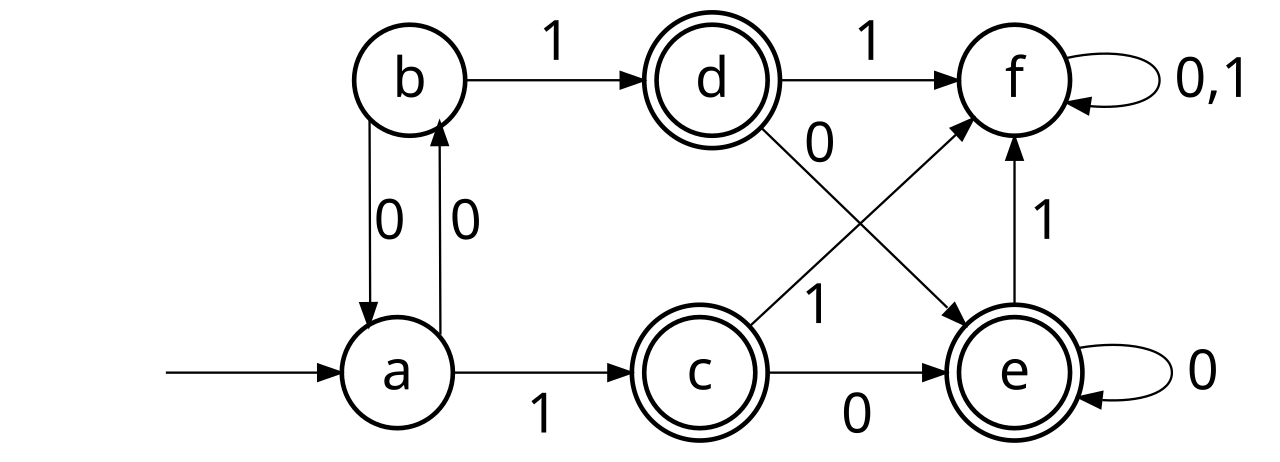
Pat Hawks, CC BY 4.0, via Wikimedia Commons (File:DFA to be minimized.svg); credit: Own work, CC BY 4.0. Prepared model input from the cited source; see original source for its unmodified file. Re-encoded for the tested C1 input variant.
- Option 1: 1100
- Option 2: 0110
- Option 3: 1010
- Option 4: 01000
- Option 5: 0101
VB0020 Visual rule application
The machine starts in S0 (the state with no arrow into it). What output sequence does it produce for the input sequence 1, 0, 0, 1, 1?
An arrow labelled x/y means: on input x, output y and move along that arrow. Write the five outputs in order.
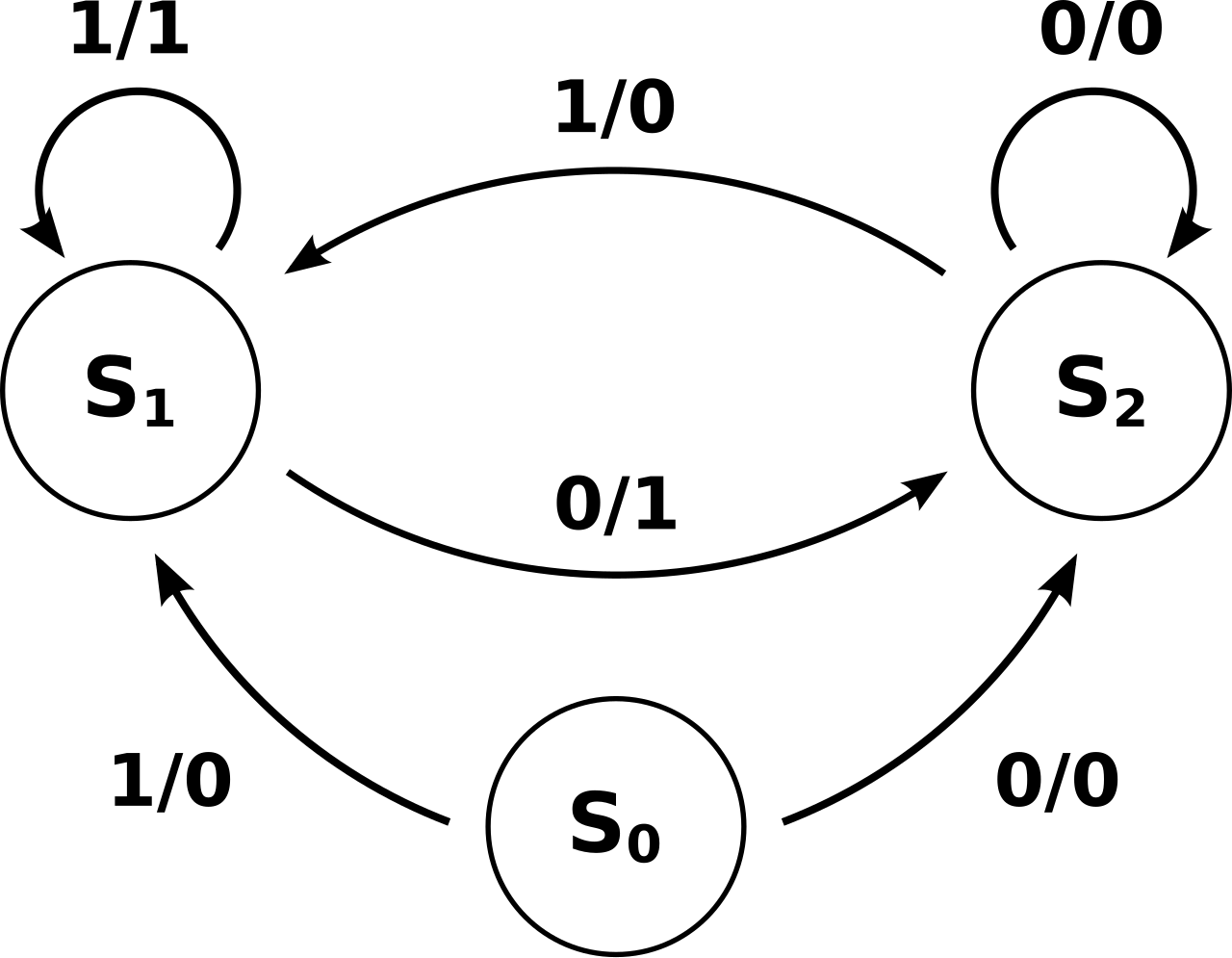
Jake Choules, Public domain, via Wikimedia Commons (File:Mealy machine state diagram.svg); credit: Own work, derived from Mealymachine_jaredwf.png., Public domain. Prepared model input from the cited source; see original source for its unmodified file. Re-encoded for the tested C1 input variant.
- Option 1: 01101
- Option 2: 00101
- Option 3: 10011
- Option 4: 01001
- Option 5: 11001
VB0021 Visual rule application
The machine starts in q0. For the input sequence z, y, y, x, x, what output string is produced?
Each state shows its output letter in its lower half. Write the output of the starting state first, then the output of each state reached after every input symbol. An arrow labelled with several letters (for example x, z) is followed for any of them.
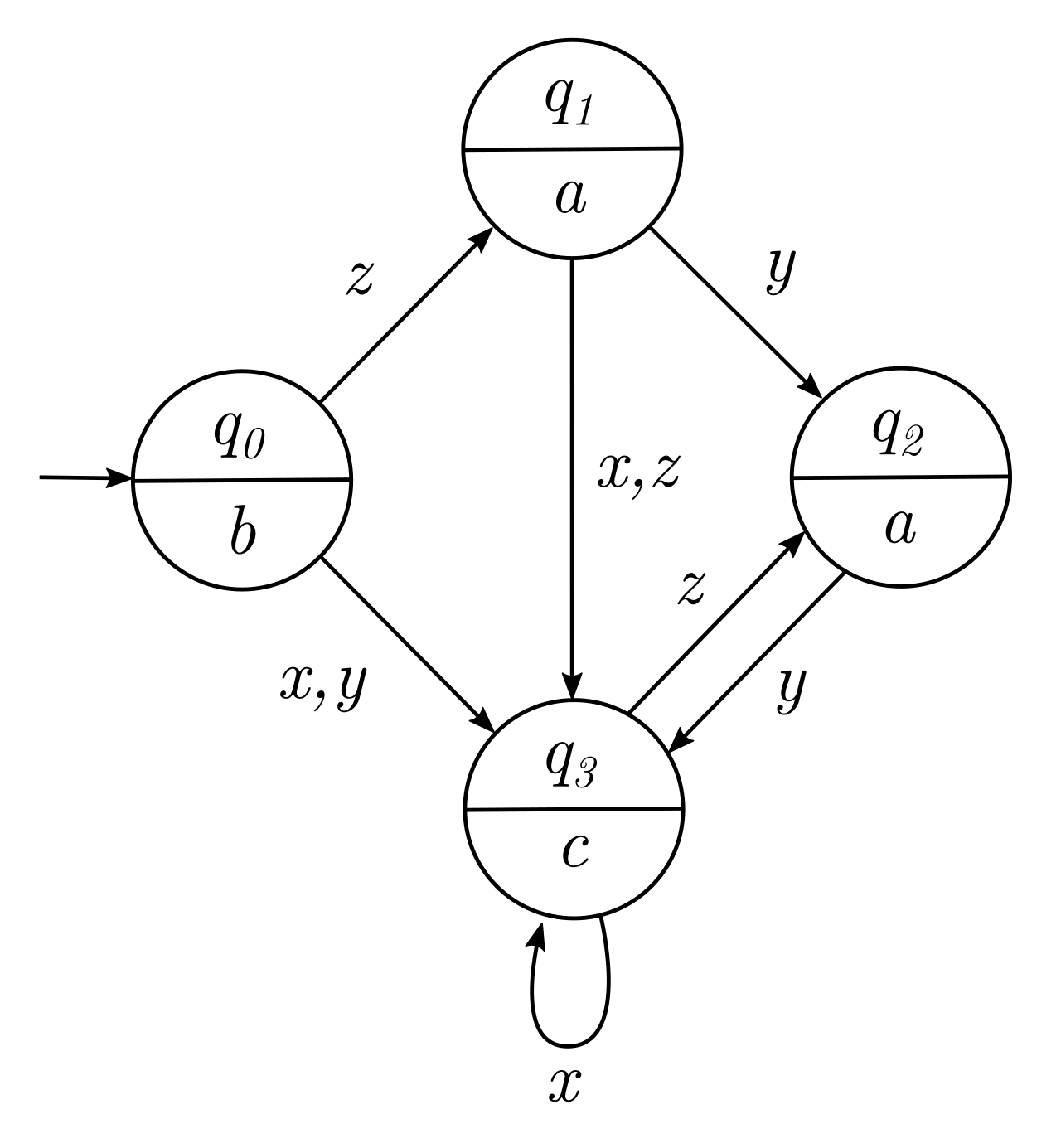
Stiegenaufgang, based on NikolausMayer's work, CC BY-SA 4.0, via Wikimedia Commons (File:MooreMachineExample.svg); credit: Based on MooreAutomaton.png - vectorized, CC BY-SA 4.0. Prepared model input from the cited source; see original source for its unmodified file. Re-encoded for the tested C1 input variant.
- Option 1: bcaccc
- Option 2: baacc
- Option 3: bacccc
- Option 4: aaccc
- Option 5: baaccc
VB0022 Visual rule application
The machine starts in state A (the top-left state). Which state is it in after reading the input 1, 1, 0, 1, 1, 1?
Follow the arrow labelled with each input symbol, one symbol at a time. A looping arrow keeps the machine in the same state.
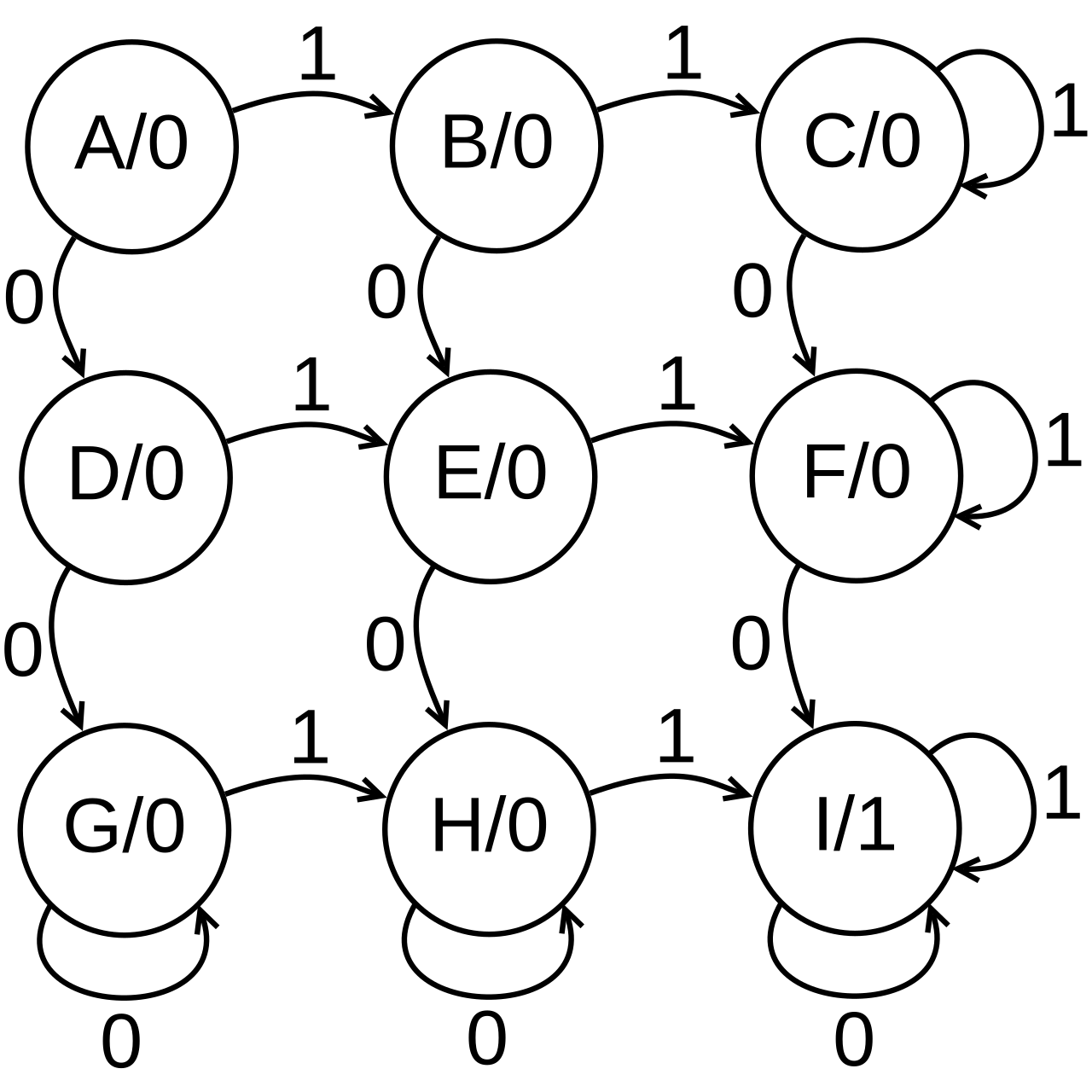
ColinStocks, CC0, via Wikimedia Commons (File:ExampleMooreMachine.svg); credit: Own work, CC0. Prepared model input from the cited source; see original source for its unmodified file. Re-encoded for the tested C1 input variant.
- Option 1: I
- Option 2: E
- Option 3: C
- Option 4: B
- Option 5: F
VB0023 Visual rule application
The machine starts in the Locked state (the arrow from the black dot). For the inputs Push, Coin, Coin, Push, Push in that order, what is the output sequence?
An arrow labelled input/output means: on that input, produce that output and move along the arrow (a loop stays in the same state).
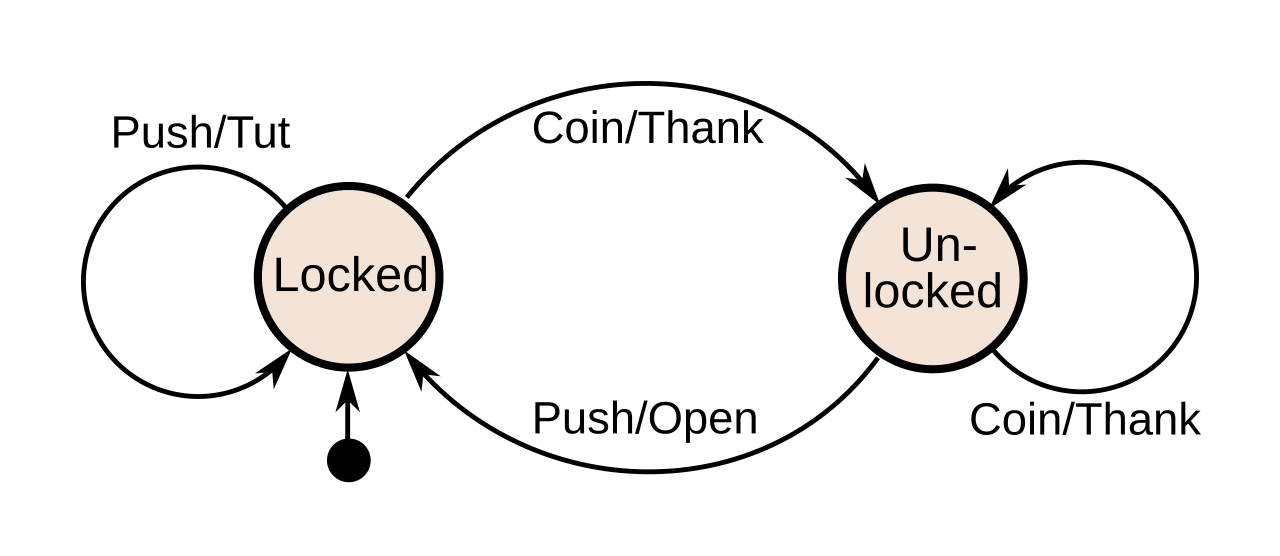
Chetvorno, CC0, via Wikimedia Commons (File:Turnstile finite-state machine with actions.svg); credit: Own work based on: Turnstile state machine colored.svg, with minor modifications, CC0. Prepared model input from the cited source; see original source for its unmodified file.
- Option 1: Tut, Thank, Thank, Open, Open
- Option 2: Open, Thank, Thank, Open, Tut
- Option 3: Tut, Thank, Open, Open, Tut
- Option 4: Tut, Thank, Thank, Open, Tut
- Option 5: Tut, Thank, Thank, Thank, Open
VB0024 Visual rule application
The machine starts in S1 with its head on the leftmost symbol of the tape 1 1 0 1 1; every other cell holds 0. When it halts, how many cells on the tape hold 1?
An arrow labelled a/b,D means: if the symbol under the head is a, write b, move the head one cell in direction D (L = left, R = right), then go to the state the arrow points to. The machine halts when no arrow leaves the current state for the symbol under the head. The tape is unbounded in both directions.
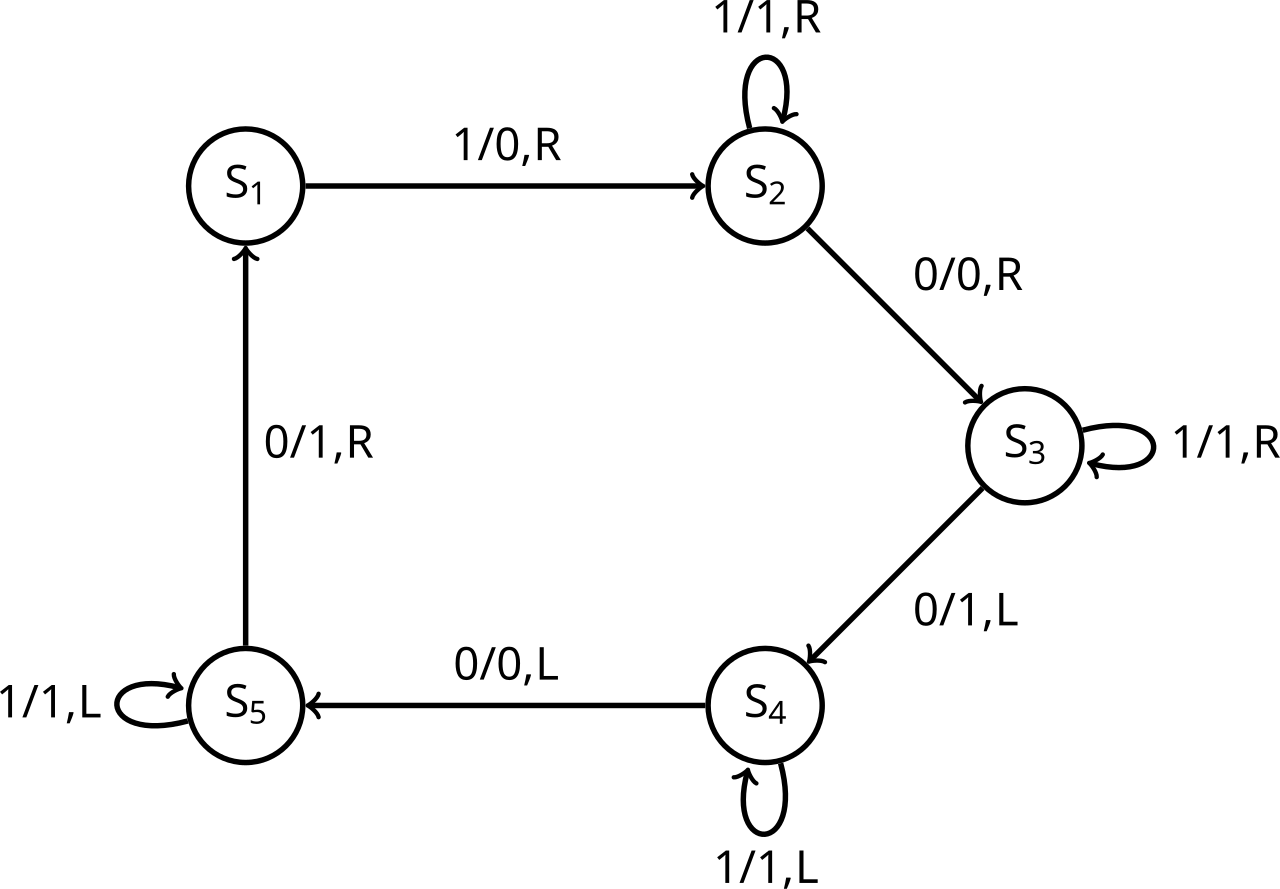
Sn KGS, CC BY-SA 4.0, via Wikimedia Commons (File:Example of a Turing machine.svg); credit: Own work, CC BY-SA 4.0. Prepared model input from the cited source; see original source for its unmodified file. Re-encoded for the tested C1 input variant.
- Option 1: 4
- Option 2: 5
- Option 3: 6
- Option 4: 7
- Option 5: 8
VB0025 Visual rule application
Starting from q0, which one of these strings is accepted by the machine?
q0 is the start state (the only state with no incoming arrow). A string is accepted if at least one path through the machine reads the whole string and ends in a state drawn with a double circle. A path that gets stuck (no arrow for the next symbol) does not count.
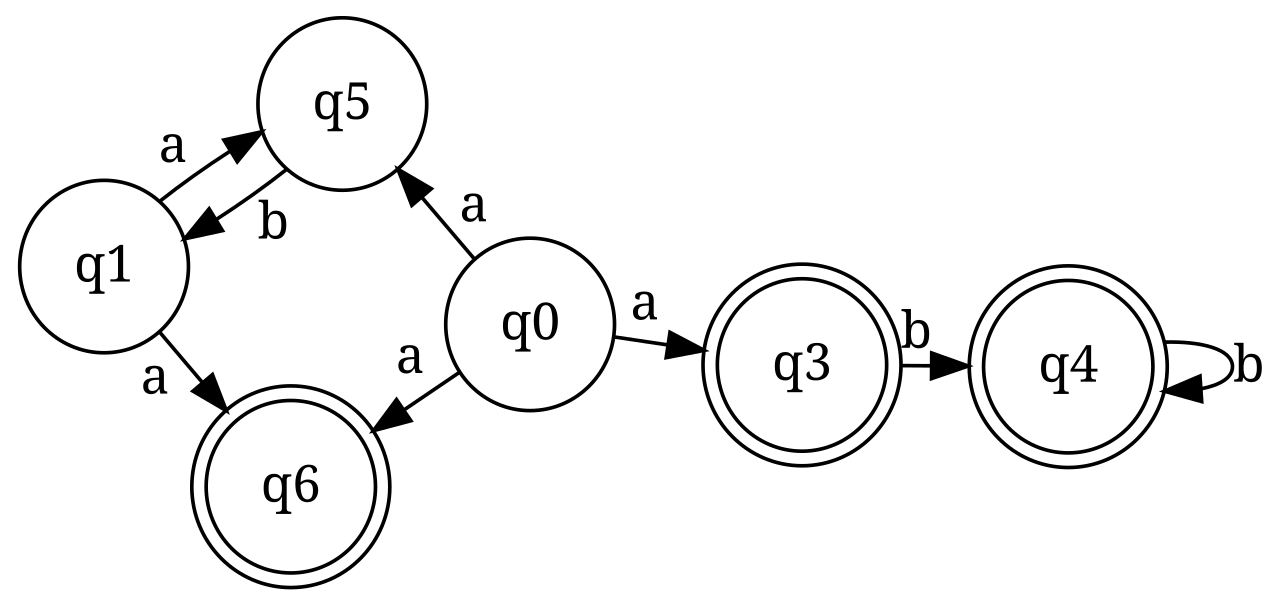
HeatSink, CC BY-SA 3.0, via Wikimedia Commons (File:Nfa several.svg); credit: Own work, CC BY-SA 3.0. Prepared model input from the cited source; see original source for its unmodified file. Re-encoded for the tested C1 input variant.
- Option 1: ba
- Option 2: ababa
- Option 3: abba
- Option 4: aab
- Option 5: abab
VB0026 Visual rule application
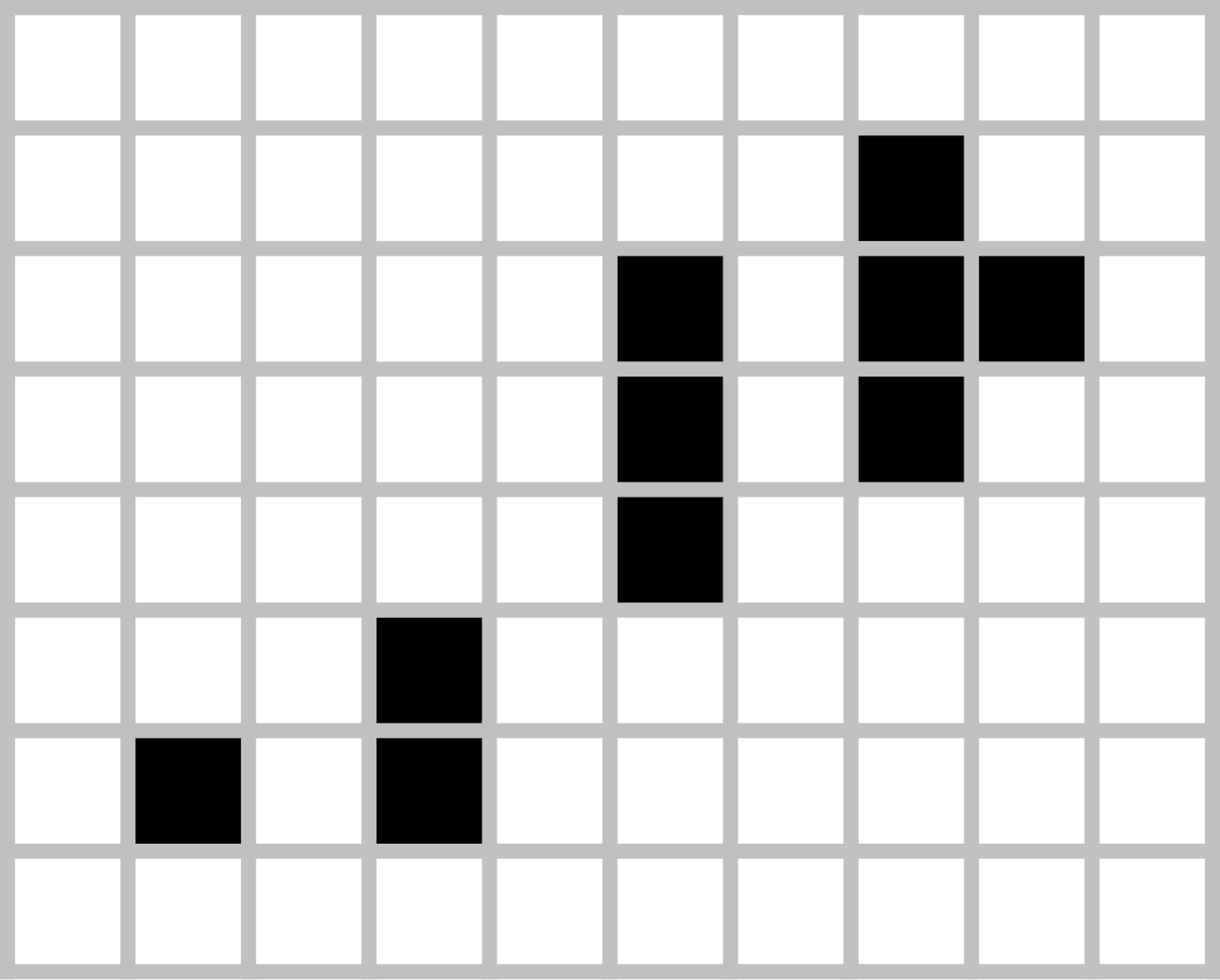
Apply the Game of Life rules once to the pattern in the picture. How many live cells are there after that one generation?
Black squares are live cells, white squares are dead cells, and every cell outside the picture is dead; the grid is unbounded in all directions. A live cell with 2 or 3 live neighbours (the 8 surrounding cells, diagonals included) stays alive, otherwise it dies; a dead cell with exactly 3 live neighbours becomes alive. All cells change together.
Bryan.burgers, Public domain, via Wikimedia Commons (File:Game of life infinite1.svg); credit: Own work, Public domain. Prepared model input from the cited source; see original source for its unmodified file. Re-encoded for the tested C1 input variant.
- Option 1: 12
- Option 2: 13
- Option 3: 14
- Option 4: 15
- Option 5: 16
VB0027 Constraint satisfaction
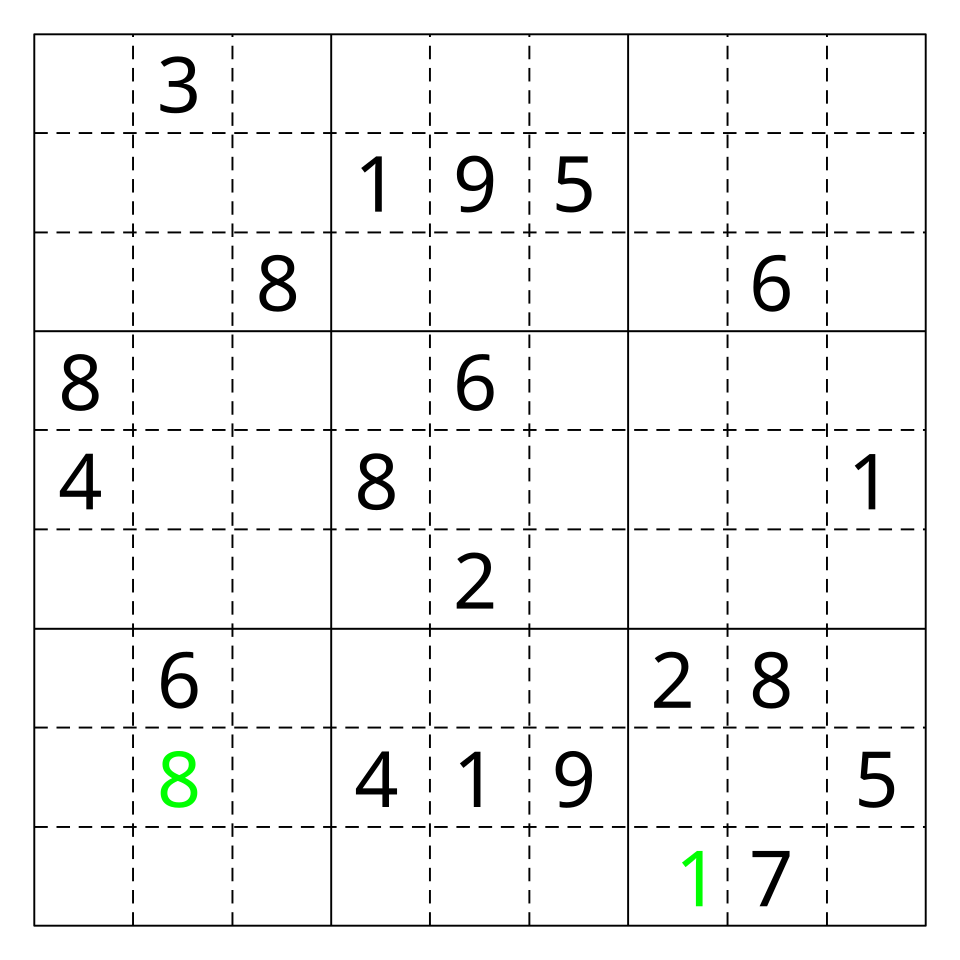
Under the usual sudoku rules (no repeated digit in any row, column or 3x3 box), which digits could legally be written in the empty centre cell, row 5 column 5? Count rows from the top and columns from the left.
Treat every digit shown, black or green, as already placed. Heavy lines mark the 3x3 boxes; dashed lines are ordinary cell borders. Do not try to solve the whole puzzle; ask only which digits do not conflict with the placed digits.
Amahoney, CC BY-SA 4.0, via Wikimedia Commons (File:Sudoku partial 1.svg); credit: Own work, CC BY-SA 4.0. Prepared model input from the cited source; see original source for its unmodified file.
- Option 1: 3, 5 or 7
- Option 2: 2, 3, 5 or 7
- Option 3: 3, 5, 7 or 9
- Option 4: 3 or 7 only
- Option 5: 1, 3, 5 or 7
VB0028 Constraint satisfaction
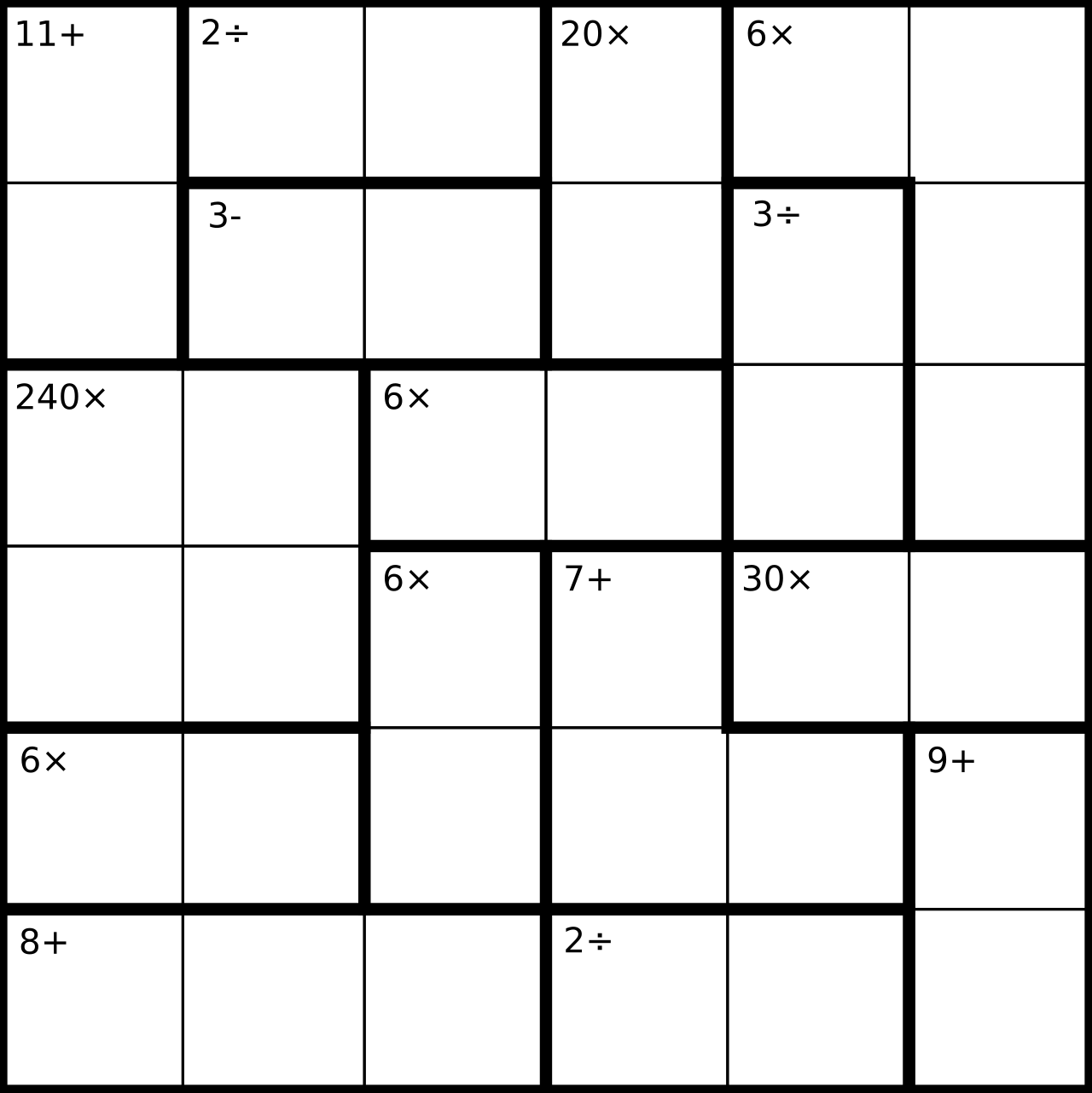
Fill the 6x6 grid with the digits 1 to 6 so that every row and every column contains each digit exactly once, and every heavily outlined group of cells produces the number in its corner using the operation shown. Exactly one completed grid satisfies every rule. Which choice is the bottom row of that grid, read left to right?
For + the digits in the group add up to the number; for x they multiply to the number; for - (two cells) the larger digit minus the smaller equals the number; for / (two cells) the larger digit divided by the smaller equals the number. Groups with no operation symbol shown do not occur; each group has exactly one label in its top-left cell. A digit may repeat inside a group only if its cells are in different rows and columns.
Underpants, SGBailey, Public domain, via Wikimedia Commons (File:KenKenProblem.svg); credit: SVG version of Kenkenproblem.png, Public domain. Prepared model input from the cited source; see original source for its unmodified file. Re-encoded for the tested C1 input variant.
- Option 1: 1 5 2 3 6 4
- Option 2: 2 1 5 6 3 4
- Option 3: 1 2 5 3 6 4
- Option 4: 1 2 5 6 3 4
- Option 5: 5 1 2 6 3 4
VB0029 Constraint satisfaction
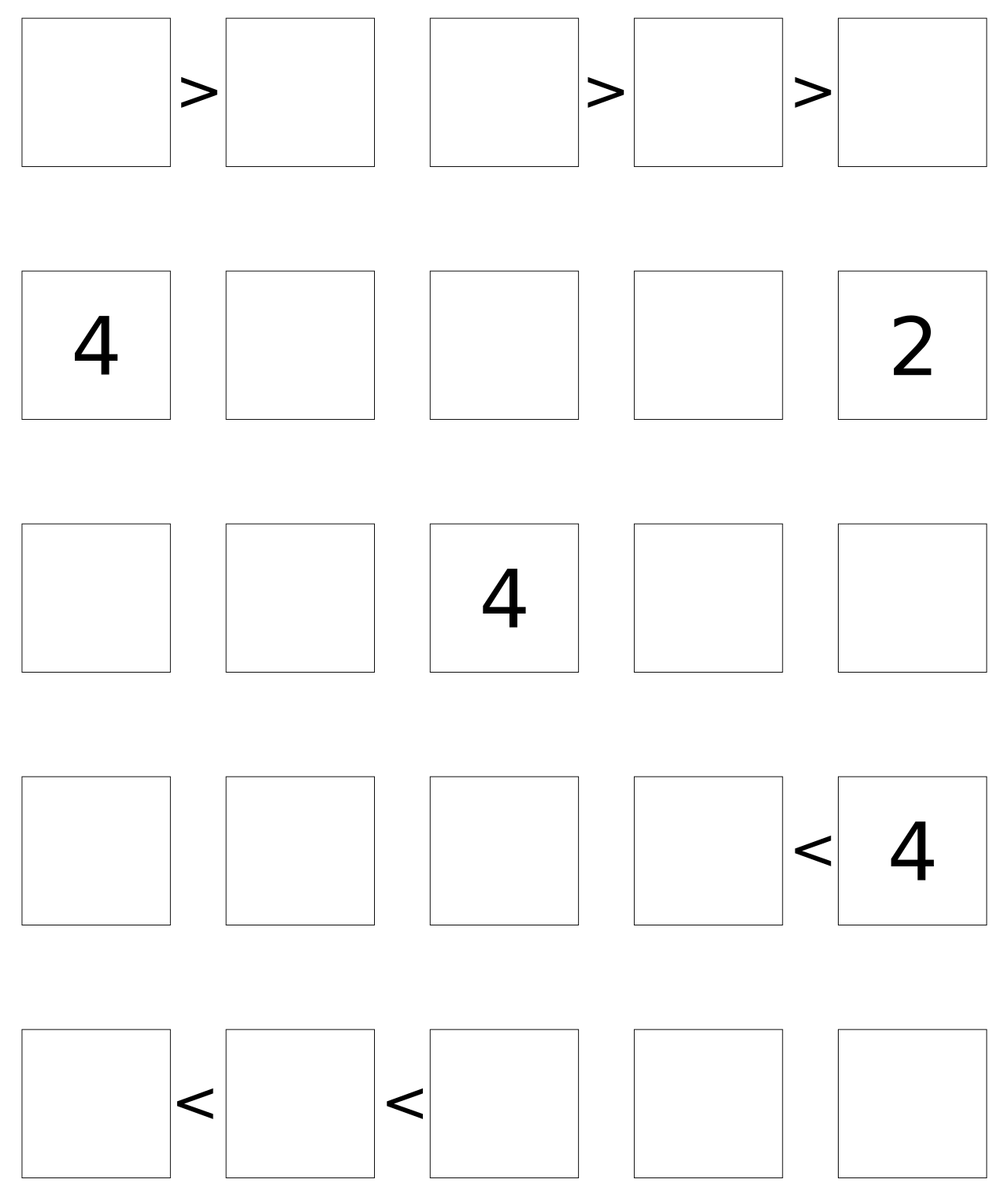
Fill the 5x5 grid with the digits 1 to 5 so that no digit repeats in any row or column and every inequality sign is true. Which digit goes in the cell in row 5, column 3? (Count rows from the top and columns from the left.)
A sign between two neighbouring cells points to the smaller one: 'a > b' means the left cell is larger than the right cell, and 'a < b' means the left cell is smaller. The grid has exactly one solution.
User:Pruneau, CC BY-SA 3.0, via Wikimedia Commons (File:Futoshiki1.svg); credit: File:Futoshiki1.png, CC BY-SA 3.0. Prepared model input from the cited source; see original source for its unmodified file. Re-encoded for the tested C1 input variant.
- Option 1: 1
- Option 2: 2
- Option 3: 3
- Option 4: 4
- Option 5: 5
VB0030 Constraint satisfaction
Solve this 6x6 Light Up puzzle. How many lamps does the completed puzzle contain?
Black squares are walls. A numbered black square must have exactly that many lamps in its four edge-adjacent squares. A lamp lights its own square and every white square in the same row and column up to the next black square. Every white square must be lit, and no lamp may be lit by another lamp. The puzzle has exactly one solution.
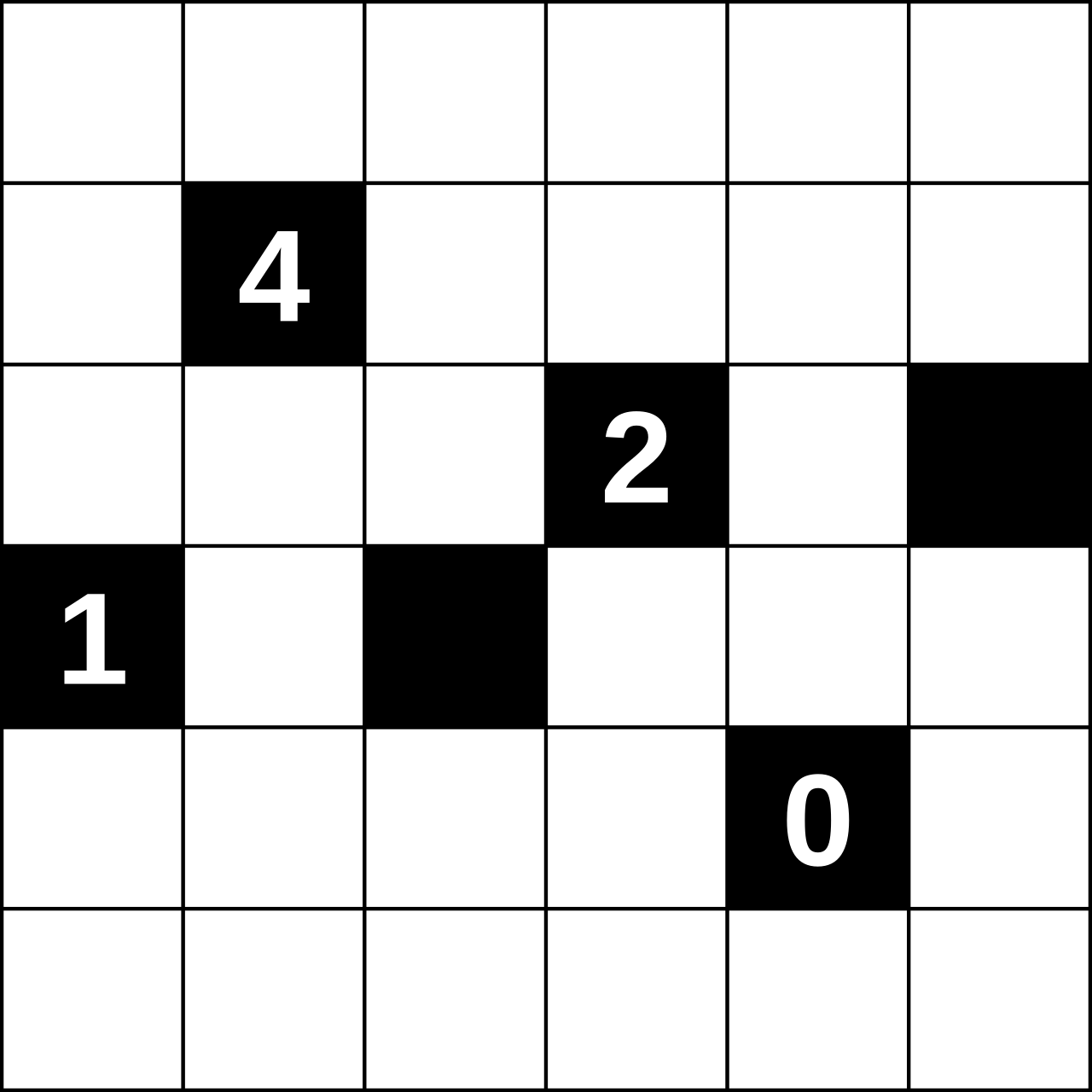
Life of Riley, Public domain, via Wikimedia Commons (File:Light up 1.svg); credit: Own work, Public domain. Prepared model input from the cited source; see original source for its unmodified file. Re-encoded for the tested C1 input variant.
- Option 1: 6
- Option 2: 7
- Option 3: 8
- Option 4: 9
- Option 5: 10
VB0031 Constraint satisfaction
Solve this 10x10 Light Up puzzle. How many lamps does the completed puzzle contain?
Black squares are walls. A numbered black square must have exactly that many lamps in its four edge-adjacent squares. A lamp lights its own square and every white square in the same row and column up to the next black square. Every white square must be lit, and no lamp may be lit by another lamp. The puzzle has exactly one solution.
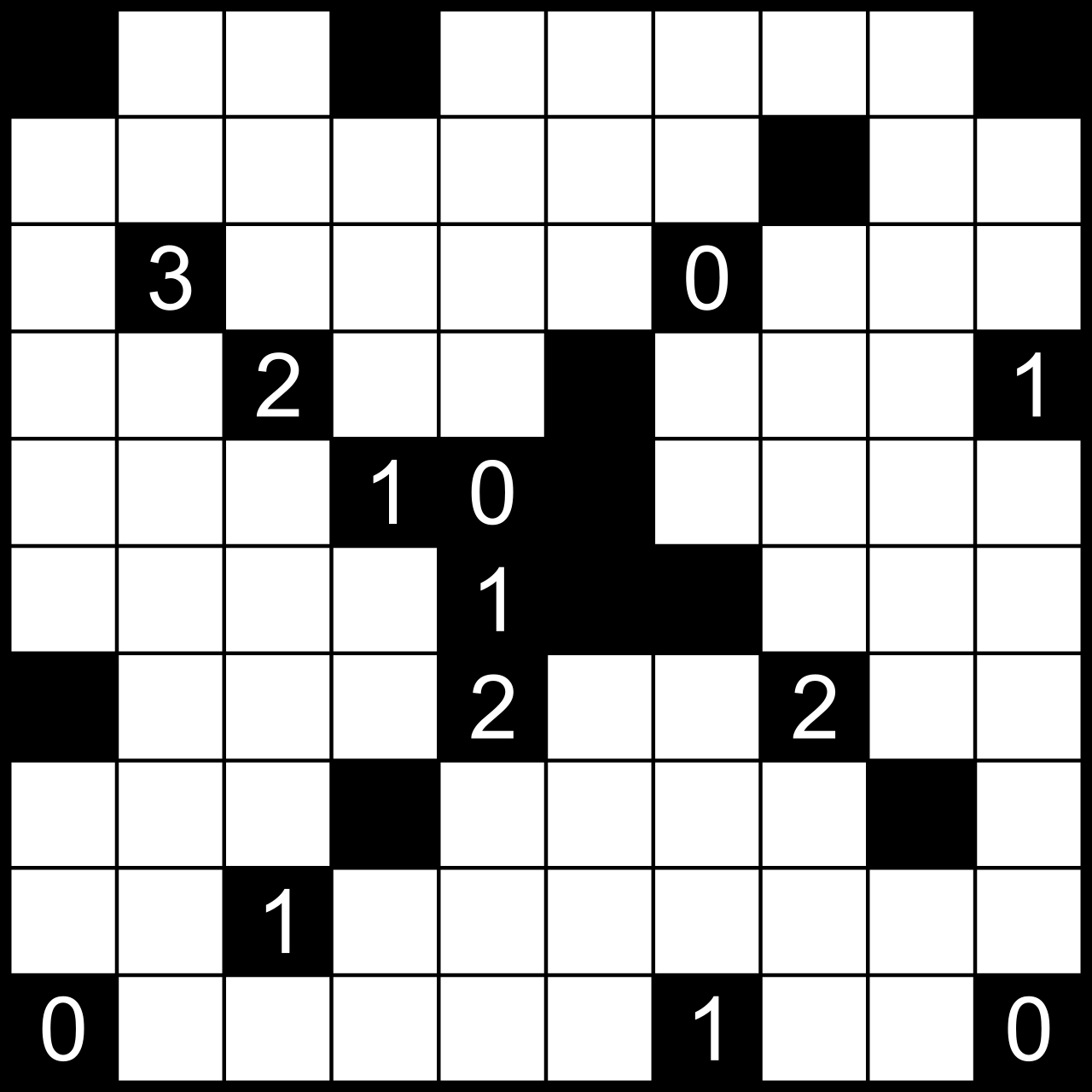
Amit6, CC BY-SA 3.0, via Wikimedia Commons (File:Lightup.svg); credit: Own work, CC BY-SA 3.0. Prepared model input from the cited source; see original source for its unmodified file. Re-encoded for the tested C1 input variant.
- Option 1: 17
- Option 2: 18
- Option 3: 19
- Option 4: 20
- Option 5: 21
VB0032 Constraint satisfaction
Solve this Hitori puzzle. Which one of these cells must be shaded black in the unique solution? (Rows count from the top, columns from the left.)
Shade some cells black so that (a) no number appears more than once among the unshaded cells of any row or column, (b) no two shaded cells share an edge, and (c) all unshaded cells form a single group connected by edges. The puzzle has exactly one solution.
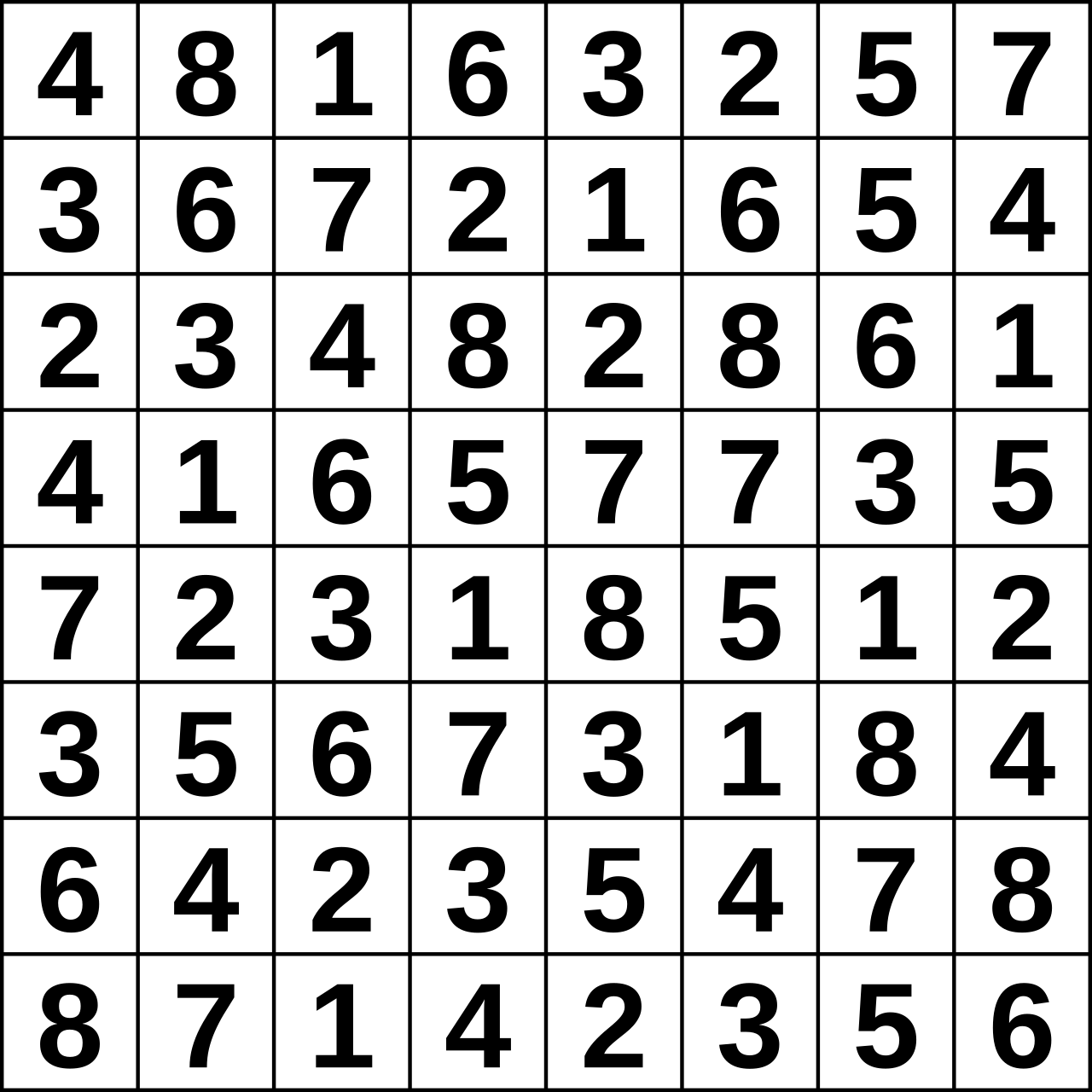
Own work, Dan1980, CC BY 1.0, via Wikimedia Commons (File:Hitori.svg); credit: Own work, based on File:Hitori.jpg, CC BY 1.0. Prepared model input from the cited source; see original source for its unmodified file. Re-encoded for the tested C1 input variant.
- Option 1: Row 3, column 4 (the 8)
- Option 2: Row 4, column 5 (the 7)
- Option 3: Row 7, column 6 (the 4)
- Option 4: Row 2, column 2 (the 6)
- Option 5: Row 3, column 6 (the 8)
VB0033 Constraint satisfaction
Solve this Kakuro. Which number goes in the white cell in row 6, column 4 (bottom row, middle of the three white cells)?
Each white cell holds a digit from 1 to 9. A number in the upper right of a grey cell is the sum of the run of white cells to its right; a number in the lower left is the sum of the run of white cells below it. Digits may not repeat within a run. The 4 is already placed. The red circles are marks and carry no meaning. The puzzle has exactly one solution.
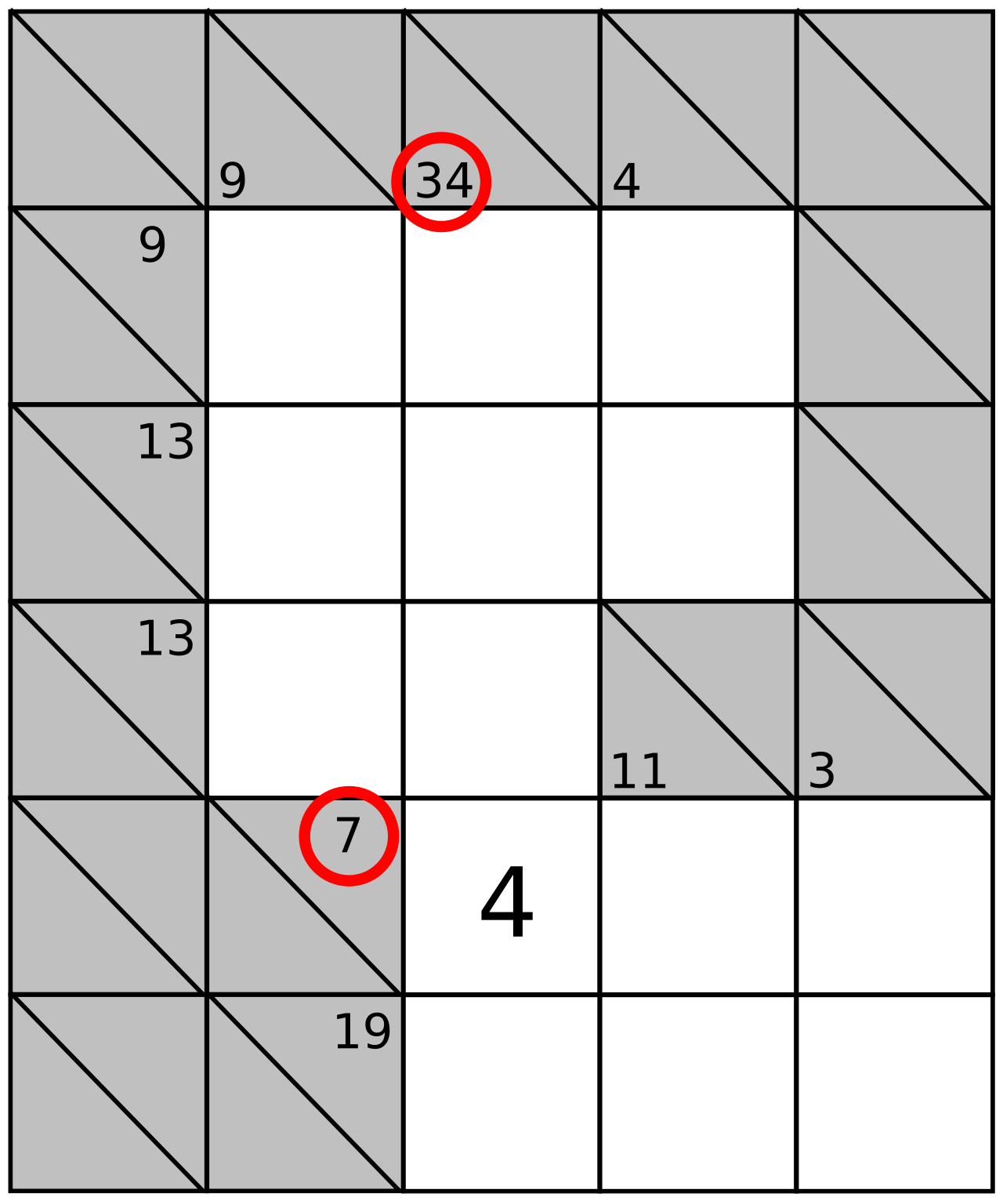
Samuli Lintula, Public domain, via Wikimedia Commons (File:Kakuro.01.svg); credit: Own work, Public domain. Prepared model input from the cited source; see original source for its unmodified file.
- Option 1: 5
- Option 2: 6
- Option 3: 7
- Option 4: 8
- Option 5: 9
VB0034 Constraint satisfaction
Using the weekday table, which itinerary meets all four conditions: (1) leave Sausalito at 9:00 or later, (2) arrive in San Francisco no later than 11:00, (3) spend more than 2 hours in San Francisco between arriving and leaving on the return ferry, and (4) be back in Sausalito by 2:00 PM?
The two left columns give the Sausalito-to-San Francisco ferries (departure, then arrival in the same row). The two right columns give the San Francisco-to-Sausalito ferries (departure, then arrival in the same row). Times above the horizontal rule drawn across the table are AM and times below it are PM.
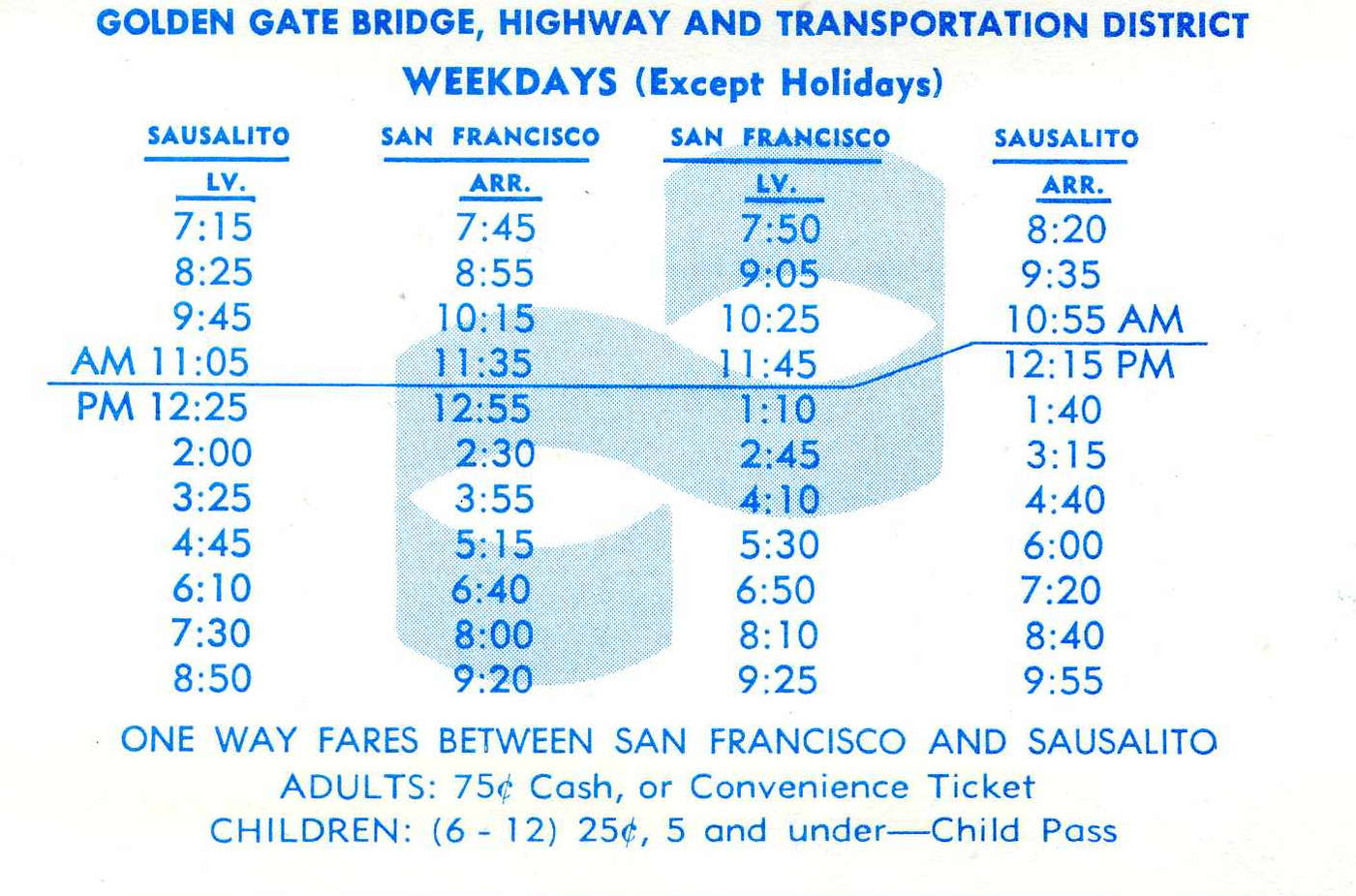
Piergiuliano Chesi, Public domain, via Wikimedia Commons (File:San Francisco Golden Gate Ferry timetable June 1974 02.jpg); credit: Own work from scan, Public domain. Prepared model input from the cited source; see original source for its unmodified file.
- Option 1: Leave Sausalito 8:25; return on the 11:45 ferry from San Francisco
- Option 2: Leave Sausalito 9:45; return on the 1:10 PM ferry from San Francisco
- Option 3: Leave Sausalito 8:25; return on the 10:25 AM ferry from San Francisco
- Option 4: Leave Sausalito 9:45; return on the 2:45 PM ferry from San Francisco
- Option 5: Leave Sausalito 9:45; return on the 11:45 AM ferry from San Francisco
VB0035 Constraint satisfaction
Which weekday satisfies both rules: (1) two lessons in a row on that day are the same subject, and (2) the last lesson of the day (the 12:10 row) is Deutsch?
Read each day's column from top (7:55) to bottom (12:10). 'In a row' means two neighbouring rows in the same column.
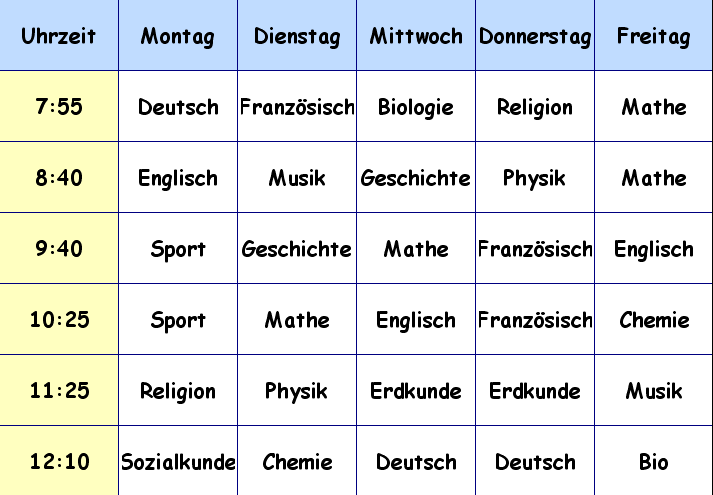
unknown, Public domain, via Wikimedia Commons (File:Stundenplan.PNG); credit: own work with Shrek!, Public domain. Prepared model input from the cited source; see original source for its unmodified file. Re-encoded for the tested C1 input variant.
- Option 1: Montag
- Option 2: Dienstag
- Option 3: Mittwoch
- Option 4: Donnerstag
- Option 5: Freitag
VB0036 Flowcharts and decision trees
An item is in the inbox. It is actionable. It is not a single step, so a project is created. The first subtask of that project would take about 10 minutes, you must do it yourself, and it has to happen at a specific time. Following the flowchart, which box does that first subtask end in?
Treat the first subtask as re-entering the chart at the box the arrow labelled 'First subtask from the project' points to. Follow Yes/No labels exactly as drawn.
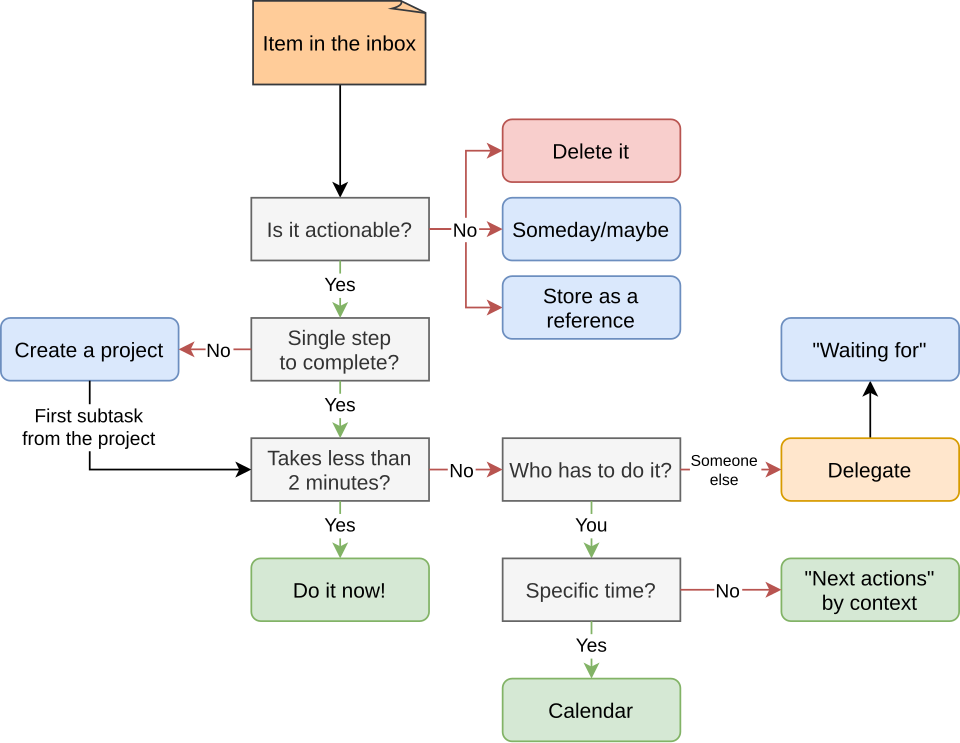
Flexagoon, CC0, via Wikimedia Commons (File:GTD flowchart.svg); credit: Own work, CC0. Prepared model input from the cited source; see original source for its unmodified file.
- Option 1: Calendar
- Option 2: Do it now!
- Option 3: "Waiting for"
- Option 4: "Next actions" by context
- Option 5: Delete it
VB0037 Flowcharts and decision trees
A sentence in an article has no citation. You do not believe it is false. You find that sources do say it, and you could add a citation but you do not want to help out. Following the flowchart from START, which end box do you reach?
Follow each answer label on the arrows as drawn. Choose the end box (a rounded box with no outgoing arrow) where the path finishes.
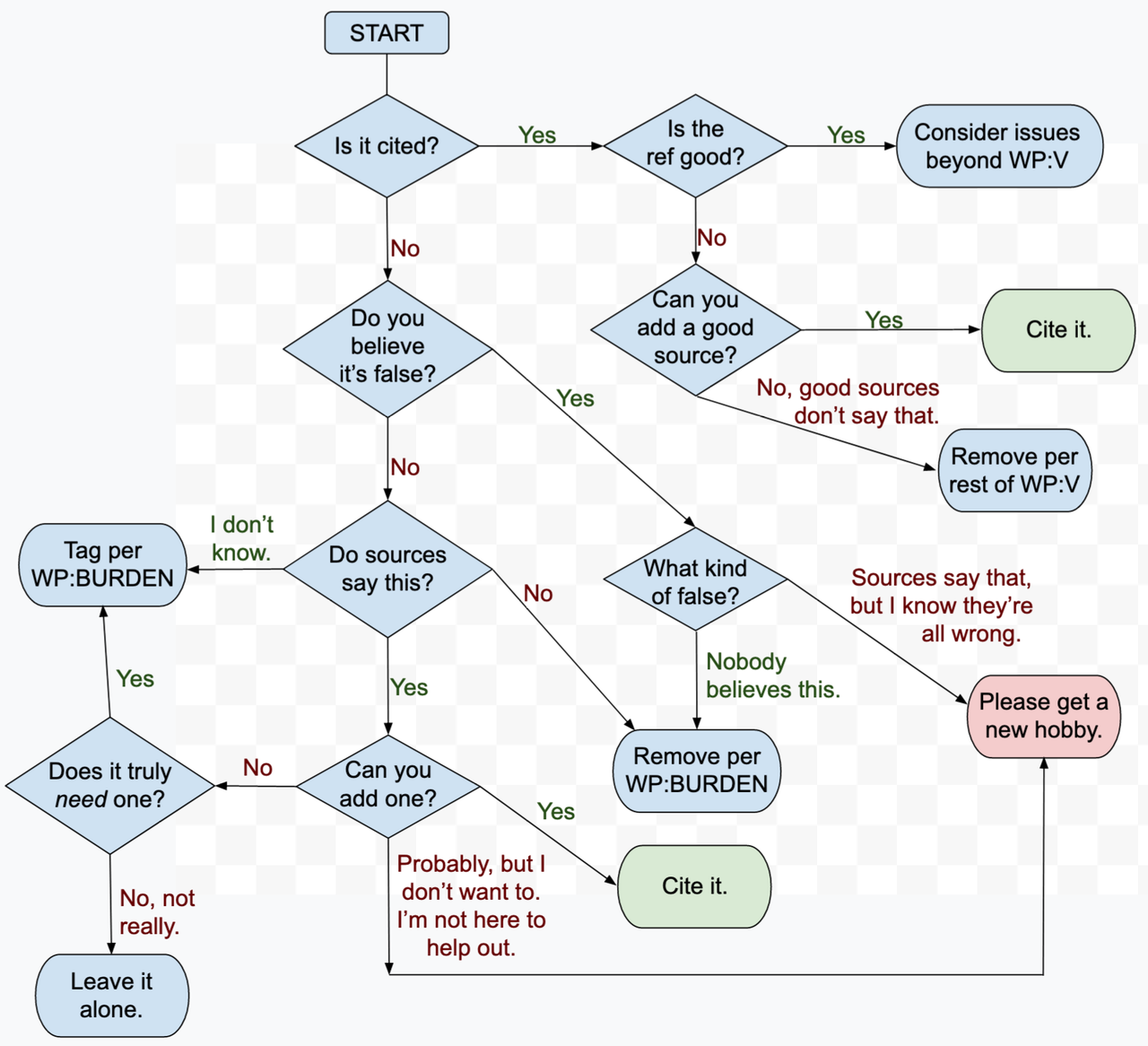
WhatamIdoing, CC BY-SA 4.0, via Wikimedia Commons (File:Possible workflow for reviewers at English Wikipedia.png); credit: Own work, CC BY-SA 4.0. Prepared model input from the cited source; see original source for its unmodified file.
- Option 1: Tag per WP:BURDEN
- Option 2: Remove per WP:BURDEN
- Option 3: Cite it.
- Option 4: Leave it alone.
- Option 5: Please get a new hobby.
VB0038 Flowcharts and decision trees
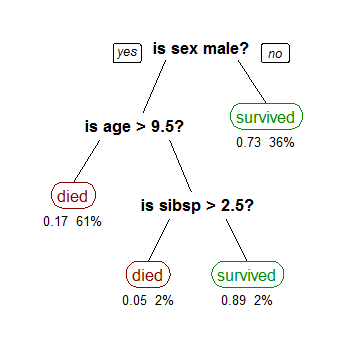
A passenger is male, 8 years old and had 3 siblings or spouses aboard. Which leaf of the tree does this passenger reach?
At every question box the 'yes' branch goes down and to the left and the 'no' branch goes down and to the right, as the two labelled boxes at the top show. 'sibsp' is the number of siblings or spouses aboard. Answer with the leaf label as printed (class, then the two numbers beneath it).
Stephen Milborrow, CC BY-SA 3.0, via Wikimedia Commons (File:CART tree titanic survivors.png); credit: Own work, CC BY-SA 3.0. Prepared model input from the cited source; see original source for its unmodified file. Re-encoded for the tested C1 input variant.
- Option 1: died (0.05, 2%)
- Option 2: died (0.17, 61%)
- Option 3: survived (0.89, 2%)
- Option 4: survived (0.73, 36%)
- Option 5: No leaf is reached
VB0039 Flowcharts and decision trees
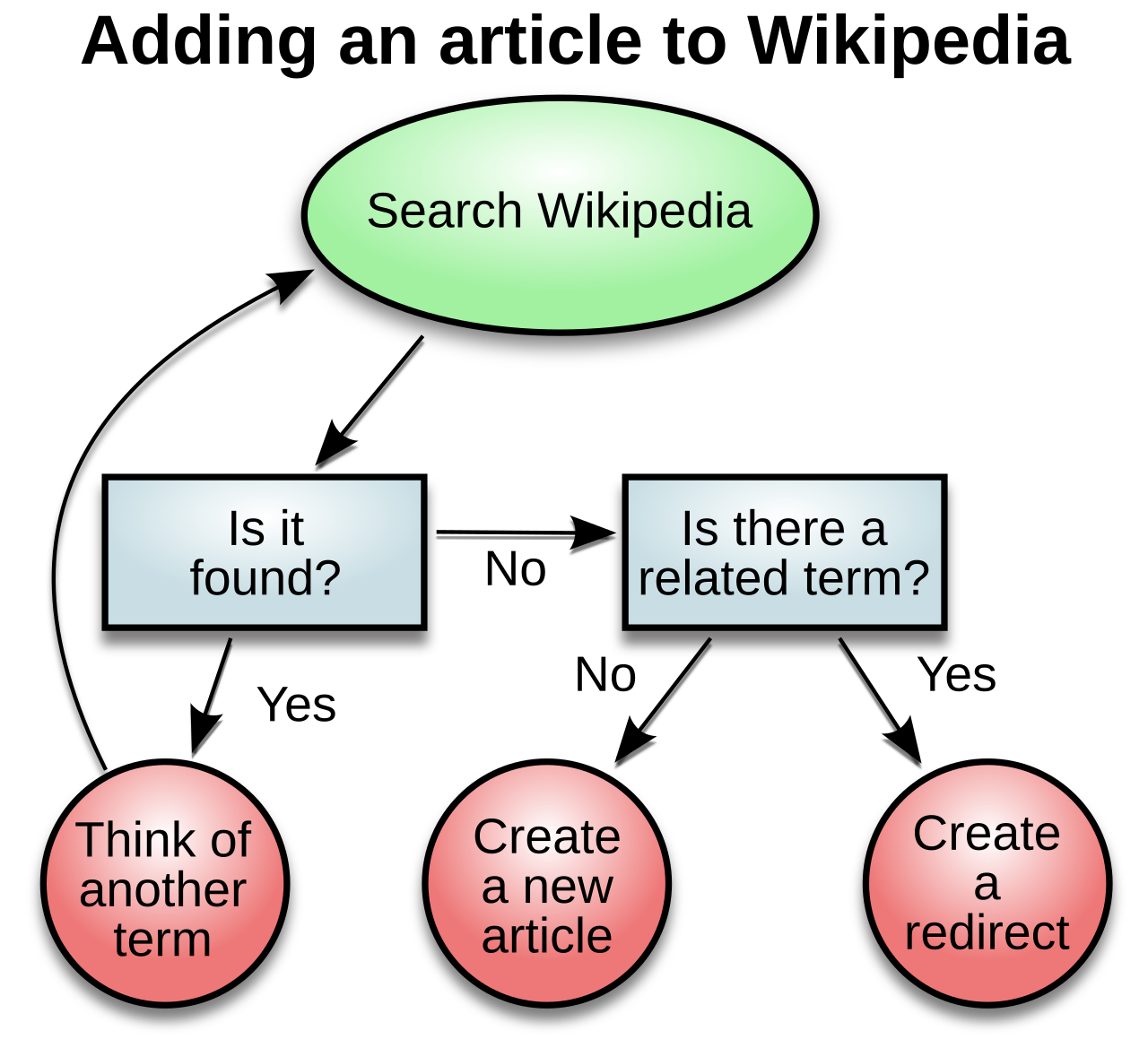
You search for a term and an article about it already exists. You think of another term and search again; this time nothing is found and there is no related term. Which box finishes the procedure?
Follow every Yes/No label as drawn and every arrow, including the long curved arrow back to the top.
derivative work: Pbroks13 (talk)
Wikipedia_article-creation.svg: Linuxerist, Public domain, via Wikimedia Commons (File:Wikipedia article-creation-2.svg); credit: Wikipedia_article-creation.svg, Public domain. Prepared model input from the cited source; see original source for its unmodified file.
- Option 1: Create a new article
- Option 2: Search Wikipedia
- Option 3: Create a redirect
- Option 4: The procedure never ends
- Option 5: Think of another term
VB0040 Flowcharts and decision trees
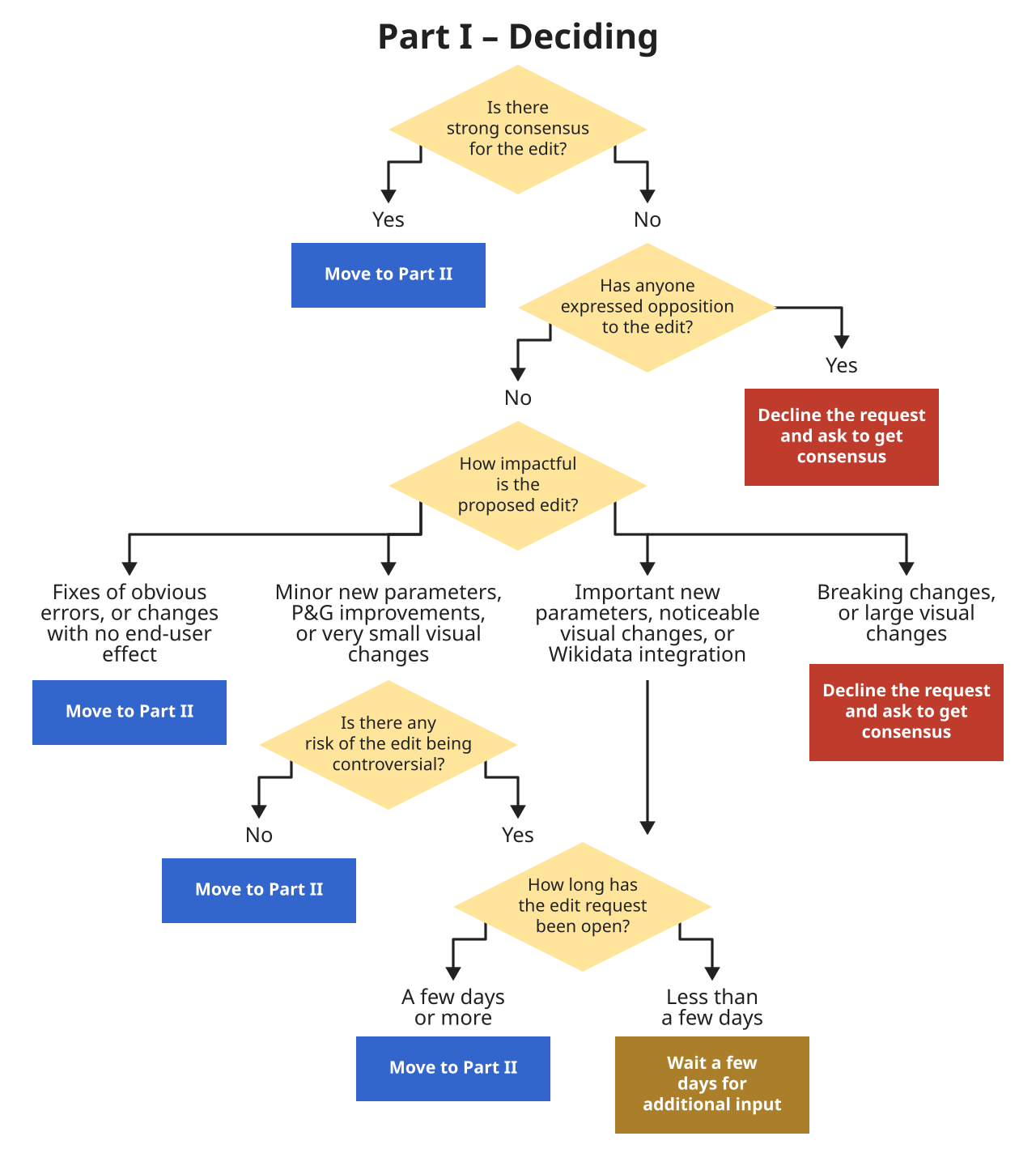
An edit request has no strong consensus, nobody has opposed it, and it proposes minor new parameters. There is some risk that the edit would be controversial, and the request has been open for one day. Which box ends the path in this chart?
Follow the labelled branches. 'Less than a few days' applies to a request open for one day.
Chaotic Enby, CC0, via Wikimedia Commons (File:Template edit request flowchart (part 1).svg); credit: Own work, CC0. Prepared model input from the cited source; see original source for its unmodified file.
- Option 1: Move to Part II
- Option 2: Wait a few days for additional input
- Option 3: No outcome is shown for this combination
- Option 4: Decline the request and ask to get consensus
VB0041 Flowcharts and decision trees
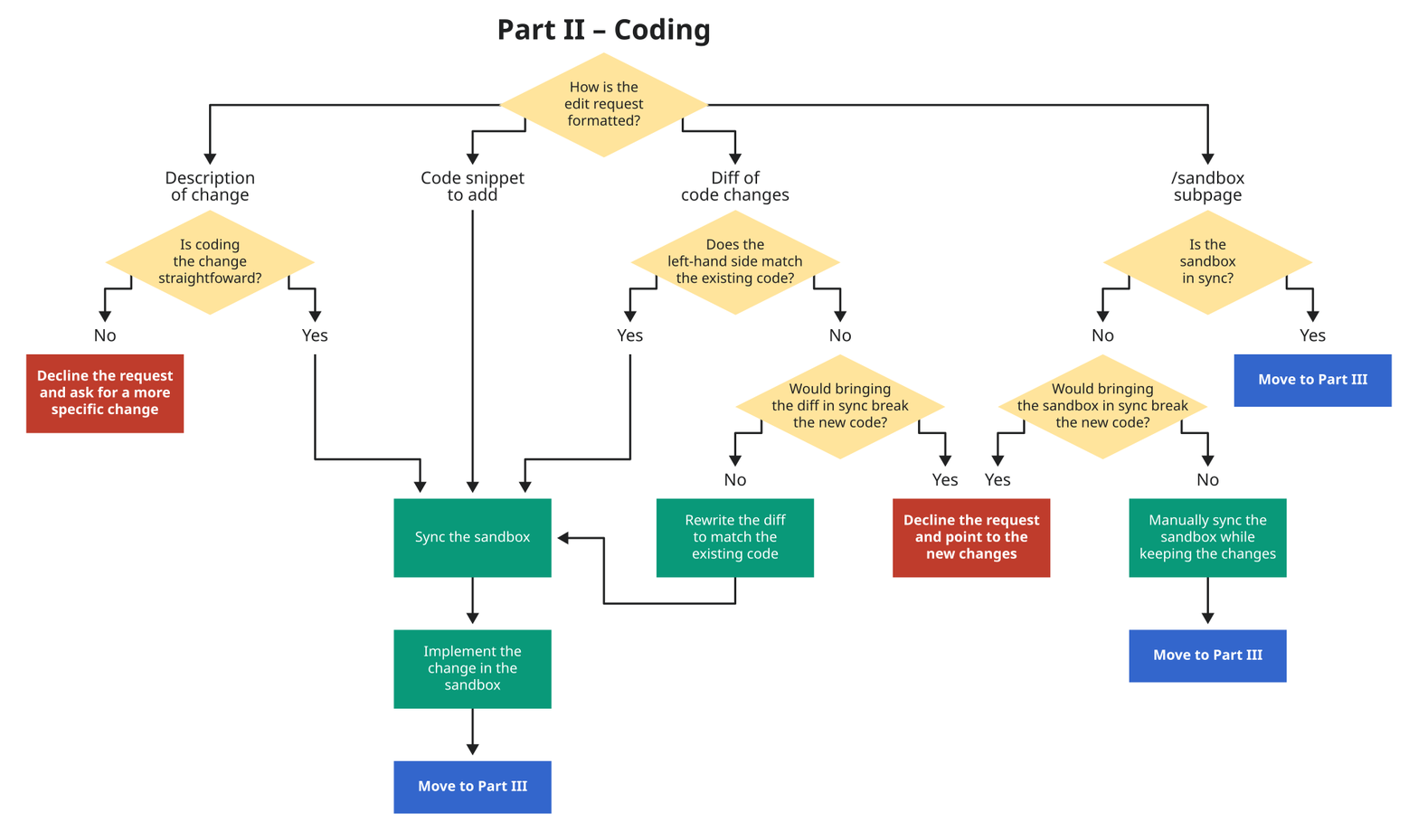
An edit request is submitted as a diff of code changes. The left-hand side of the diff does not match the existing code, but bringing the diff in sync would not break the new code. How many green action boxes does the request pass through before reaching 'Move to Part III'?
Count each green box on the path once. Blue boxes and decision diamonds are not counted.
Chaotic Enby, CC0, via Wikimedia Commons (File:Template edit request flowchart (part 2).svg); credit: Own work, CC0. Prepared model input from the cited source; see original source for its unmodified file. Reviewed crop or preparation replaces the original source framing.
- Option 1: 1
- Option 2: 2
- Option 3: 3
- Option 4: 4
- Option 5: 5
VB0042 Flowcharts and decision trees
Inputs are A = 9 and B = 30. How many times is the box 'B <- B - A' executed before the chart reaches 'DISKWEL A'?
Translations for convenience: 'ya' = yes; 'ket' = no / otherwise; 'ket (< pe =)' = otherwise (A < B or A = B); 'ANTRE' = input; 'KAE DA 2' = go to step 2; 'DISKWEL' = display. Follow the arrows including the two return arrows that re-enter above step 2. The numbers 1-9 beside the boxes are step labels only.
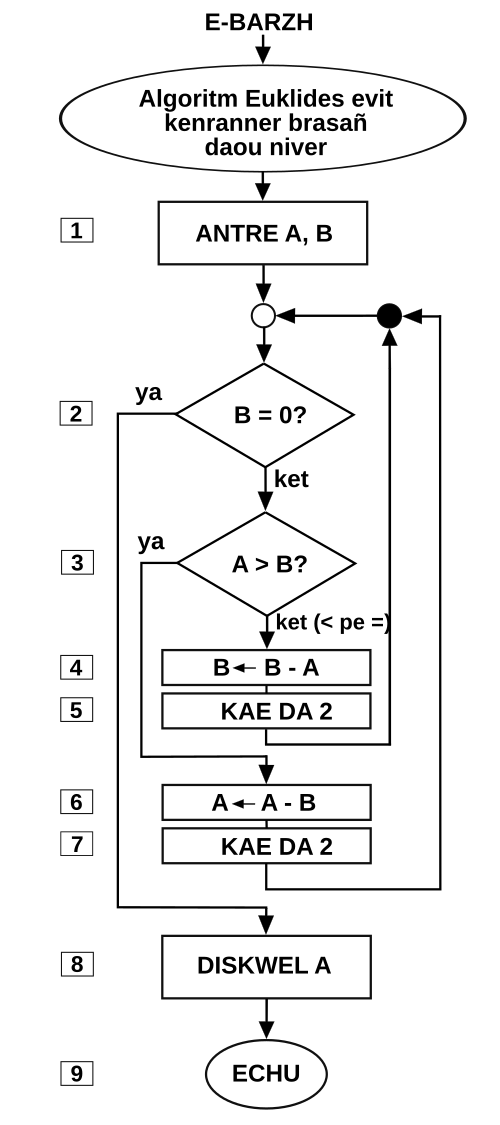
Huñvreüs, CC BY-SA 4.0, via Wikimedia Commons (File:Euclid algorithm flowchart diagram in Breton.svg); credit: Own work, CC BY-SA 4.0. Prepared model input from the cited source; see original source for its unmodified file. Re-encoded for the tested C1 input variant.
- Option 1: 2
- Option 2: 3
- Option 3: 4
- Option 4: 5
- Option 5: 6
VB0043 Flowcharts and decision trees
Start at 'Previous consensus'. Someone makes an edit, the article is then edited further, you disagree with the change, a compromise is reached and implemented, and the article is then not edited further. In total, how many times is the box 'Make an edit' visited?
Count each arrival at the box, including the first.
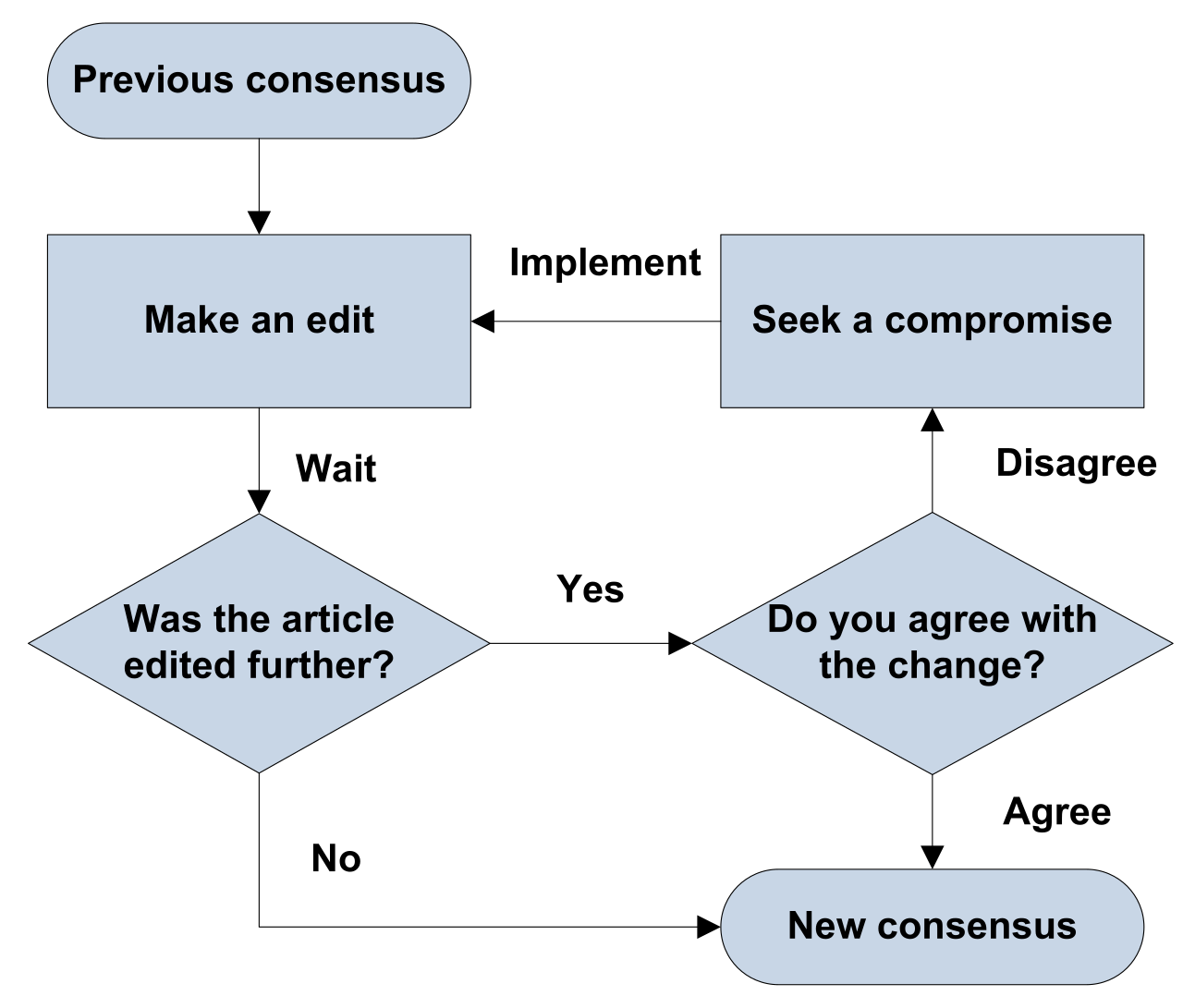
Locke Cole at English Wikipedia, CC BY-SA 3.0, via Wikimedia Commons (File:Consensus Flowchart.svg); credit: Transferred from en.wikipedia to Commons by Jayantanth using CommonsHelper., CC BY-SA 3.0. Prepared model input from the cited source; see original source for its unmodified file.
- Option 1: 1
- Option 2: 2
- Option 3: 3
- Option 4: 4
- Option 5: 5
VB0044 Flowcharts and decision trees
A person taking part is not an old steward. Counting only rectangular boxes (not the ovals or the small circle), how many boxes are passed from Start to End?
Count each rectangle on the path once, including 'Steward election starts' and 'Final decisions'.
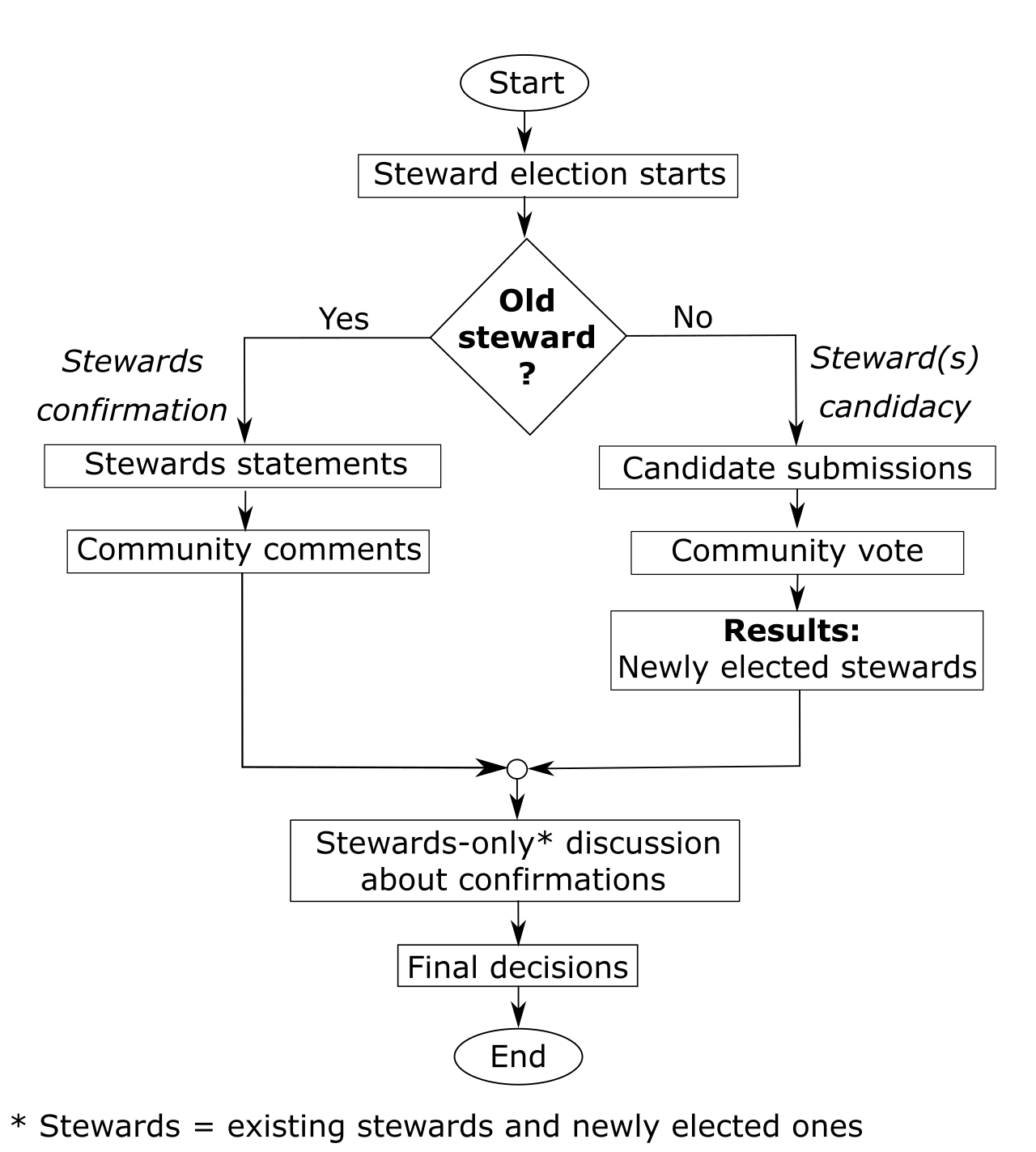
Created by Michel Bakni, edited and uploaded by علاء, CC BY-SA 3.0, via Wikimedia Commons (File:Flowchart of Stewards election.svg); credit: Own work, CC BY-SA 3.0. Prepared model input from the cited source; see original source for its unmodified file. Re-encoded for the tested C1 input variant.
- Option 1: 4
- Option 2: 5
- Option 3: 6
- Option 4: 7
- Option 5: 8
VB0045 Flowcharts and decision trees
After the initial counting box, the totals are A = 60, B = 25 and C = 15. All three candidates remain. According to the drawn procedure, what action happens next?
Follow the arrows and tests exactly as drawn, rather than using an election rule remembered from elsewhere. No candidate has withdrawn.
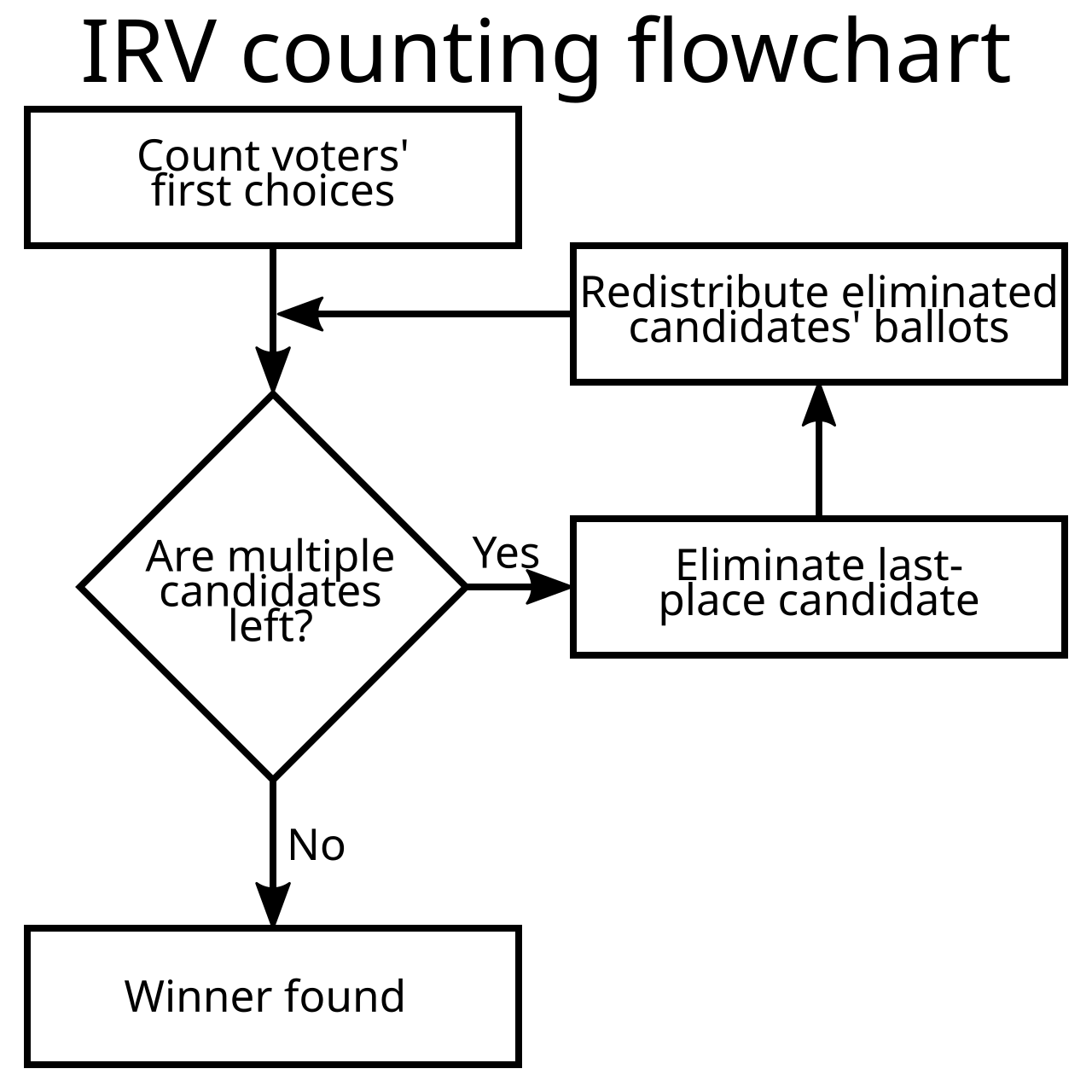
Zerodamage, CC BY-SA 3.0, via Wikimedia Commons (File:IRV counting flowchart.svg); credit: File:Alternative IRV counting flowchart.png, CC BY-SA 3.0. Prepared model input from the cited source; see original source for its unmodified file. Re-encoded for the tested C1 input variant.
- Option 1: Declare A the winner immediately
- Option 2: Redistribute C's ballots before eliminating anyone
- Option 3: Eliminate B
- Option 4: Eliminate C
VB0046 Causal and counterfactual reasoning
Inputs are A = 1, B = 0 and C_in = 1. Suppose the output of the upper of the two AND gates is forced to 0 whatever its inputs are. What are the circuit's outputs S and C_out?
Standard gate symbols: a D shape with a flat back is AND, a curved back with one extra curved line is XOR, a curved back is OR. A black dot marks a connection; lines that cross without a dot do not connect. Only that one AND-gate output is changed.
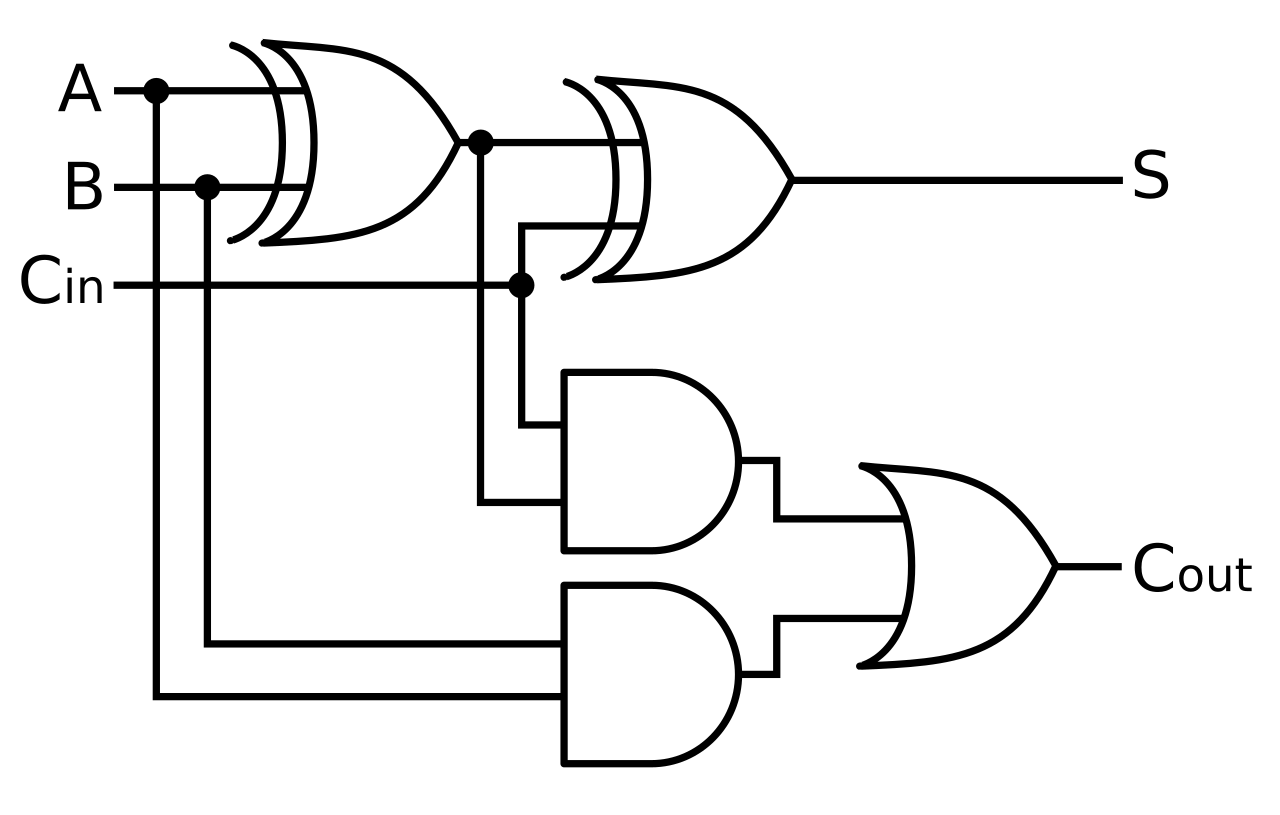
en:User:Cburnett, CC BY-SA 3.0, via Wikimedia Commons (File:Full-adder.svg); credit: Own work This W3C-unspecified vector image was created with Inkscape ., CC BY-SA 3.0. Prepared model input from the cited source; see original source for its unmodified file. Re-encoded for the tested C1 input variant.
- Option 1: S = 0, C_out = 1
- Option 2: S = 1, C_out = 0
- Option 3: S = 0, C_out = 0
- Option 4: The outputs are not established by the supplied circuit and rules
VB0047 Causal and counterfactual reasoning
Enable E = 1 and data D = 1. Before this, the stored output Q was 0. Suppose the output of the lower AND gate is forced to 0 whatever its inputs are. What are Q and the inverted output Q-bar afterwards?
The two cross-coupled OR-with-circle gates are NOR gates. A NOR pair whose other inputs from the AND gates are both 0 keeps its previous outputs. A dot marks a connection; lines that cross without a dot do not connect.
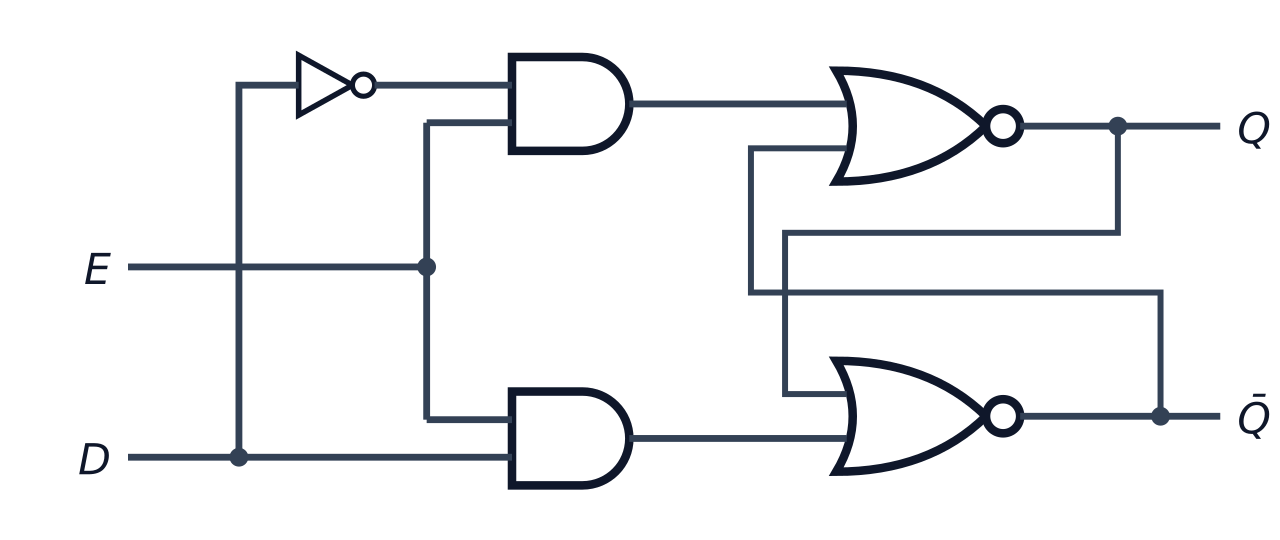
Oğuz Ergin, CC BY-SA 4.0, via Wikimedia Commons (File:Flip flop D mandali tr.svg); credit: Own work, CC BY-SA 4.0. Prepared model input from the cited source; see original source for its unmodified file.
- Option 1: Q = 0, Q-bar = 1
- Option 2: Q = 1, Q-bar = 0
- Option 3: Q = 0, Q-bar = 0
- Option 4: Q = 1, Q-bar = 1
VB0048 Causal and counterfactual reasoning
The depicted adder receives A = 0111 and B = 0001, with carry in 0. If the carry wire connecting the leftmost two boxes is forced to 0, what are s3 s2 s1 s0?
Each box is a one-bit full adder: sum is the total of its two input bits and incoming carry modulo 2; outgoing carry is 1 if at least two inputs are 1. Use the drawn bit labels and wiring to identify the affected stages.
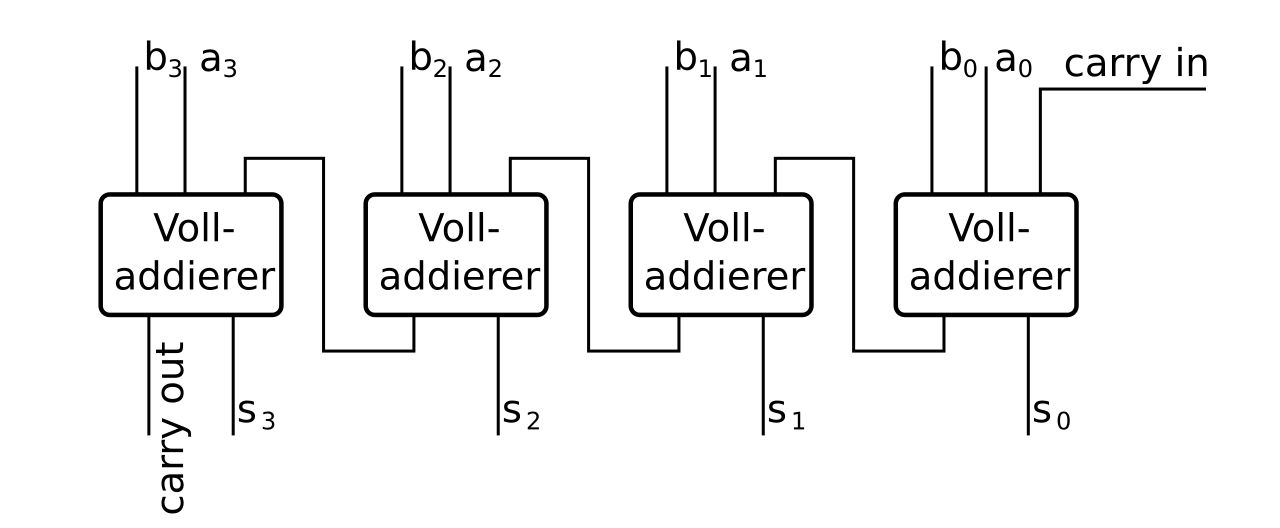
Mik81, CC0, via Wikimedia Commons (File:Ripple-carry-adder.svg); credit: Own work, CC0. Prepared model input from the cited source; see original source for its unmodified file. Re-encoded for the tested C1 input variant.
- Option 1: 1000
- Option 2: 0000
- Option 3: 0100
- Option 4: 0110
VB0049 Causal and counterfactual reasoning
Inputs are p = 1, q = 1 and r = 0. The first gate (the leftmost, controlled by p) is removed so that it does nothing. What values appear on the 'carry' and 'parity' outputs?
Each vertical connection is a swap gate: a black dot on one line is the control, and the two crossed lines are swapped if and only if the control line carries 1. The two lowest input lines carry the constants 0 (upper) and 1 (lower). Gates act from left to right.
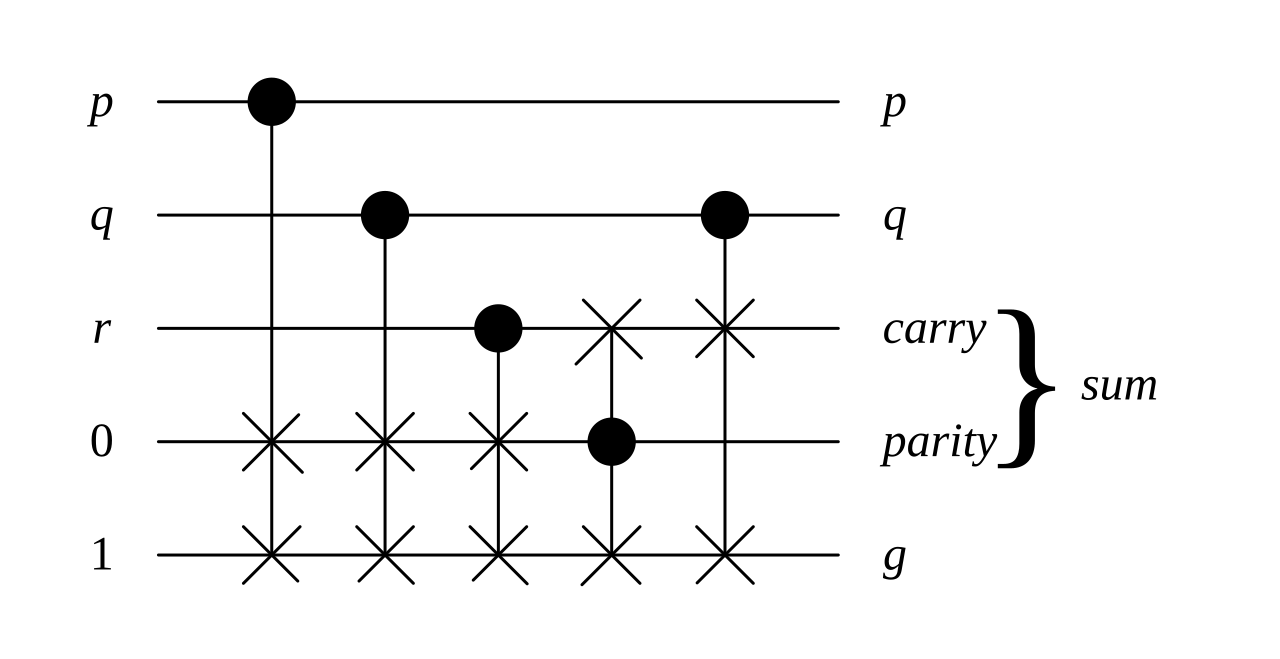
Bret Mulvey, CC BY-SA 4.0, via Wikimedia Commons (File:Fredkin Full Adder.svg); credit: Own work, CC BY-SA 4.0. Prepared model input from the cited source; see original source for its unmodified file. Re-encoded for the tested C1 input variant.
- Option 1: carry = 0, parity = 1
- Option 2: carry = 1, parity = 0
- Option 3: carry = 0, parity = 0
- Option 4: carry = 1, parity = 1
VB0050 Charts and quantitative comparisons
Between 2000 and 2010, which country's share of the population using the Internet increased by the largest number of percentage points?
Read the value of each country's line at 2000 and at 2010 from the vertical axis and compare the increases. Use only the plotted chart.
CCA0010: image withheld pending third-party terms review. Tested SHA256: a22ea71183cadebee83e68fbca6f345b8c2e9535198bdaeed76ba8fa2b7ec010.
Our World in Data, 'Share of the population using the Internet', data source: World Telecommunication/ICT Indicators Database - International Telecommunication Union (ITU), via World Bank (2026); CC BY, CC BY 4.0 (per OWID FAQ; third-party source terms not independently cleared). Prepared model input from the cited source; see original source for its unmodified file.
- Option 1: United States
- Option 2: Germany
- Option 3: India
- Option 4: China
- Option 5: Brazil
VB0051 Charts and quantitative comparisons
In 2020, about how many times larger was the United States' GDP per capita than India's?
Read both values at 2020 from the vertical axis, divide, and choose the nearest option.
CCA0059: image withheld pending third-party terms review. Tested SHA256: 29e35248e89176fbe01ecfe8a94d517cdb4340a0c95768a620b8267c2546a883.
Our World in Data, 'GDP per capita', data source: Eurostat, OECD, IMF, and World Bank (2026); CC BY, CC BY 4.0 (per OWID FAQ; third-party source terms not independently cleared). Prepared model input from the cited source; see original source for its unmodified file.
- Option 1: About 12 times
- Option 2: About 3 times
- Option 3: About 15 times
- Option 4: About 9 times
- Option 5: About 6 times
VB0052 Charts and quantitative comparisons
In 2010, how many of the other four countries used less than one third as much primary energy per person as the United States?
Read all five lines at 2010 (a labelled tick) and compare each other country with one third of the United States value.
CCA0062: image withheld pending third-party terms review. Tested SHA256: d3d6b6e05aebd49bc8b420e878e0d8437a9da92df186ec355f9e968ba4d66925.
Our World in Data, 'Primary energy use per person', data source: Energy Institute – Statistical Review of World Energy (2026) and other sources; CC BY, CC BY 4.0 (per OWID FAQ; third-party source terms not independently cleared). Prepared model input from the cited source; see original source for its unmodified file.
- Option 1: 0
- Option 2: 1
- Option 3: 2
- Option 4: 3
- Option 5: 4
VB0053 Charts and quantitative comparisons
In which period did China's annual CO2 emissions first rise above those of the United States?
Find where the China line first crosses above the United States line. The horizontal axis starts in 1792; use the labelled years to estimate the crossing.
CCA0065: image withheld pending third-party terms review. Tested SHA256: e9da119c45650a1aec35833086543ed46ae7558f3c1c42f4c2175c36dc047b84.
Our World in Data, 'Annual CO₂ emissions', data source: Global Carbon Budget (2025); CC BY, CC BY 4.0 (per OWID FAQ; third-party source terms not independently cleared). Prepared model input from the cited source; see original source for its unmodified file.
- Option 1: 2000 to 2009
- Option 2: Before 1990
- Option 3: 2020 or later
- Option 4: 2010 to 2019
- Option 5: 1990 to 1999
VB0054 Document reconciliation
Which formula reproduces the printed TOTAL without double-counting any tax base?
Use all ten item-price lines from CARPACCIO through CREME BRULEE. GST TAXSUBTOTAL and LIQUOR TAXSUBTOTAL are separate printed lines from GST TAX and LIQUOR TAX.
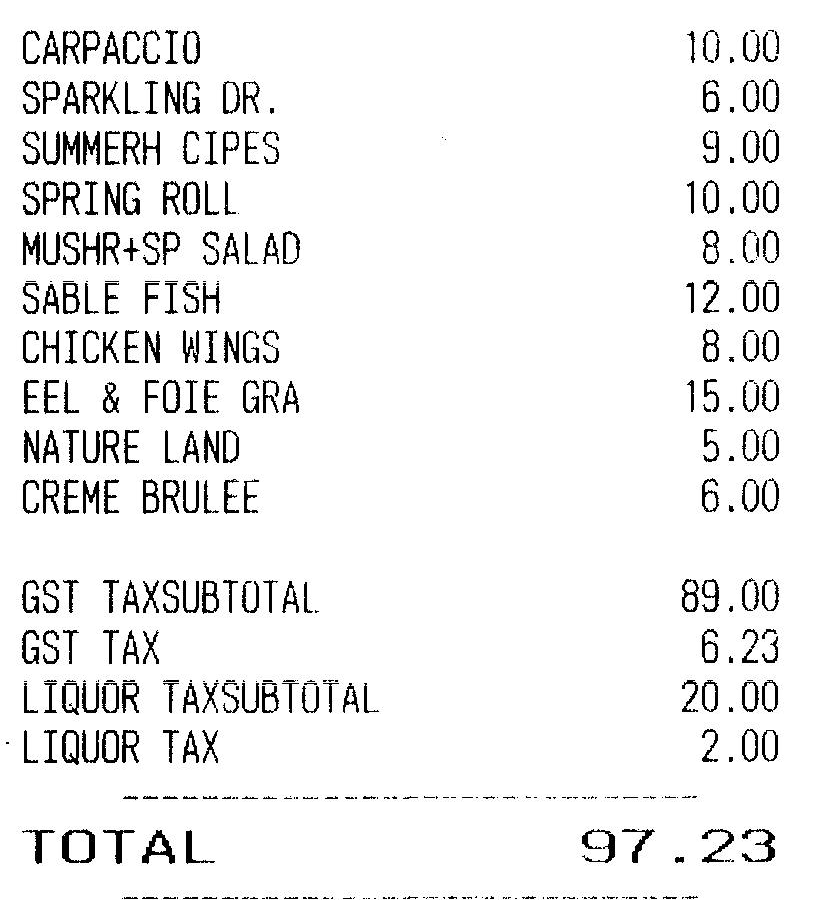
Roland Tanglao from Vancouver, Canada, CC BY 2.0, via Wikimedia Commons (File:A fine bill for a fine meal!.jpg); credit: Umami Bill from July 11 2005, CC BY 2.0. Prepared model input from the cited source; see original source for its unmodified file. Reviewed crop or preparation replaces the original source framing. Re-encoded for the tested C1 input variant.
- Option 1: Item prices + GST TAX + LIQUOR TAX
- Option 2: Item prices + LIQUOR TAX only
- Option 3: Item prices + GST TAX only
- Option 4: Item prices + all four tax-related lines
VB0055 Document reconciliation
On this supermarket receipt, treat the lines marked with an asterisk (* or *TX after the price) as the taxable items and TAX PAID as the tax charged on them. What tax rate was applied?
Use the printed prices of the starred lines only. Round to the nearest whole percent.
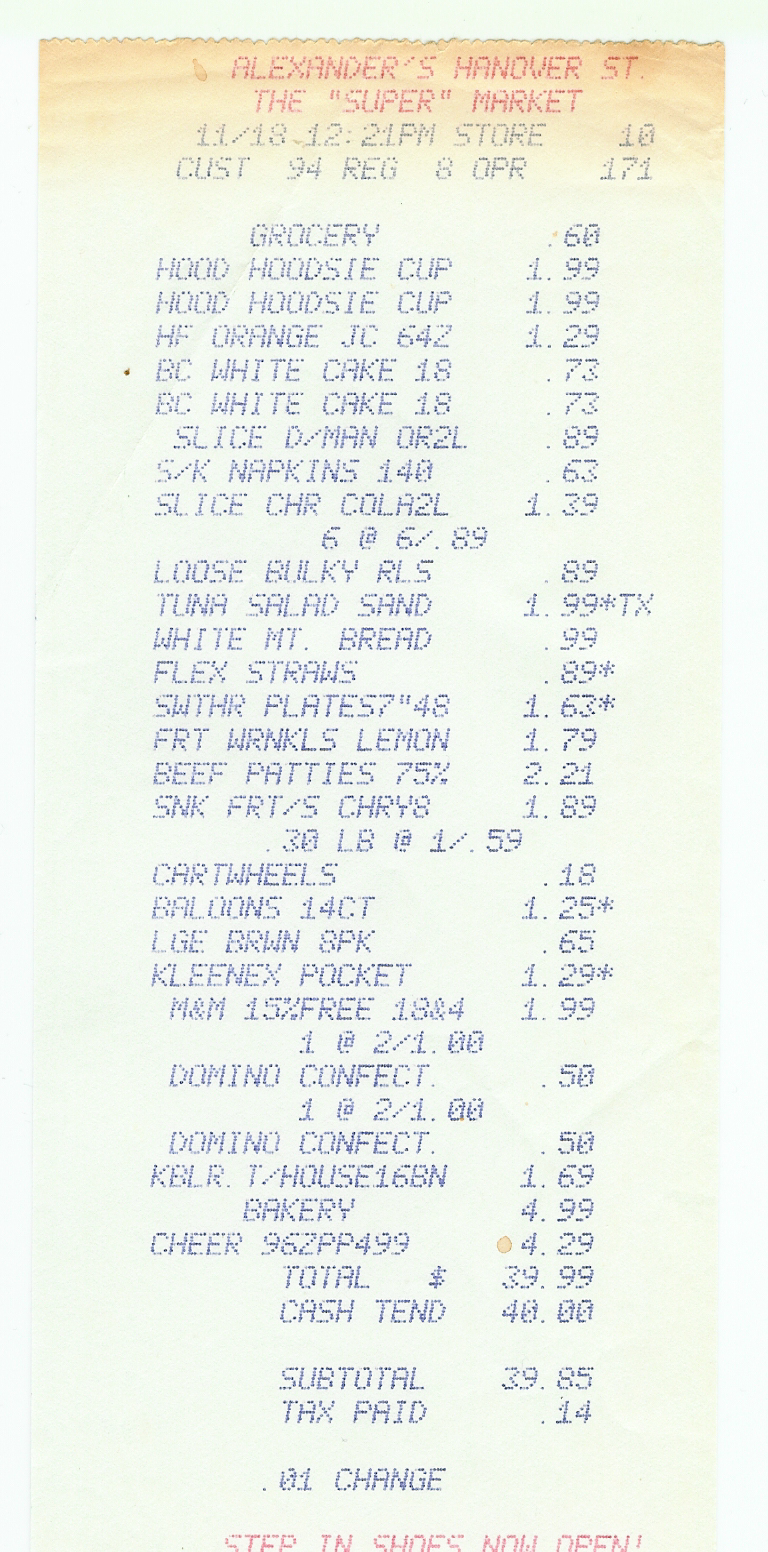
Struthious Bandersnatch, CC0, via Wikimedia Commons (File:Alexander's Supermarket receipt, late twentieth century.tif); credit: Own work, CC0. Prepared model input from the cited source; see original source for its unmodified file.
- Option 1: 1%
- Option 2: 2%
- Option 3: 3%
- Option 4: 5%
- Option 5: 7%
VB0056 Document reconciliation
Which item-line difference accounts for the difference between the two printed TOTAL amounts?
Compare the two tickets as shown. HT is before VAT, TVA is VAT and TTC includes VAT.
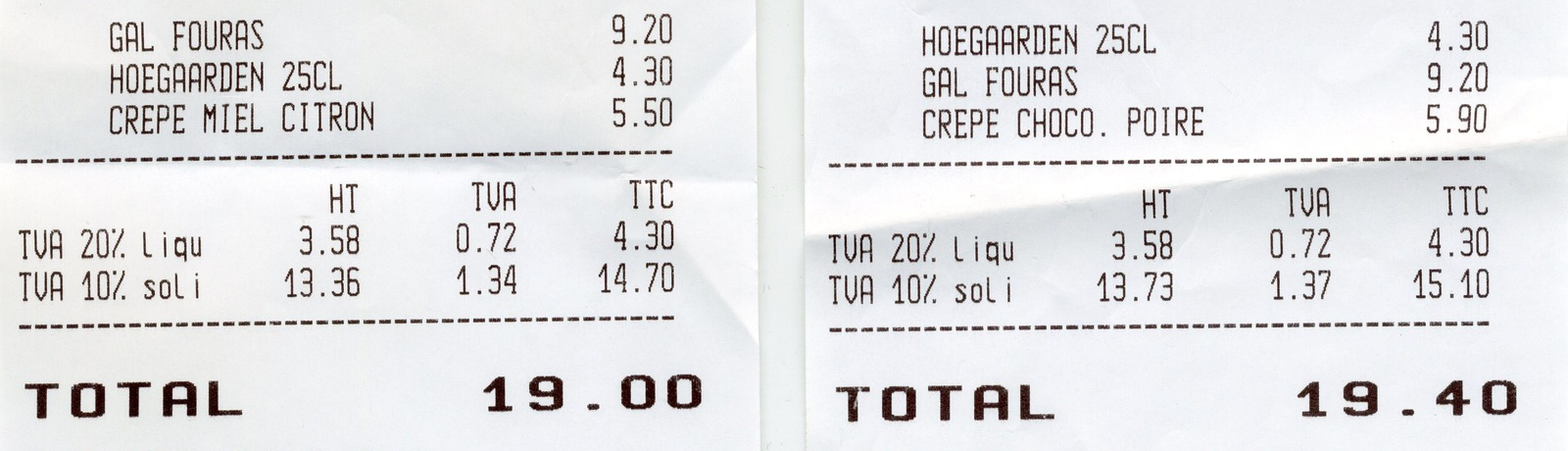
Crêperie Tante Lucie, Public domain, via Wikimedia Commons (File:Tickets de caisse de la crêperie Tante Lucie.jpg); credit: Crêperie Tante Lucie, Public domain. Prepared model input from the cited source; see original source for its unmodified file. Reviewed crop or preparation replaces the original source framing.
- Option 1: The galette costs more on the right
- Option 2: Hoegaarden costs more on the right
- Option 3: The dessert crepe costs more on the right
- Option 4: The right ticket adds a separate cover charge
VB0057 Document reconciliation
For the printed number of litres, suppose the unit price had been 0.990 EUR per litre instead of the printed unit price. How much higher would the rounded total be than the printed total?
Decimal commas are used. Calculate the new total and round it to the nearest cent before comparing.
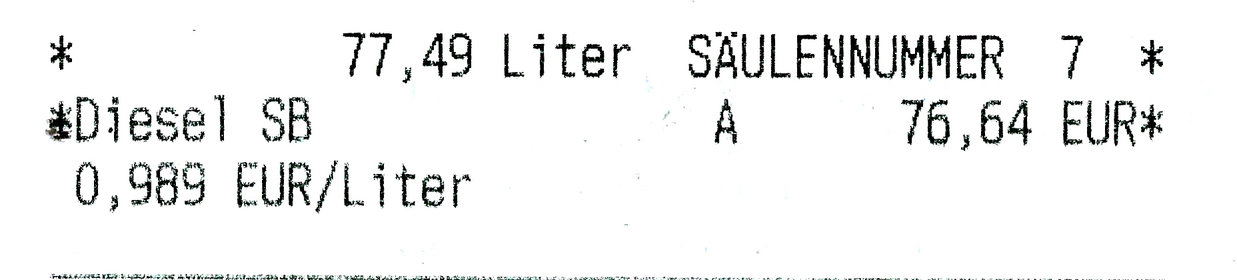
HIT-Tankstelle, Public domain, via Wikimedia Commons (File:Tankquittung HIT-Tankstelle Rheinbach mit Abschnitt Technische Sicherheitseinrichtung, 2020.jpg); credit: Scan by Raimond Spekking, Public domain. Prepared model input from the cited source; see original source for its unmodified file. Reviewed crop or preparation replaces the original source framing.
- Option 1: 0.01 EUR
- Option 2: 0.08 EUR
- Option 3: 0.77 EUR
- Option 4: 7.75 EUR
VB0058 Document reconciliation
If the customer handed over 40.00 EUR instead of the printed cash amount, how much change should they receive after the printed deduction?
Decimal commas are used. Summe is total, MwSt.-Senkung is a deduction, Bar Euro is cash and Rueckgeld is change. Keep the purchases and deduction unchanged.
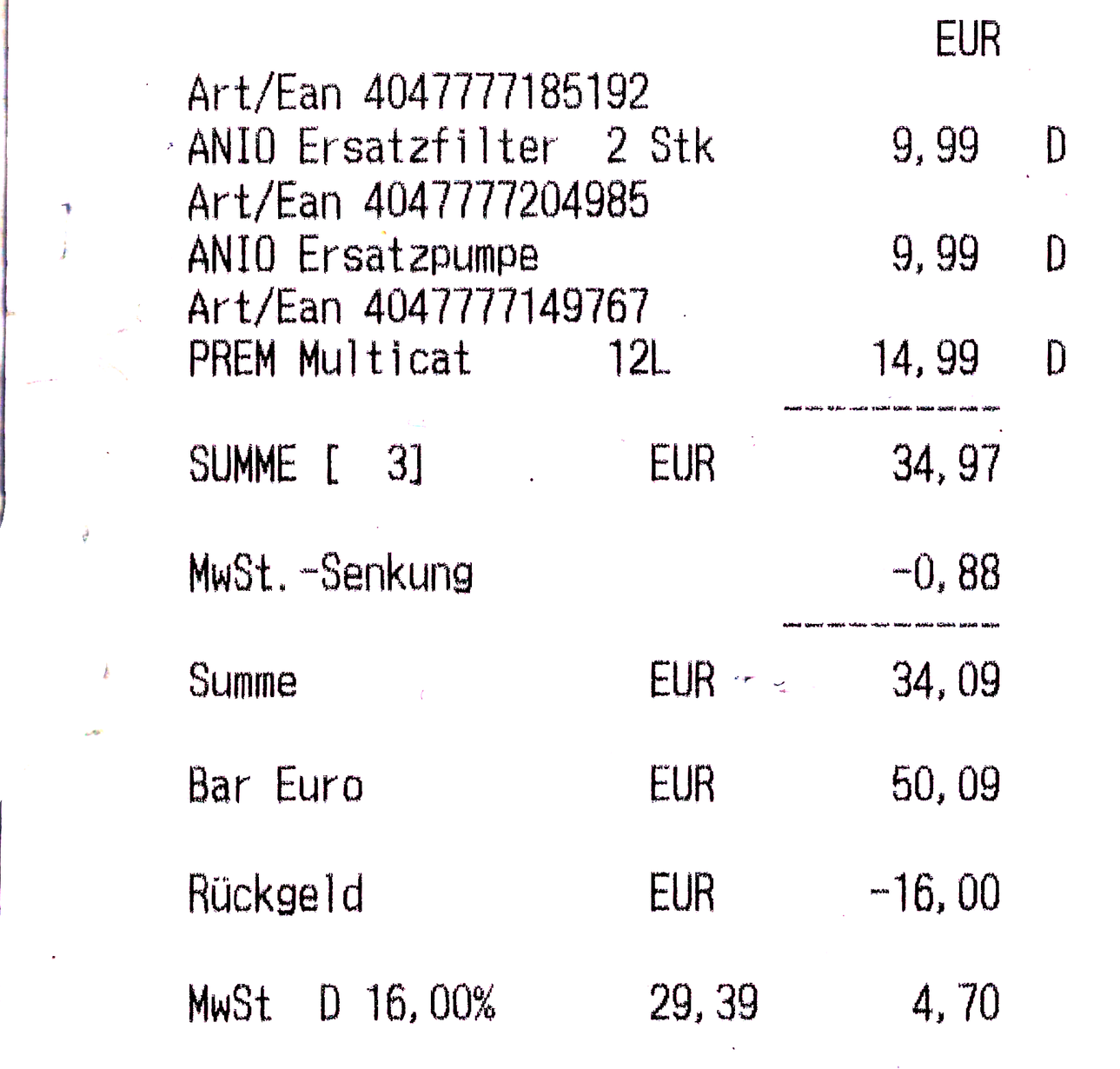
Fressnapf, Public domain, via Wikimedia Commons (File:Kassenzettel Fressnapf mit ausgewiesener MwSt-Senkung und TSE Transaktionsnummer 12 2020.png); credit: Scan by Raimond Spekking, Public domain. Prepared model input from the cited source; see original source for its unmodified file. Reviewed crop or preparation replaces the original source framing.
- Option 1: 5.03 EUR
- Option 2: 5.91 EUR
- Option 3: 6.79 EUR
- Option 4: 16.00 EUR
VB0059 Document reconciliation
If one of the cola drinks were removed while every other purchased unit stayed the same, what would the revised total be?
Columns are product, unit price, quantity and line amount. The cola row is labelled 콜라. Prices are VAT-inclusive; subtract one printed unit price with no other repricing or adjustment.
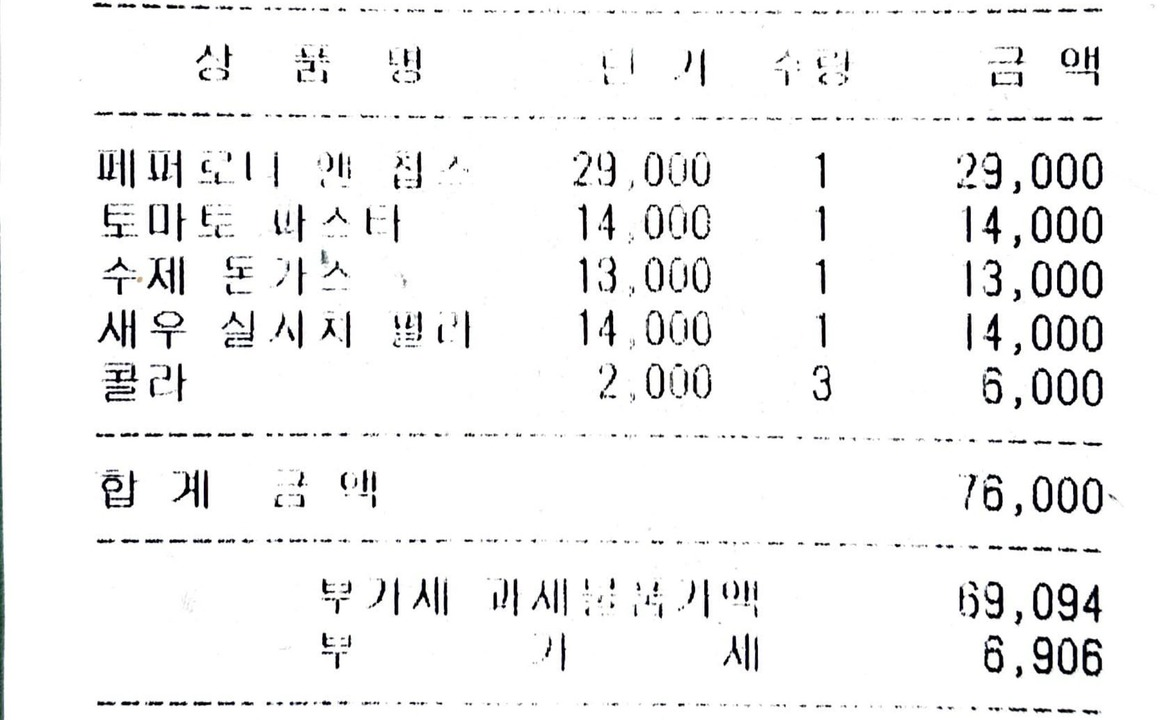
이태리집(태백시 소재), Public domain, via Wikimedia Commons (File:Receipt taebaek restaurant IMG 2614 modified.jpg); credit: 이태리집(태백시 소재), Public domain. Prepared model input from the cited source; see original source for its unmodified file. Reviewed crop or preparation replaces the original source framing.
- Option 1: 78,000 won
- Option 2: 70,000 won
- Option 3: 72,000 won
- Option 4: 74,000 won
VB0060 Document reconciliation
If the amount before VAT increased by 10.00 CHF, keeping the VAT rate printed on this receipt, what would the new VAT amount be?
The printed total includes VAT. Compute the current tax-exclusive base from that total, add 10.00 CHF, then apply the printed rate and round VAT to the nearest cent.
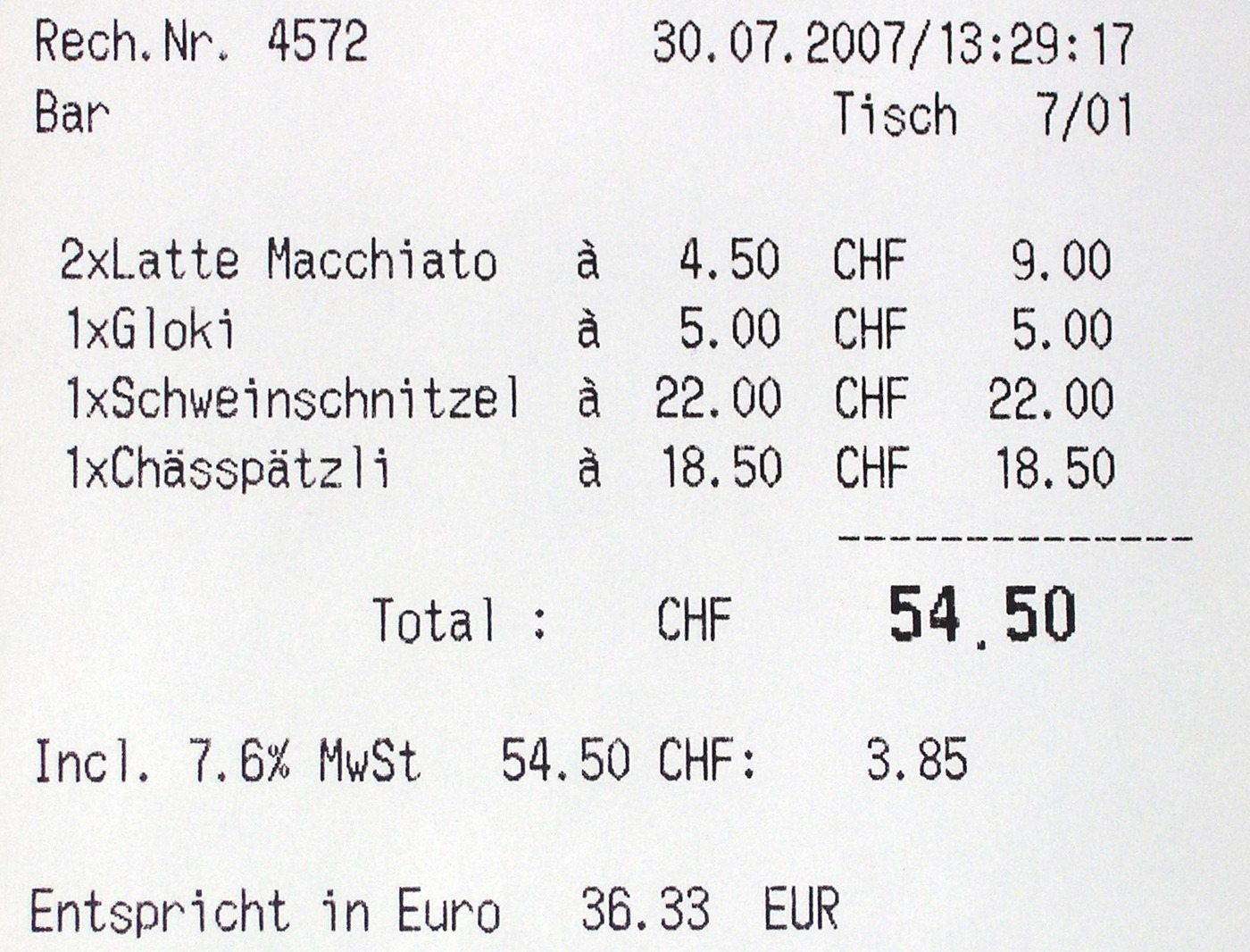
Audrius Meskauskas (Audriusa), CC BY-SA 3.0, via Wikimedia Commons (File:ReceiptSwiss.jpg); credit: Own work, CC BY-SA 3.0. Prepared model input from the cited source; see original source for its unmodified file.
- Option 1: 3.85 CHF
- Option 2: 4.61 CHF
- Option 3: 4.85 CHF
- Option 4: 5.45 CHF
VB0061 Document reconciliation
If the same exchange direction and net rate shown on this memo were applied to MOP 525.00, how many HKD would be received?
Use the printed net rate with no extra fee. Round the result to two decimal places.
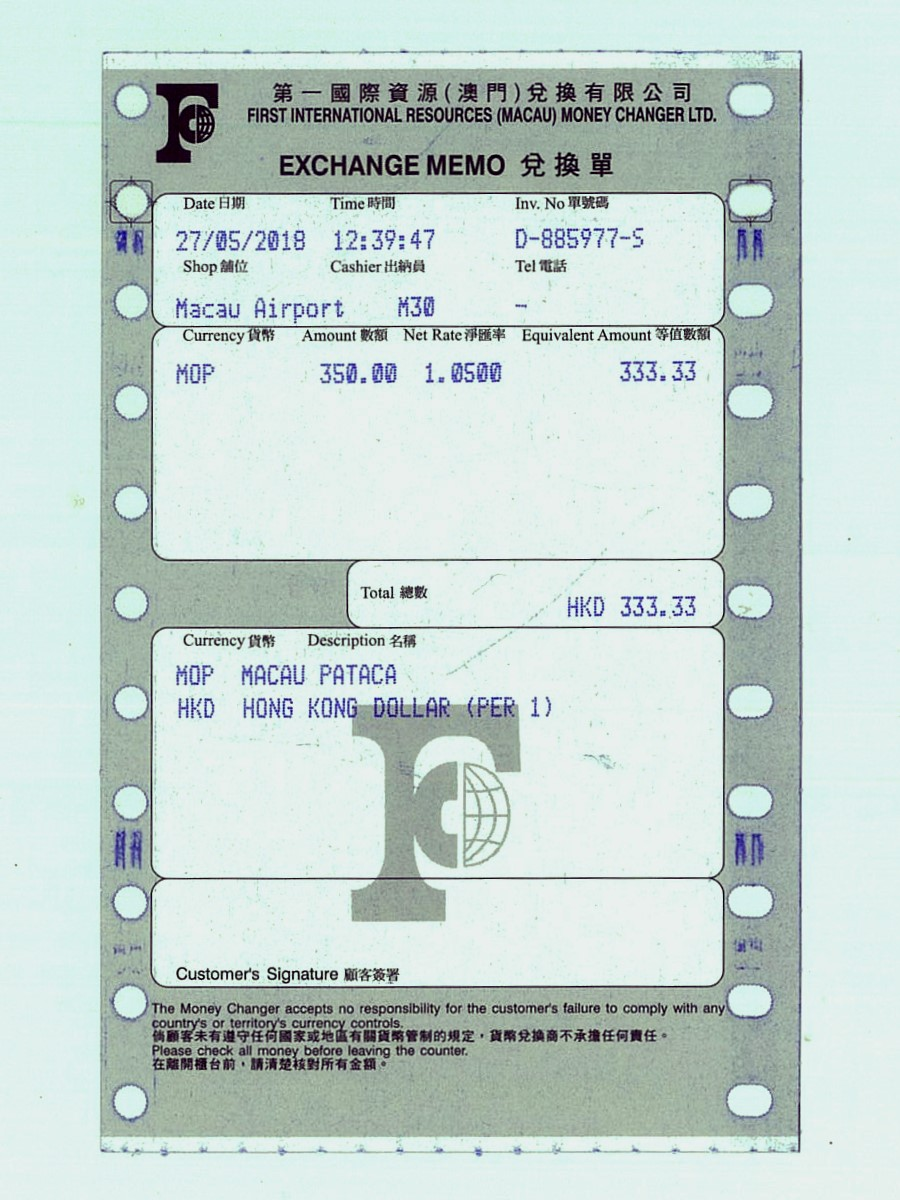
Solomon203, CC BY-SA 4.0, via Wikimedia Commons (File:FIRMMC exchange memo at Macau Airport 20180527.jpg); credit: Own work, CC BY-SA 4.0. Prepared model input from the cited source; see original source for its unmodified file.
- Option 1: HKD 523.95
- Option 2: HKD 498.75
- Option 3: HKD 500.00
- Option 4: HKD 551.25
VB0062 Document reconciliation
What change would be due if the customer handed over 200.00 yuan instead of the printed cash amount, keeping the purchases and rounding adjustment unchanged?
合计 = total; 去零 = rounding-off deduction; 现金 = cash; 找零 = change. Subtract the printed deduction from the printed total before calculating change.
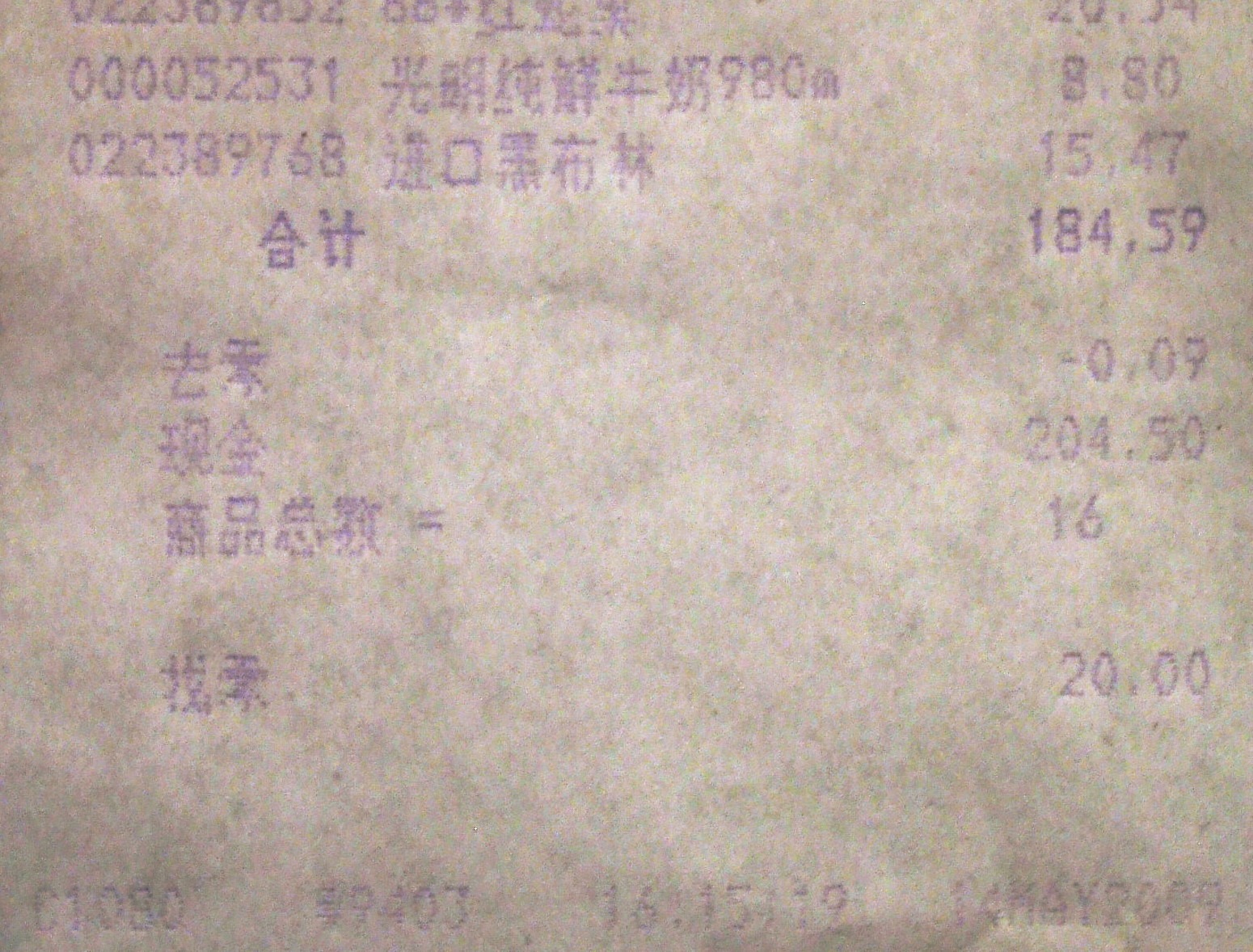
User:Smyth, Public domain, via Wikimedia Commons (File:Chinese Swedish rounding.jpg); credit: Own work, Public domain. Prepared model input from the cited source; see original source for its unmodified file.
- Option 1: 20.00 yuan
- Option 2: 15.41 yuan
- Option 3: 15.59 yuan
- Option 4: 15.50 yuan
VB0063 Document reconciliation
What is the sum of the three Total Cost amounts in this purchase-order table?
Use the printed Total Cost column. Rounding to the nearest cent.
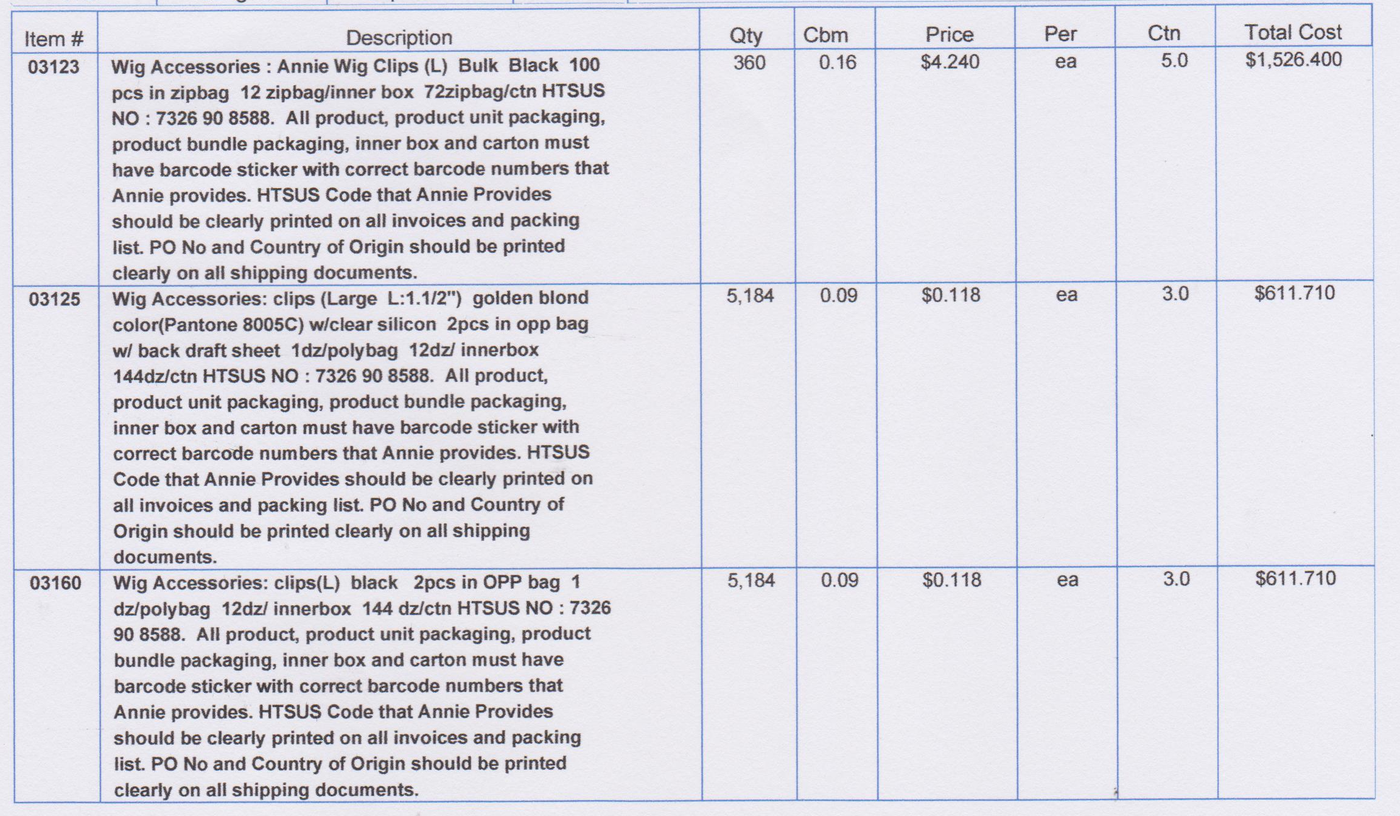
Kxtar, CC BY-SA 4.0, via Wikimedia Commons (File:Invoice1633.jpg); credit: Own work, CC BY-SA 4.0. Prepared model input from the cited source; see original source for its unmodified file.
- Option 1: $2,750.12
- Option 2: $2,839.82
- Option 3: $2,749.92
- Option 4: $2,149.82
- Option 5: $2,749.82
VB0064 Interface state decisions
A user wants both 'Show preview on first edit' and 'Show preview before edit box' to be turned on in this preferences tab. What is the minimum change needed before pressing Save?
Clicking a checkbox toggles it. Do not change any other setting. Ignore the other tabs.
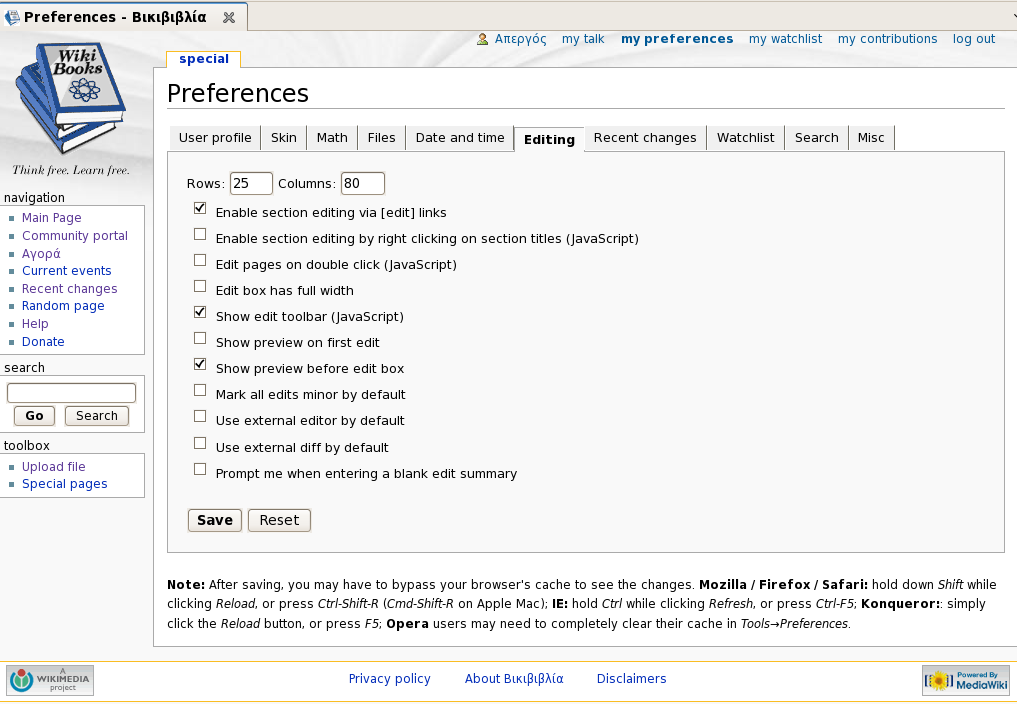
self, CC BY-SA 3.0, via Wikimedia Commons (File:Screenshot Preferences Βικιβιβλία 5.png); credit: www.mediawiki.org (source code), el.wikibooks.org (content), CC BY-SA 3.0. Prepared model input from the cited source; see original source for its unmodified file.
- Option 1: Tick 'Show preview on first edit' only
- Option 2: Tick both 'Show preview on first edit' and 'Show preview before edit box'
- Option 3: Untick 'Show preview before edit box' and tick 'Show preview on first edit'
- Option 4: Nothing needs to change on this tab
- Option 5: Tick 'Show preview before edit box' only
VB0065 Interface state decisions
A user wants dates written in the all-numeric style that begins with the year (like 2001-04-08 09:12:34) and does not want any time-zone change. Which action on this page achieves that?
Pressing Save stores the visible choices. Do not change fields that the goal does not mention.
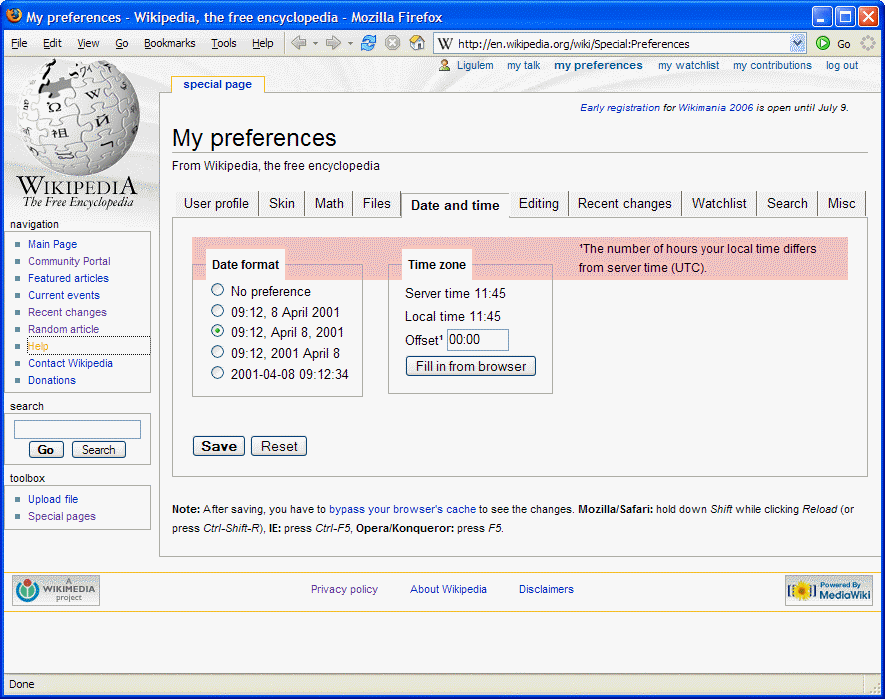
Original uploader was Ligulem at meta Wikimedia Foundation Governance Wiki, CC BY-SA 4.0, via Wikimedia Commons (File:Date-preferences-Screenshot.png); credit: Transferred from meta.wikimedia to Commons., CC BY-SA 4.0. Prepared model input from the cited source; see original source for its unmodified file. Re-encoded for the tested C1 input variant.
- Option 1: Select '09:12, 2001 April 8', then Save
- Option 2: The required date-format action is not established by this screenshot
- Option 3: Click 'Fill in from browser', then Save
- Option 4: Select the radio button beside '2001-04-08 09:12:34', then Save
- Option 5: Keep the current selection and click Save
VB0066 Interface state decisions
A user wants to keep 'Year in Review' as it is but does not want tables in articles to be collapsed automatically. What is the smallest change to make on this screen?
A switch with its knob on the right and a blue track is on; a switch with its knob on the left is off. Tapping a switch flips it. Make no other change.
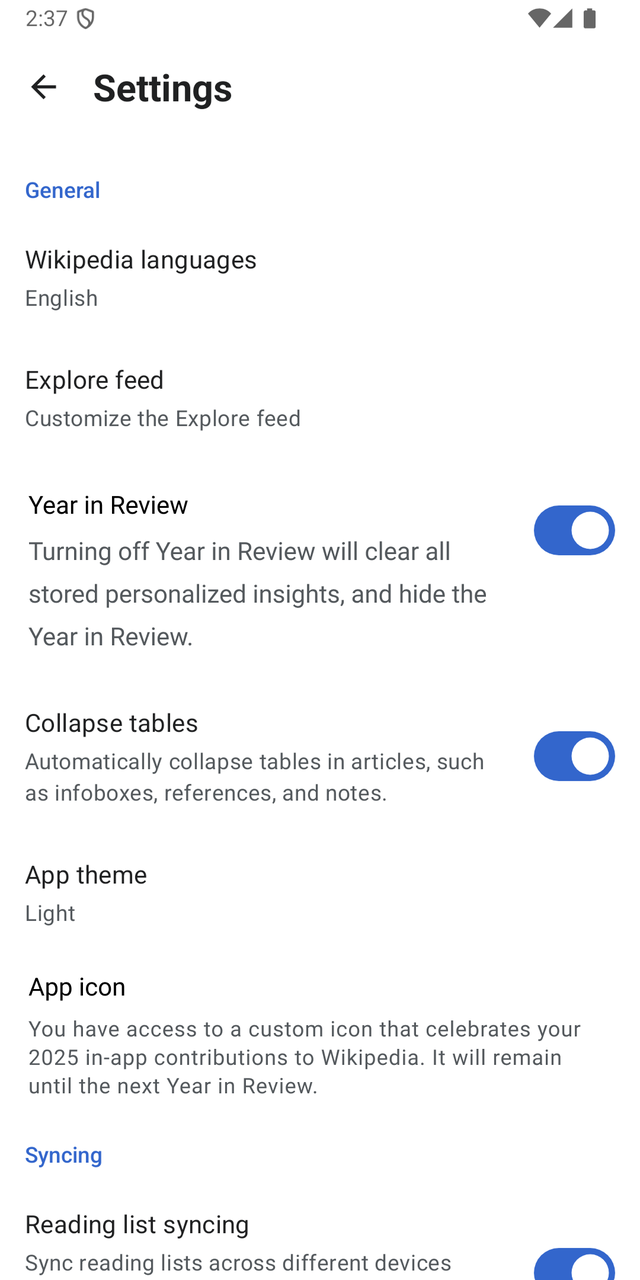
SChekfa-WMF, CC BY 4.0, via Wikimedia Commons (File:Android settings screen year in review.png); credit: Wikimedia Foundation Design, CC BY 4.0. Prepared model input from the cited source; see original source for its unmodified file.
- Option 1: No change is needed
- Option 2: Tap the 'Collapse tables' switch once
- Option 3: Tap the 'Year in Review' switch once
- Option 4: Tap 'App theme' and choose another theme
- Option 5: Tap both the 'Year in Review' and 'Collapse tables' switches
VB0067 Interface state decisions
A mapper wants to see only the flat (non-panoramic) photos from the Panoramax overlay and keep every other overlay setting unchanged. What is the smallest change to make?
A ticked box means the item is shown. A greyed-out item cannot be changed.
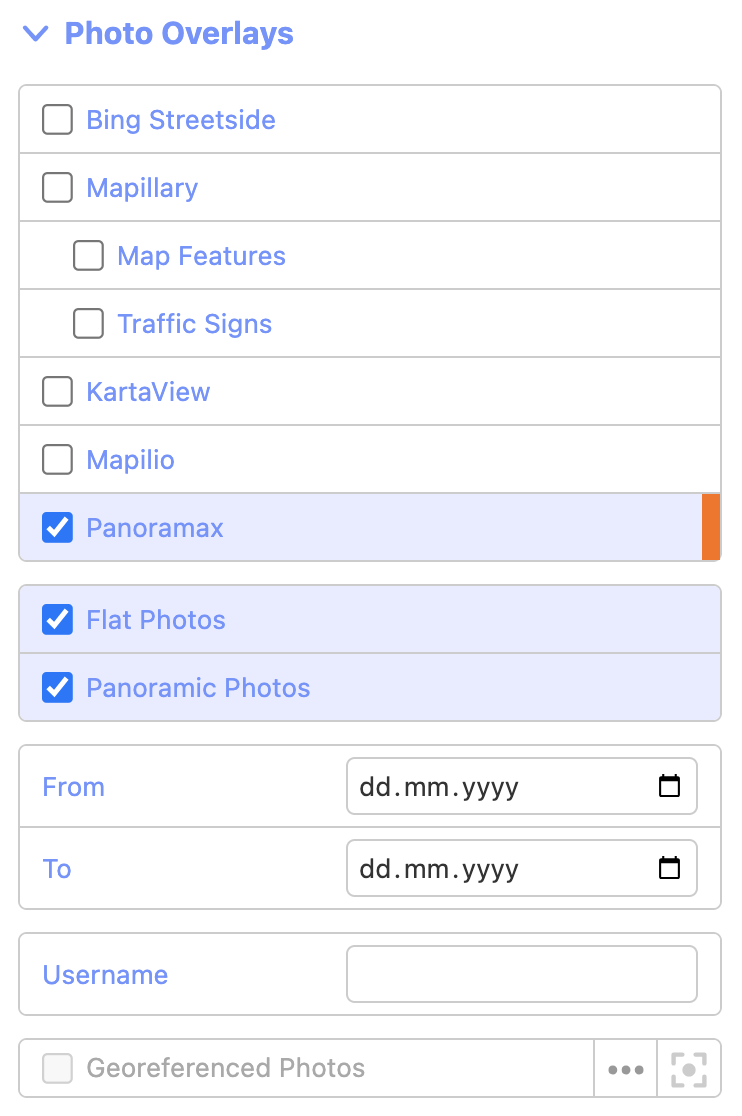
Pajbr, CC0, via Wikimedia Commons (File:Panoramax in iD editor 20241002.png); credit: Own work, CC0. Prepared model input from the cited source; see original source for its unmodified file.
- Option 1: Untick 'Panoramic Photos'
- Option 2: Untick 'Flat Photos'
- Option 3: Tick 'Georeferenced Photos'
- Option 4: Tick 'Mapillary'
- Option 5: Untick 'Panoramax'
VB0068 Interface state decisions
The edit summary 'Formatting' is correct, but the user's change is not a minor edit and they still want to watch the page. What must be changed before tapping PUBLISH?
A box with a blue fill and a white check mark is ticked. Make the smallest possible change.
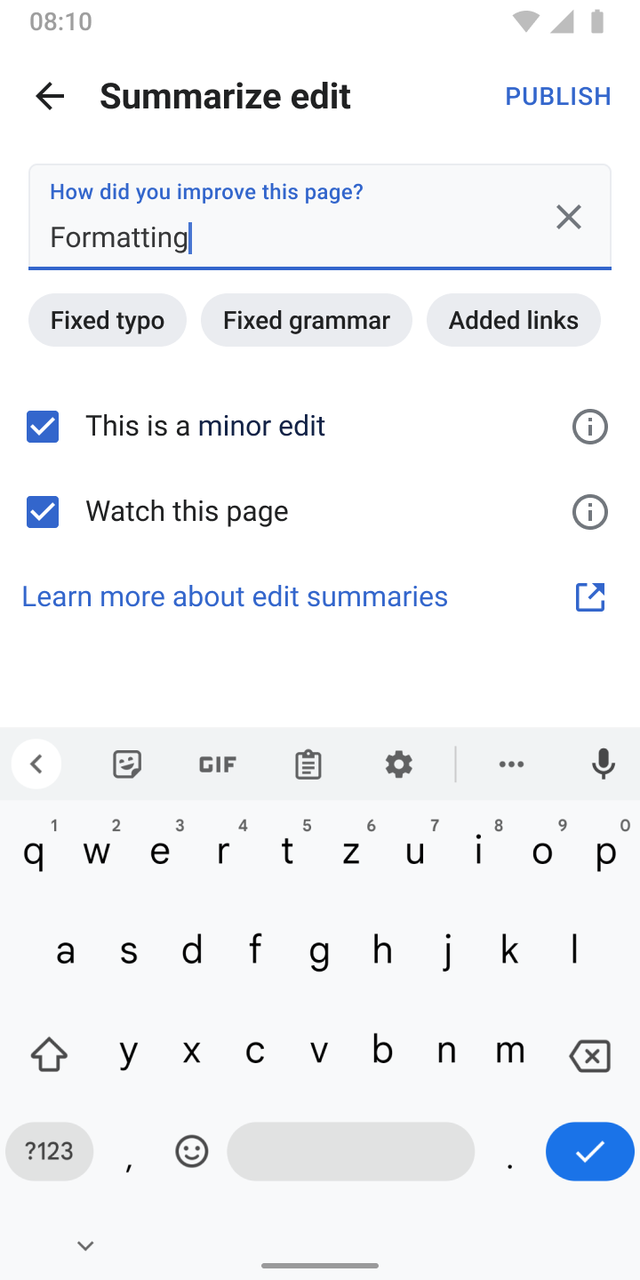
ARamadan-WMF, CC BY-SA 4.0, via Wikimedia Commons (File:Edit-summary in Wikipedia mobile app.png); credit: Own work, CC BY-SA 4.0. Prepared model input from the cited source; see original source for its unmodified file.
- Option 1: Untick 'Watch this page'
- Option 2: Clear the summary with the X button
- Option 3: Nothing; tap PUBLISH now
- Option 4: Tap the 'Added links' suggestion
- Option 5: Untick 'This is a minor edit'
VB0069 Interface state decisions
The user wants to log in to de.wikipedia while keeping the program's menus in English. Apart from entering credentials, what is the smallest required change from the visible state?
Project selects the wiki site. Language selects the program's menu language. Leave unrelated settings unchanged.
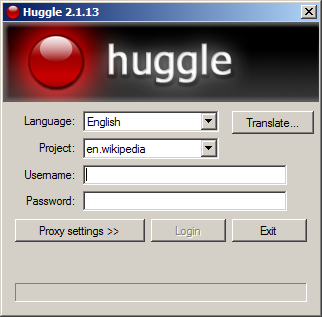
Addshore at English Wikipedia, Public domain, via Wikimedia Commons (File:Huggle Login Form.png); credit: Transferred from en.wikipedia to Commons by IngerAlHaosului using CommonsHelper., Public domain. Prepared model input from the cited source; see original source for its unmodified file.
- Option 1: Change Project only
- Option 2: Neither Project nor Language needs changing
- Option 3: Change Language only
- Option 4: Change both Project and Language
VB0070 Image and text consistency
Which one of the following statements about this departures board is true?
The column headed 'Spår' gives the platform number. The board lists fifteen departures. Exactly one statement is true.
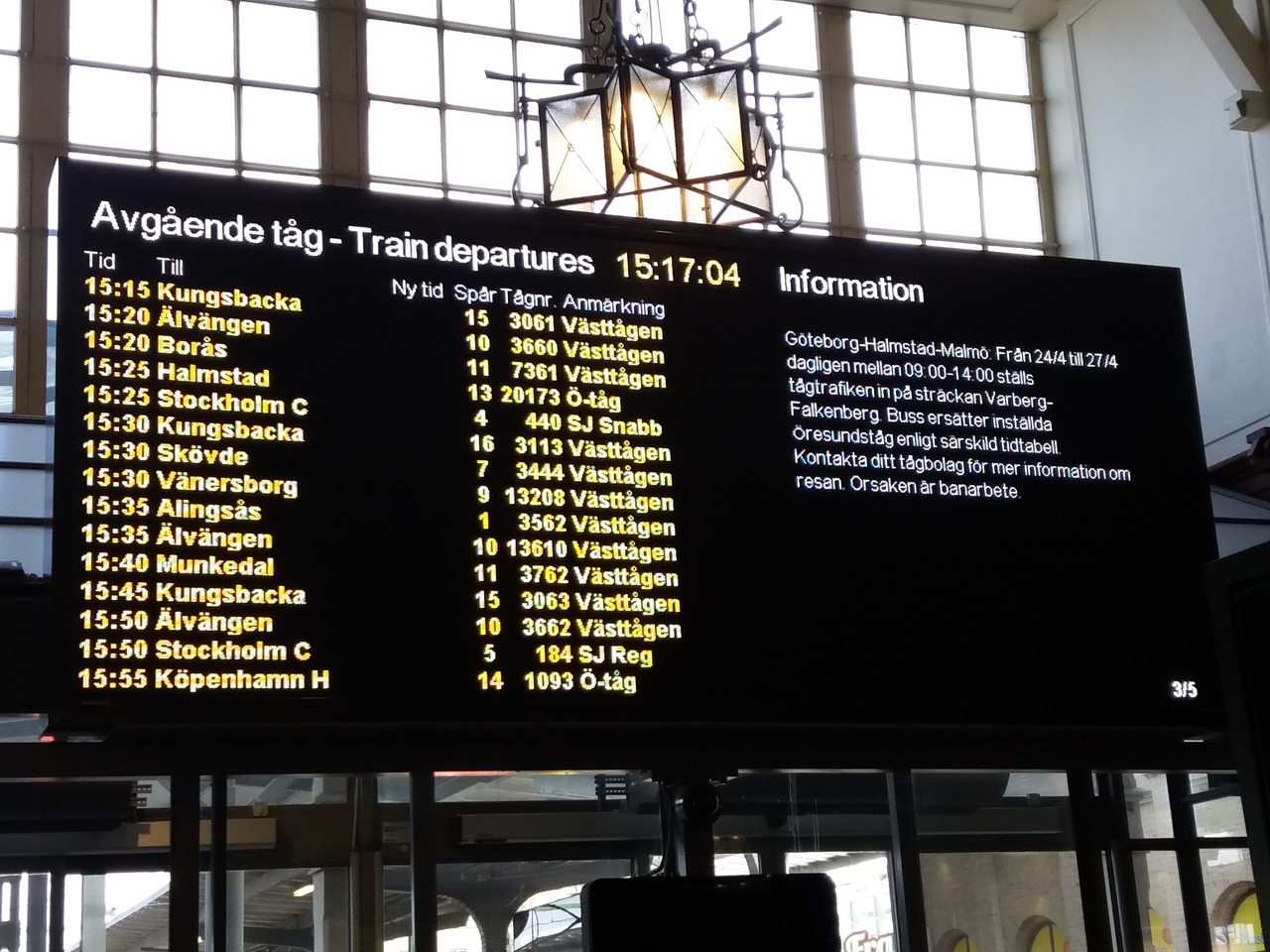
Yann Forget, CC BY-SA 4.0, via Wikimedia Commons (File:Train departure board in Göteborg railway station, Sweden .jpg); credit: Own work, CC BY-SA 4.0. Prepared model input from the cited source; see original source for its unmodified file.
- Option 1: The first departure listed leaves from platform 1.
- Option 2: Exactly three of the fifteen departures use a platform number above 12.
- Option 3: The departures to Borås and to Munkedal use different platforms.
- Option 4: All three departures to Älvängen use platform 10.
- Option 5: The two departures to Stockholm C use the same platform.
VB0071 Image and text consistency
Which one of the following statements about this train information display is true?
The times in brackets are the scheduled times at each calling point. The large 13:24 is the departure time shown at the top. Exactly one statement is true.
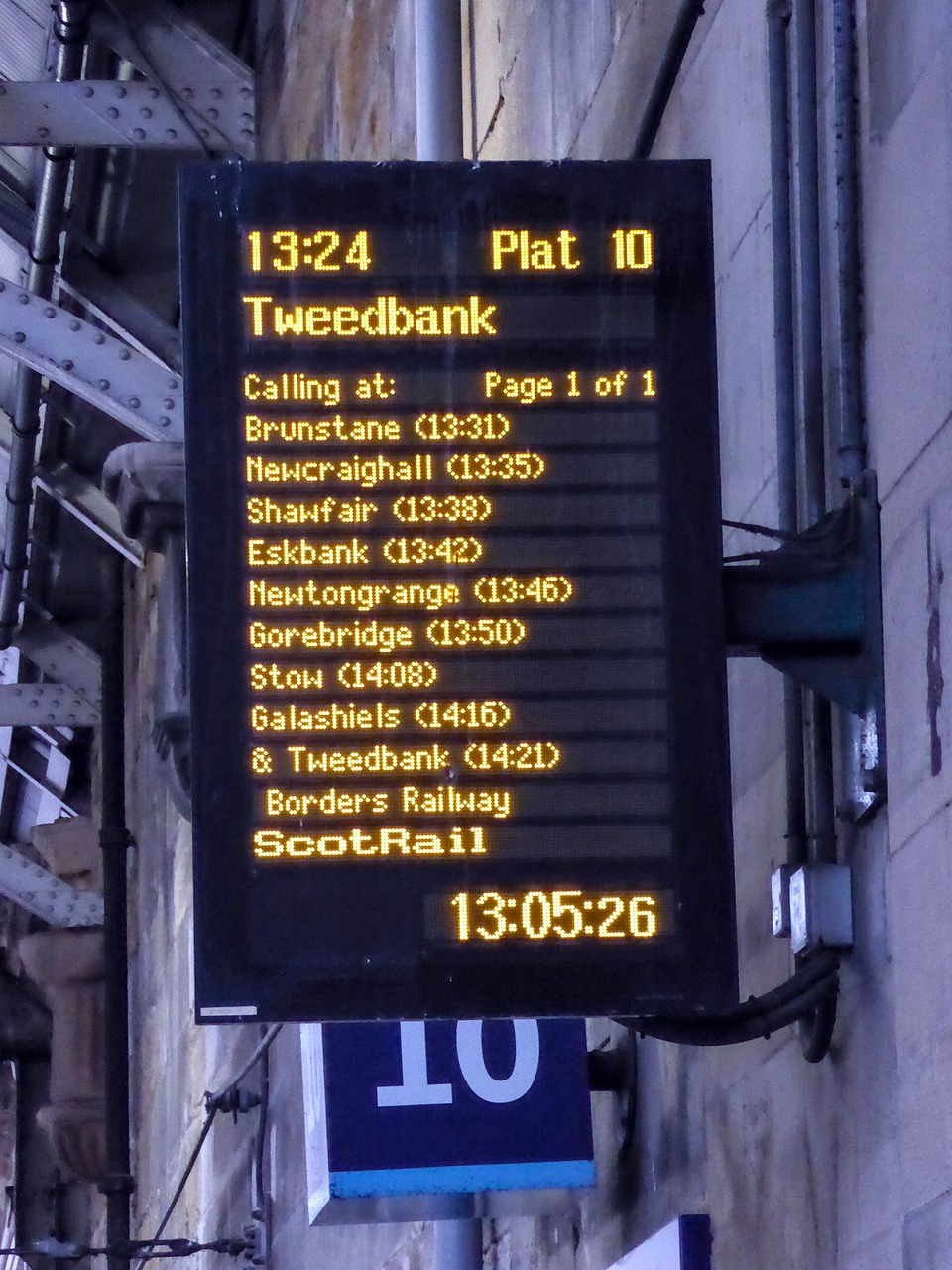
John Lucas, CC BY-SA 2.0, via Wikimedia Commons (File:A Borders Railway departure board - geograph.org.uk - 7744028.jpg); credit: Geograph Britain and Ireland, CC BY-SA 2.0. Prepared model input from the cited source; see original source for its unmodified file.
- Option 1: The longest time gap between consecutive listed calling points is between Gorebridge and Stow.
- Option 2: The train leaves from platform 13.
- Option 3: The train takes 8 minutes to go from Newtongrange to Gorebridge.
- Option 4: Shawfair is the first calling point after Brunstane.
- Option 5: The train reaches Tweedbank before it reaches Galashiels.
VB0072 Image and text consistency
Which one of these statements is consistent with the scoreboard?
Exactly one statement is consistent with the picture. 'TOL' means timeouts left and 'QTR' the quarter. The team name above each score is the team that owns that score.
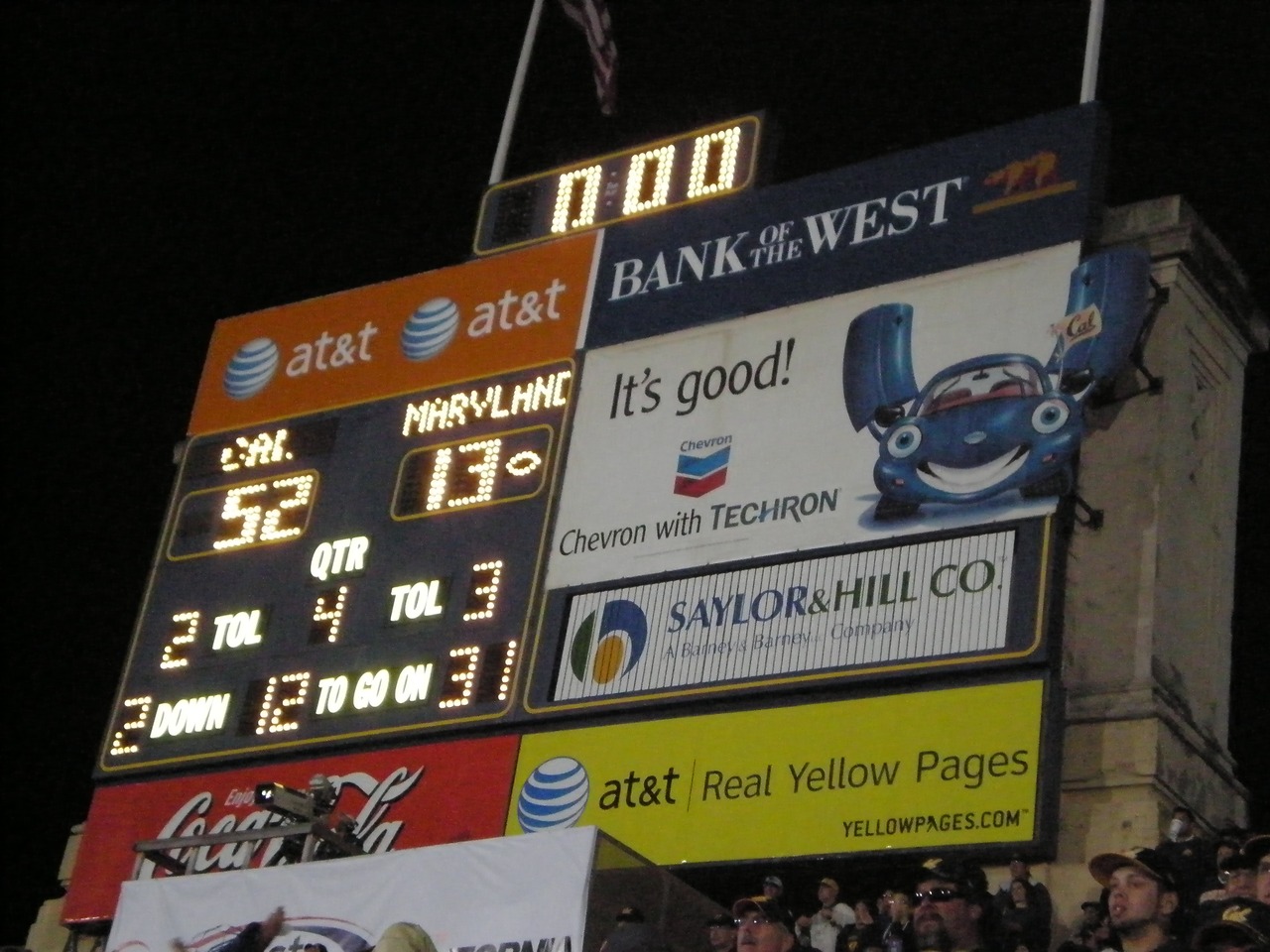
BrokenSphere, CC BY-SA 3.0, via Wikimedia Commons (File:Final score of Maryland at Cal 2009-09-05.JPG); credit: Own work, CC BY-SA 3.0. Prepared model input from the cited source; see original source for its unmodified file.
- Option 1: The two scores add up to 75
- Option 2: The scoreboard shows MARYLAND ahead by 39 points
- Option 3: CAL has more timeouts left than MARYLAND
- Option 4: The scoreboard shows CAL ahead by exactly 39 points
- Option 5: The game is in the second quarter
VB0073 Image and text consistency
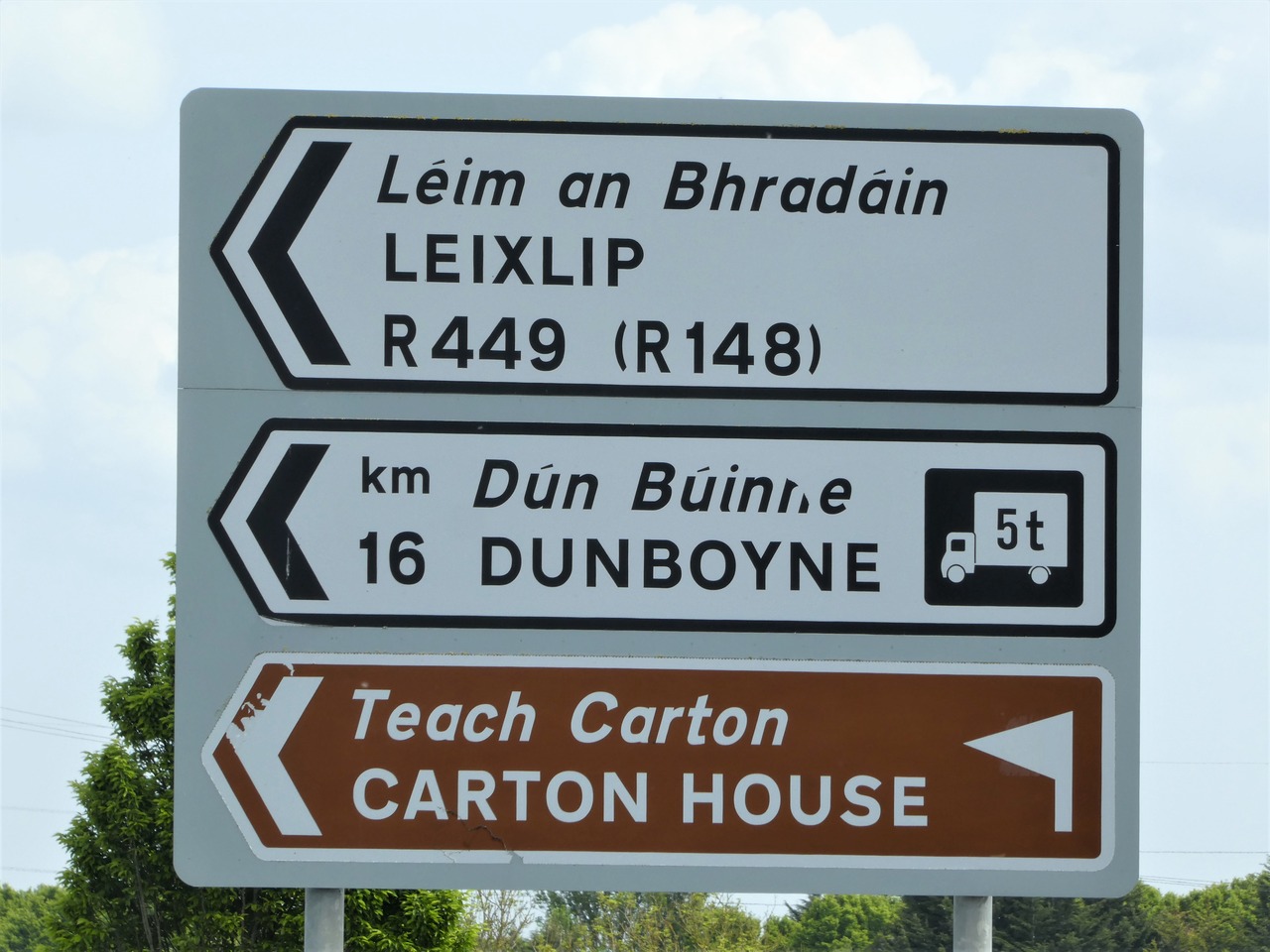
Which one of these statements is consistent with the road sign?
Exactly one statement is consistent with the picture.
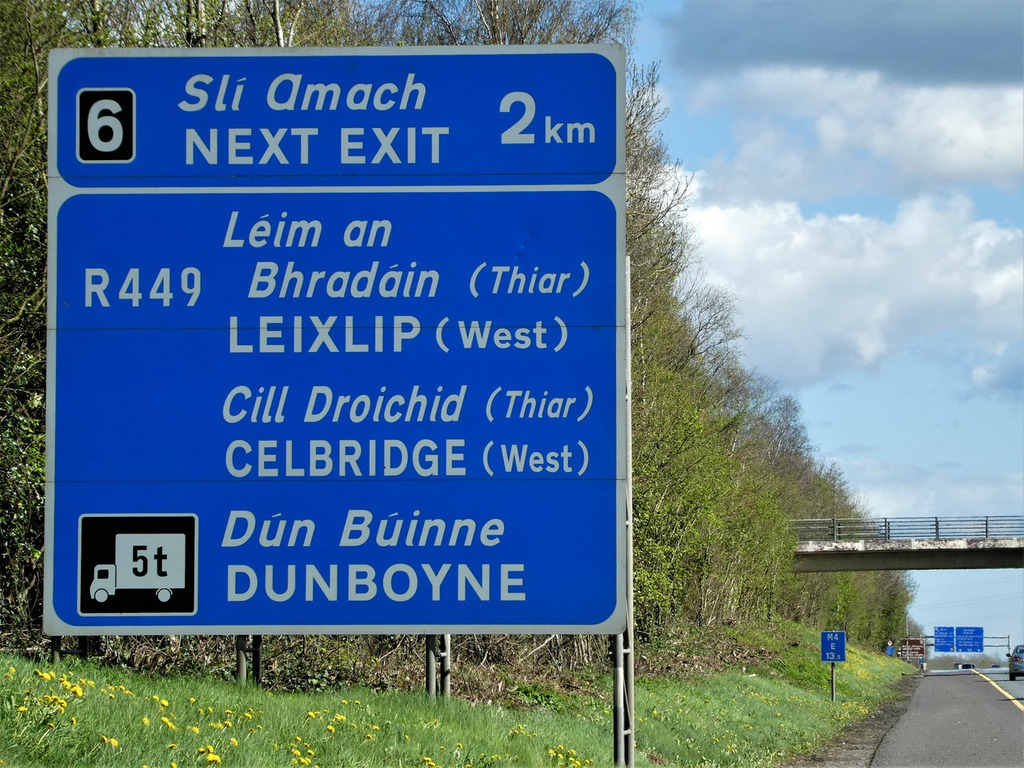
Leimanbhradain, CC BY-SA 4.0, via Wikimedia Commons (File:Sign-1030661, M4, Co. Kildare, Ireland.jpg); credit: Own work, CC BY-SA 4.0. Prepared model input from the cited source; see original source for its unmodified file. Re-encoded for the tested C1 input variant. Lossy image encoding was visually reviewed before testing. Resized from [1280, 960] to [1024, 768] before testing.
- Option 1: The 5t lorry symbol is next to Leixlip
- Option 2: The next exit is number 2, in 6 km
- Option 3: Dunboyne is marked '(West)'
- Option 4: Celbridge is signed for the next exit but Leixlip is not
- Option 5: The next exit, number 6, is 2 km ahead
VB0074 Image and text consistency
Which one of these statements is consistent with the road sign?
Exactly one statement is consistent with the picture.
Leimanbhradain, CC BY-SA 4.0, via Wikimedia Commons (File:Sign-1040504, Celbridge, Co. Kildare, Ireland.jpg); credit: Own work, CC BY-SA 4.0. Prepared model input from the cited source; see original source for its unmodified file.
- Option 1: Carton House is signed on a green background
- Option 2: Dunboyne is signed at 16 km and the lorry symbol shows 5t
- Option 3: Dunboyne is signed at 16 km and the lorry symbol shows 7.5t
- Option 4: Leixlip is on the R149
- Option 5: Dunboyne is signed at 18 km
VB0075 Image and text consistency
Which statement is consistent with the road sign?
The printed number beside each place is its signed distance in kilometres. Compare those displayed distances without assuming the destinations lie on one unbranched route.
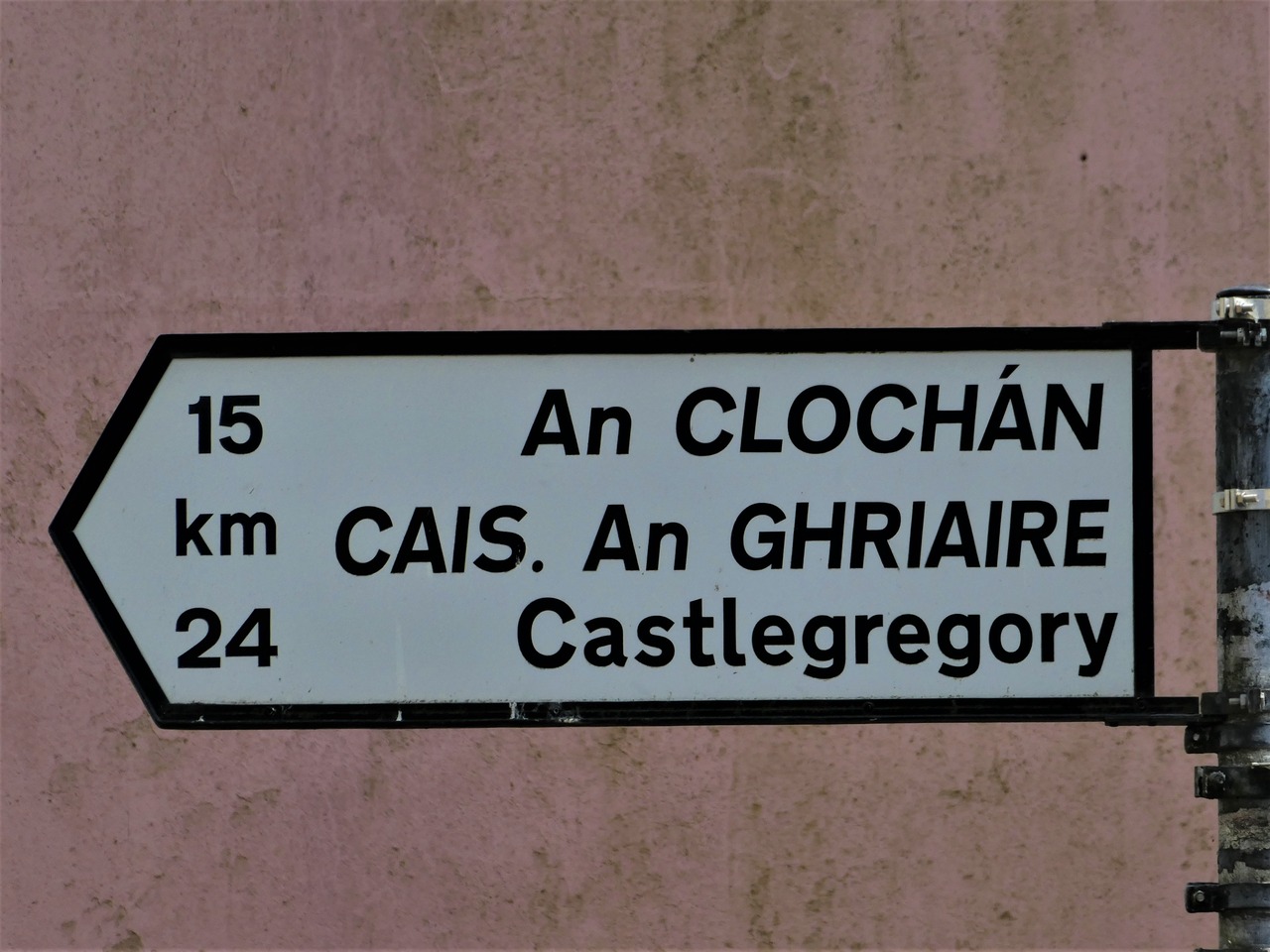
Mucklagh, CC BY-SA 4.0, via Wikimedia Commons (File:Sign-1050251, Dingle, Co. Kerry, Ireland.jpg); credit: Own work, CC BY-SA 4.0. Prepared model input from the cited source; see original source for its unmodified file.
- Option 1: An Clochan is signed at 24 km
- Option 2: The arrow points to the right
- Option 3: Castlegregory is signed at 15 km
- Option 4: The signed distance to Castlegregory is 9 km greater than the signed distance to An Clochan
VB0076 Image and text consistency
Which one of these statements about the chess position is consistent with the picture?
Exactly one statement is consistent with the picture. Files run a-h from left to right and ranks 1-8 from bottom to top, as the board labels show. White pieces are the light-coloured ones, black the dark ones.
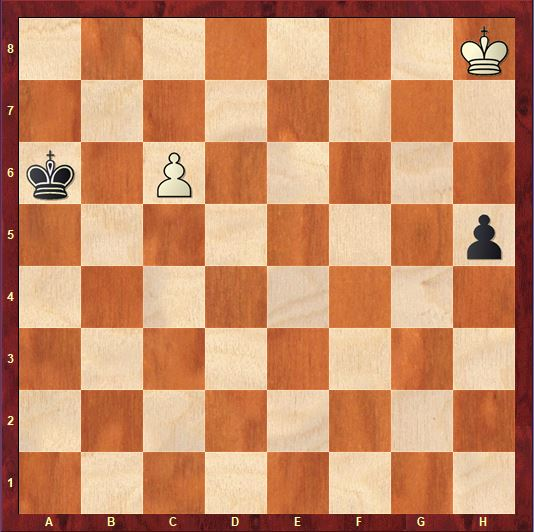
Melv douc, CC BY-SA 4.0, via Wikimedia Commons (File:Studio de Reti.JPG); credit: Own work, CC BY-SA 4.0. Prepared model input from the cited source; see original source for its unmodified file.
- Option 1: Black's pawn is on h6
- Option 2: Black has more pieces than White
- Option 3: Black's king is on a7
- Option 4: White has two pawns
- Option 5: White's king is on h8 and White's pawn is on c6
VB0077 Image and text consistency
Which one of these statements is consistent with the clock's display?
Exactly one statement is consistent with the picture.
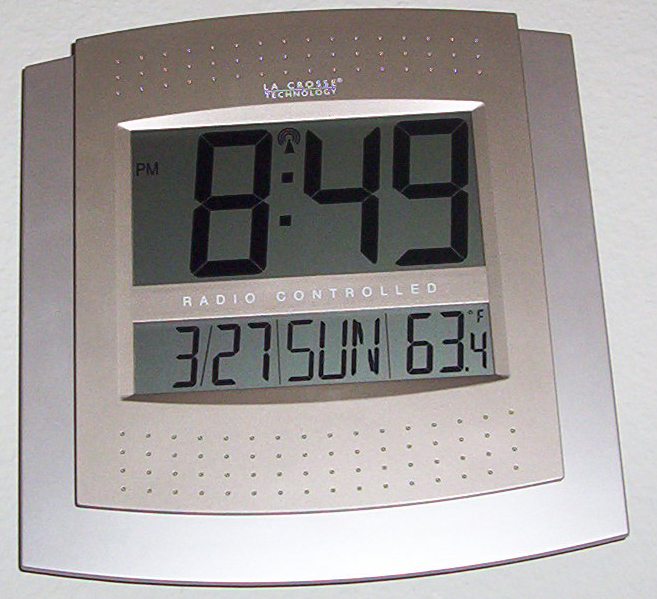
unknown, CC BY-SA 3.0, via Wikimedia Commons (File:Atomic clock.jpg), CC BY-SA 3.0. Prepared model input from the cited source; see original source for its unmodified file.
- Option 1: It shows 8:49 PM and the day Sunday
- Option 2: It shows 9:48 PM
- Option 3: It shows the day Monday
- Option 4: It shows a temperature of 63.4 degrees Celsius
- Option 5: It shows a morning time
VB0078 Image and text consistency
Which one of these statements is consistent with the chart?
Exactly one statement is consistent with the picture. Use the plotted lines and the labelled axes; 'the end of the chart' means the right-hand end of each line.
CCA0134: image withheld pending third-party terms review. Tested SHA256: e0b7fd82c2cfdc9287e27e8f07b694c4eb8d7c9853e3e9700bf2af508fe43733.
Our World in Data, 'Child mortality rate', data source: Gapminder (2015); UN Inter-agency Group for Child Mortality Estimation (2025); CC BY, CC BY 4.0 (per OWID FAQ; third-party source terms not independently cleared). Prepared model input from the cited source; see original source for its unmodified file.
- Option 1: Nigeria's line stays above 10% in every year from 1990 to the end of the chart
- Option 2: In 2000 Brazil's line is above India's line
- Option 3: The United States line rises above 5% after 1980
- Option 4: India's line is below 20% throughout the chart
- Option 5: In 1960 China's line is below Brazil's line
VB0079 Image and text consistency
Which one of these statements is consistent with the chart?
Exactly one statement is consistent with the picture. Use the plotted lines and the labelled axes.
CCA0135: image withheld pending third-party terms review. Tested SHA256: 794c70c12da3475b712a66261c30472fb50d78323899164bd98f2be8d51d09c2.
Our World in Data, 'Maternal mortality ratio', data source: UN MMEIG (2023) and other sources; CC BY, CC BY 4.0 (per OWID FAQ; third-party source terms not independently cleared). Prepared model input from the cited source; see original source for its unmodified file.
- Option 1: Nigeria's line stays above 900 at every point where it is plotted
- Option 2: China's line is above Brazil's line in 1990
- Option 3: Brazil's line ends below China's line
- Option 4: The United States line peaks above 1,200 around 1918
- Option 5: India's line is above Nigeria's line at some point
VB0080 Attribute binding and set logic
To the right of the tall vertical wooden post, small ancient glass inlays are mounted in three general vertical columns (left, middle, and right). Which motif is depicted on the inlay fragment that is both located in the rightmost column and has a rounded blue body?
Bind both properties (rightmost column position and rounded blue body) to the same single fragment before identifying its depicted motif.
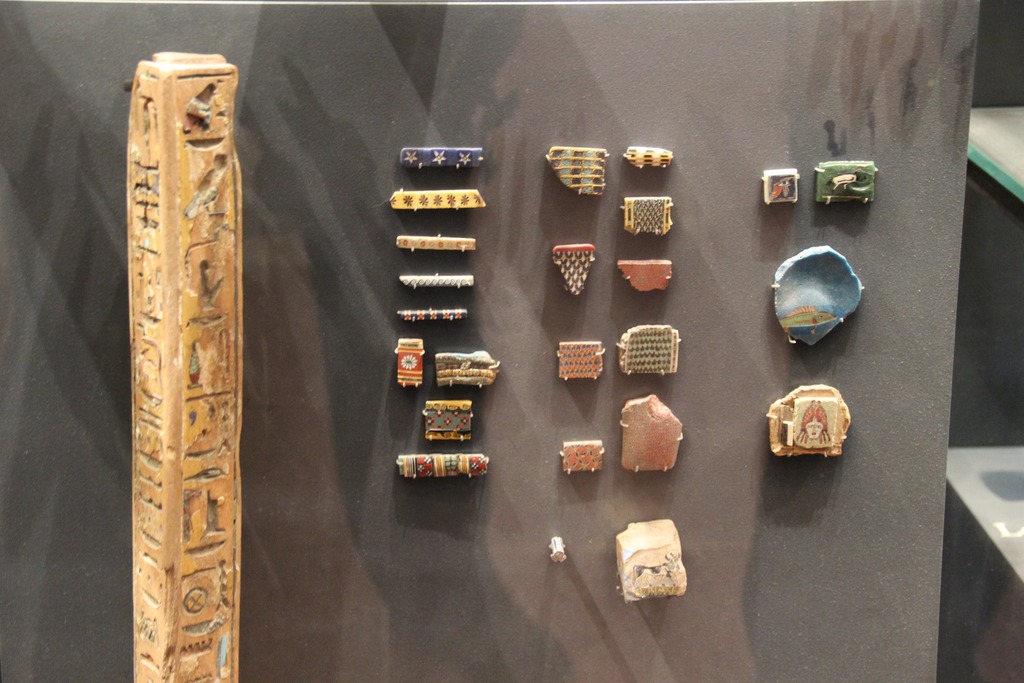
Gary Lee Todd, Ph.D. / Wikimedia Commons / CC0 1.0, CC0. Prepared model input from the cited source; see original source for its unmodified file.
- Option 1: A walking four-legged animal
- Option 2: A frontal human face
- Option 3: A fish in side profile
- Option 4: A row of three five-pointed stars
VB0081 Attribute binding and set logic
In the main row of upright pens, some pens are uncapped to expose a pointed metal fountain-pen nib at the top, while others remain capped. Which barrel description belongs to an upright pen that both has an exposed classic metal fountain-pen nib at the top and stands to the left of the black-and-silver 'MORISON' pen?
Consider only the upright pens standing side-by-side in the main vertical row. An exposed classic fountain-pen nib is an open split metal nib protruding from a dark grip section at the top end of the pen.
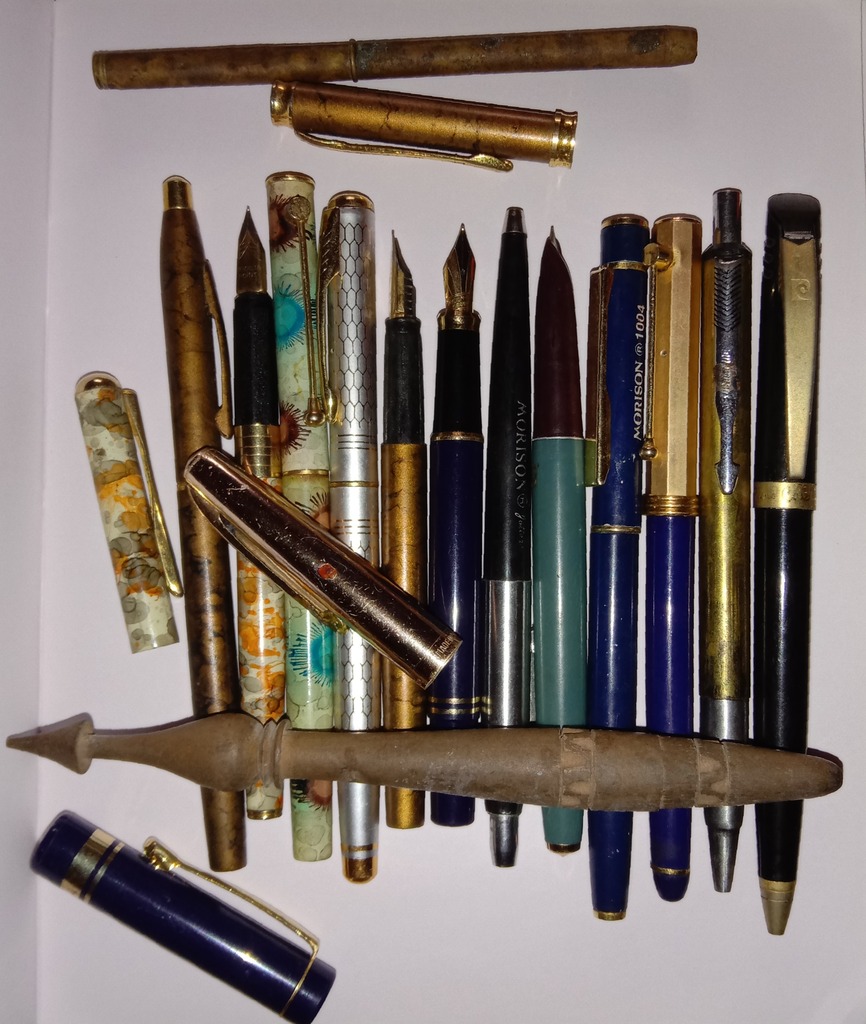
Billjones94 (Yogabrata Chakraborty) / Wikimedia Commons / CC BY-SA 4.0, CC BY-SA 4.0. Prepared model input from the cited source; see original source for its unmodified file.
- Option 1: White barrel patterned with orange and grey markings
- Option 2: Solid black barrel with a wide gold clip at the far right end
- Option 3: Royal-blue lower barrel paired with a faceted gold metal cap
- Option 4: Silver metal body with a hexagonal honeycomb grid pattern
VB0082 Conditional counting
How many billiard balls are visibly resting completely outside the triangular rack in this photograph?
Count only balls visible within the photograph and completely outside the rack's interior perimeter. Do not infer objects beyond the image boundaries.
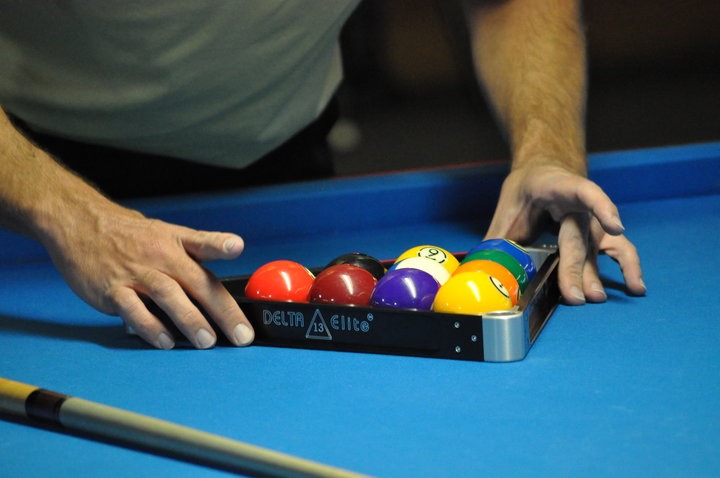
File:Billiard Balls and Rack.jpg / Wikimedia Commons (creator verification pending), CC BY-SA 3.0. Prepared model input from the cited source; see original source for its unmodified file.
- Option 1: 0
- Option 2: 2
- Option 3: 3
- Option 4: 1
VB0083 Conditional counting
Several dozen coins are scattered on the dark ribbed mat in front of the cat. How many of the visible coins are bimetallic—specifically showing a silver-colored inner core surrounded by a yellow-gold outer ring?
Count only coins on the mat that visibly display both a silver-colored central disc and a contrasting yellow-gold outer ring. Exclude every coin cut off by an image border, as well as solid yellow-gold or copper-colored coins. Partial overlap by another object is allowed only if both qualifying materials remain clearly visible.
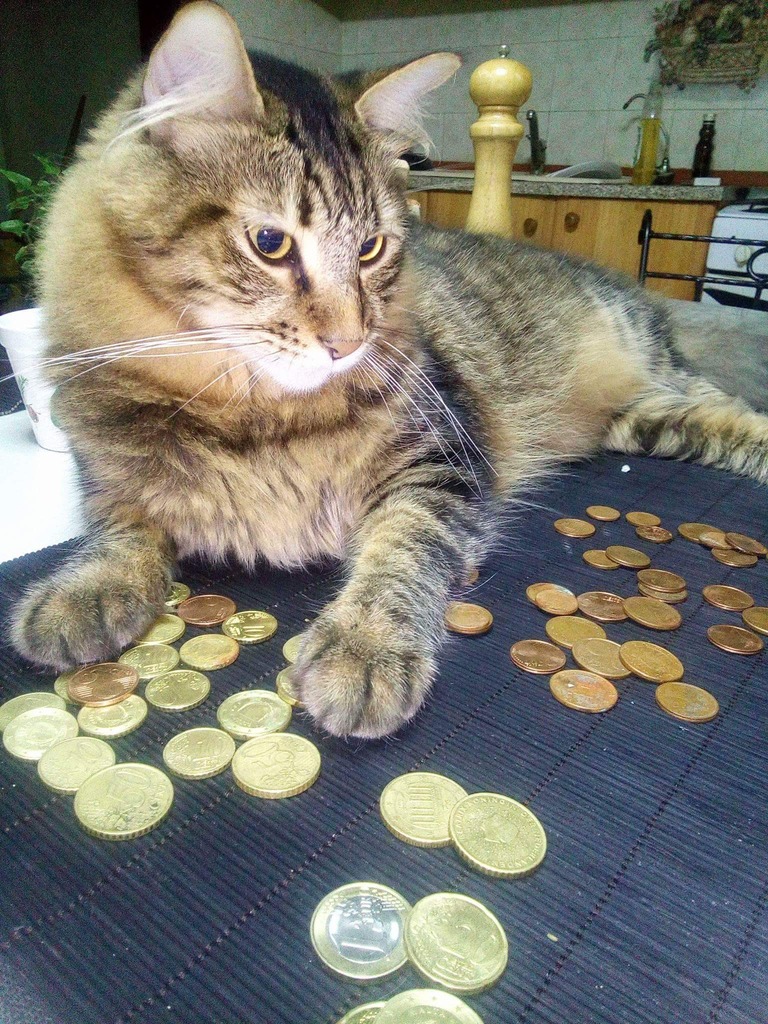
Continentaleurope / Wikimedia Commons / CC BY-SA 4.0, CC BY-SA 4.0. Prepared model input from the cited source; see original source for its unmodified file.
- Option 1: 2
- Option 2: 1
- Option 3: 3
- Option 4: 0
VB0084 Conditional counting
This diagram shows a small trefoil knot at the upper left, a larger rectangular-loop knot diagram at the lower left, and a deformed version of that larger diagram on the right after the red-arrow move. How many strand crossings appear in the small upper-left knot, and how many strand crossings appear in the right-hand diagram?
A strand crossing is a point where one white-filled black-bordered ribbon passes directly over another, indicated by a break in the under-passing ribbon's black border lines.
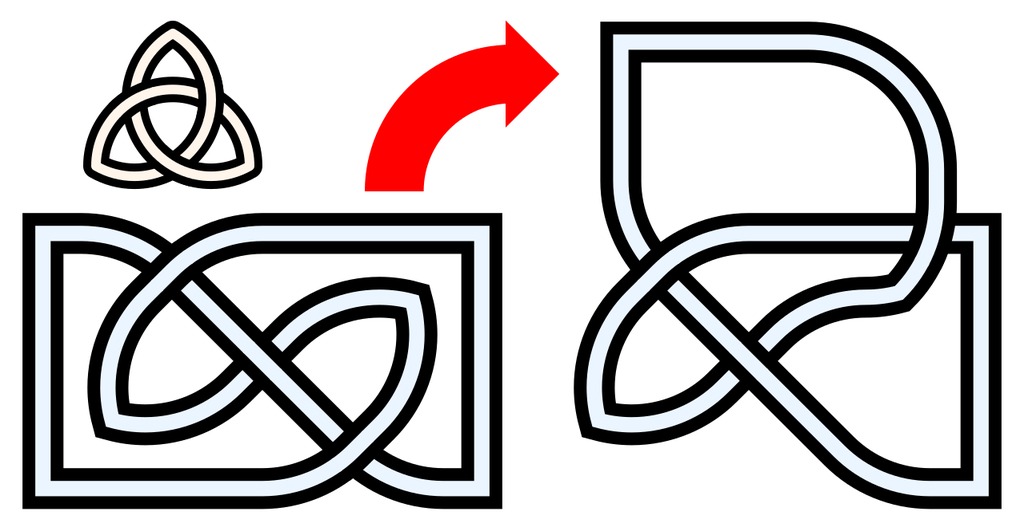
AnonMoos / Wikimedia Commons / Public Domain, Public domain. Prepared model input from the cited source; see original source for its unmodified file.
- Option 1: 3 in the upper-left knot and 6 in the right-hand diagram
- Option 2: 4 in the upper-left knot and 5 in the right-hand diagram
- Option 3: 3 in the upper-left knot and 4 in the right-hand diagram
- Option 4: 3 in the upper-left knot and 5 in the right-hand diagram
VB0085 Spatial relationships
Which square is in the same rank as the white rook and the same file as the white knight?
Use the file letters and rank numbers printed on the board. A rank is a horizontal row and a file is a vertical column.
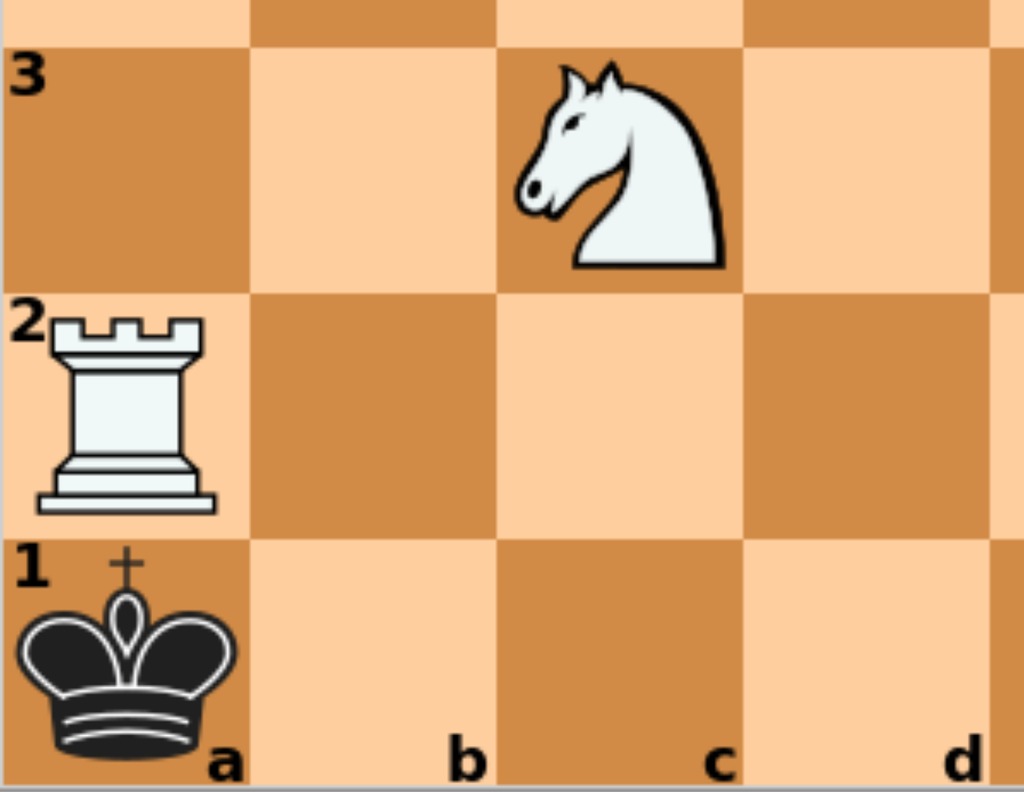
File:ArabicMate.svg / Wikimedia Commons (creator verification pending), CC BY-SA 4.0. Prepared model input from the cited source; see original source for its unmodified file.
- Option 1: a2
- Option 2: c3
- Option 3: c2
- Option 4: b2
VB0086 Rotation and reflection
Suppose the left four-sphere figure is reflected horizontally across a vertical line passing through the central black point (a left-to-right mirror flip in the image plane, with no vertical flip). Compared with the actual right-hand figure shown in the diagram, which pair of vertex sphere colors would remain swapped?
A horizontal reflection across a vertical line reverses left-right positions while keeping top-bottom positions unchanged in the two-dimensional image.
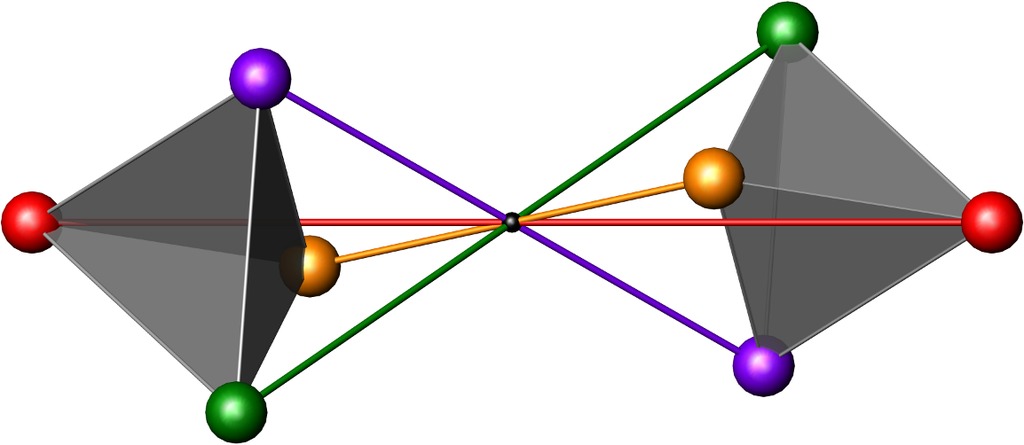
File:3D point reflection.png / Wikimedia Commons, CC0. Prepared model input from the cited source; see original source for its unmodified file.
- Option 1: Red and orange
- Option 2: Red and green
- Option 3: Purple and green
- Option 4: Purple and orange
VB0087 Geometry, folding and fit
When this net is folded into a closed cube, which square is opposite the central square that has another square attached on both its left and its right?
Fold along the shared square edges without cutting, stretching or overlapping faces. Identify positions in the pictured flat net.
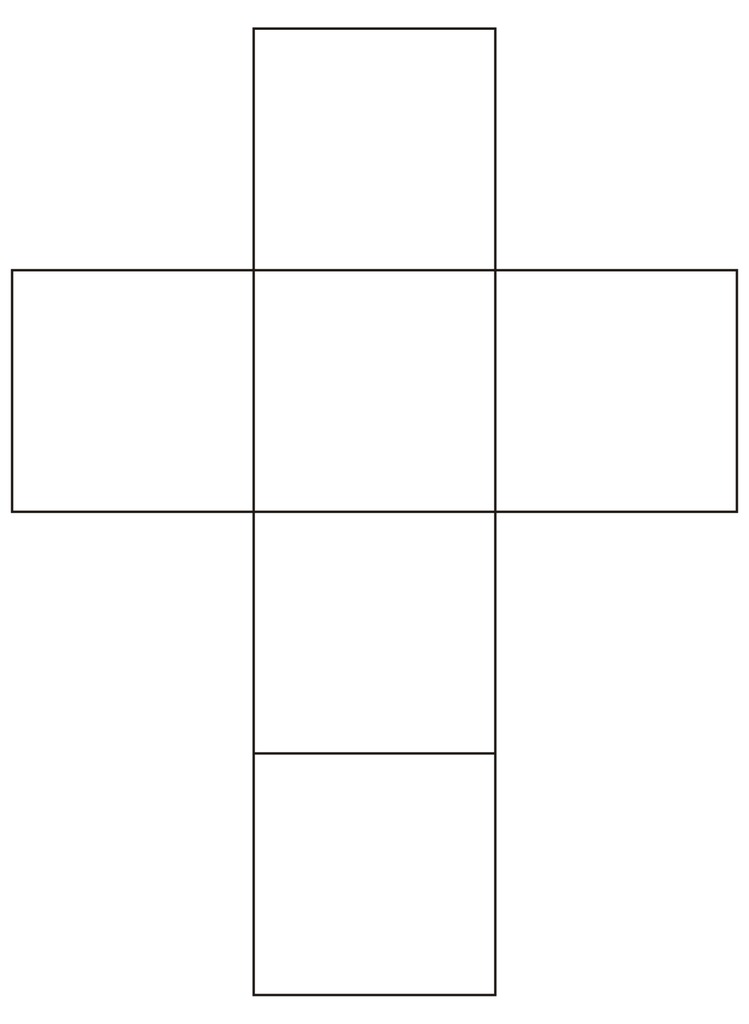
File:Hexahedron flat.svg / Wikimedia Commons, Public domain. Prepared model input from the cited source; see original source for its unmodified file.
- Option 1: The topmost square
- Option 2: The rightmost square
- Option 3: The bottommost square
- Option 4: The leftmost square
VB0088 Inspection against a reference
Image 1 is a reference photograph of four candles. In Image 2, which candle has a clearly visible cluster of dark particles on its wax surface above the wick, unlike the reference candles?
Identify a visible surface difference only; do not infer product safety or hidden damage. Positions refer to the two-by-two arrangement in Image 2.
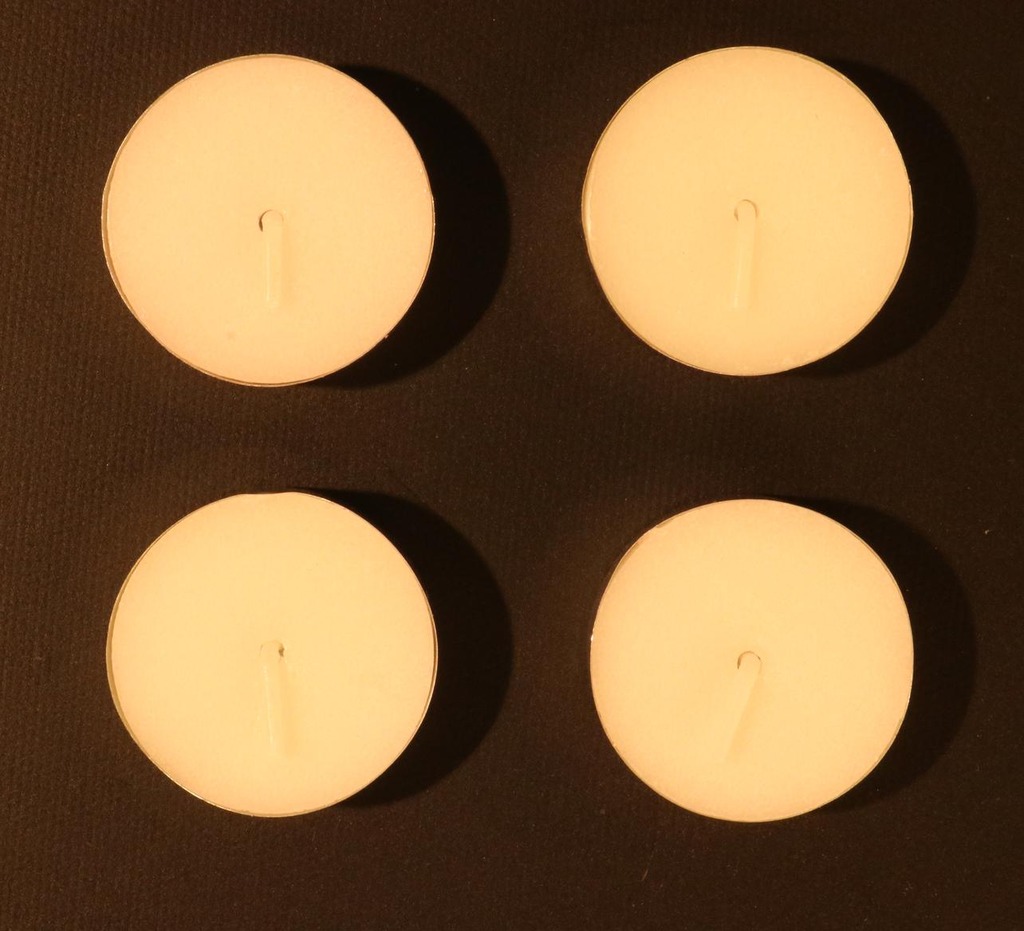
Zou et al., Spot-the-Difference Self-Supervised Pre-training for Anomaly Detection and Segmentation (VisA Dataset), Amazon Science, CC BY 4.0, CC BY 4.0. Prepared model input from the cited source; see original source for its unmodified file.
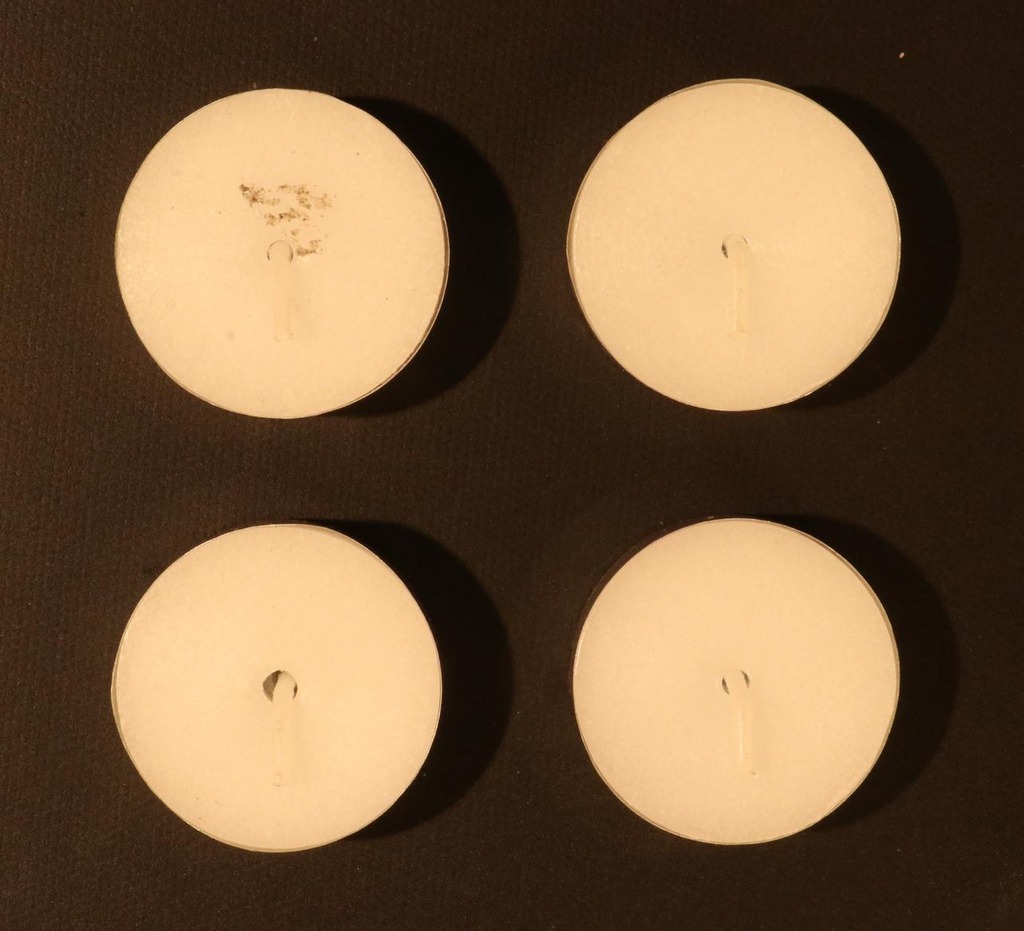
Zou et al., VisA Dataset, Amazon Science, CC BY 4.0, CC BY 4.0. Prepared model input from the cited source; see original source for its unmodified file.
- Option 1: Top-left
- Option 2: Top-right
- Option 3: Bottom-left
- Option 4: Bottom-right
VB0089 Matching across images
Image 1 shows a frontal view of an ancient painted amphora, and Image 2 shows the same amphora viewed from an angle centered on one of its two vertical handles. By matching the painted neck scene, vertical geometric border strips, and lower body figures visible next to the handle in Image 2 against Image 1, which side of Image 1 corresponds to the handle centered in Image 2?
Match specific visible painted features—such as the direction the neck figure faces, the vertical inscription beside its back, and the vertical border strips—between the two views.
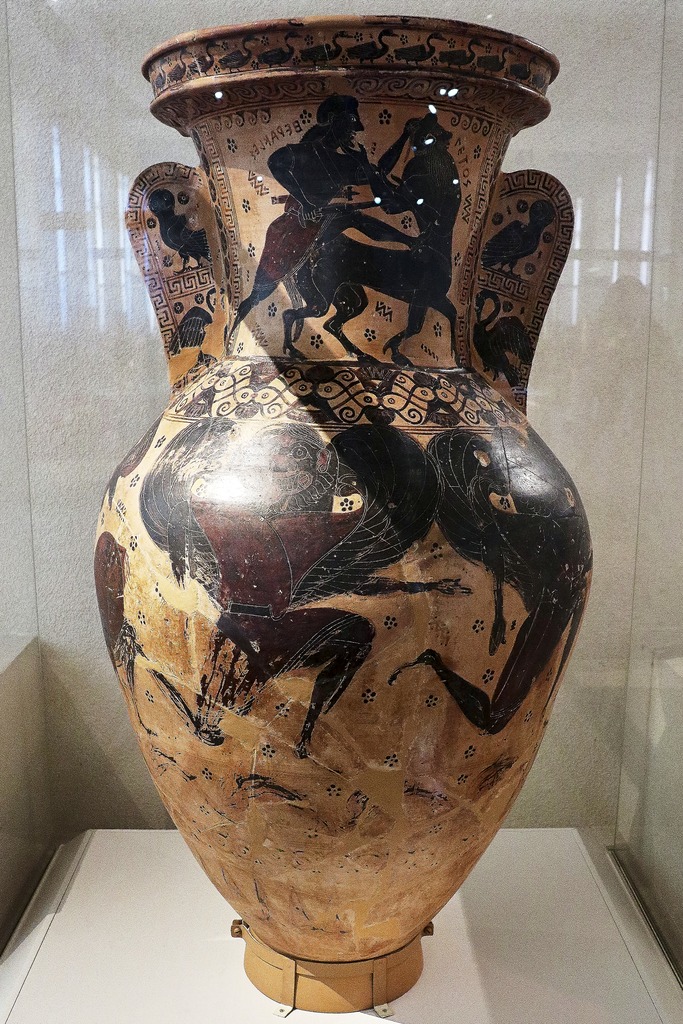
George E. Koronaios / Wikimedia Commons / CC BY-SA 4.0, CC BY-SA 4.0. Prepared model input from the cited source; see original source for its unmodified file.
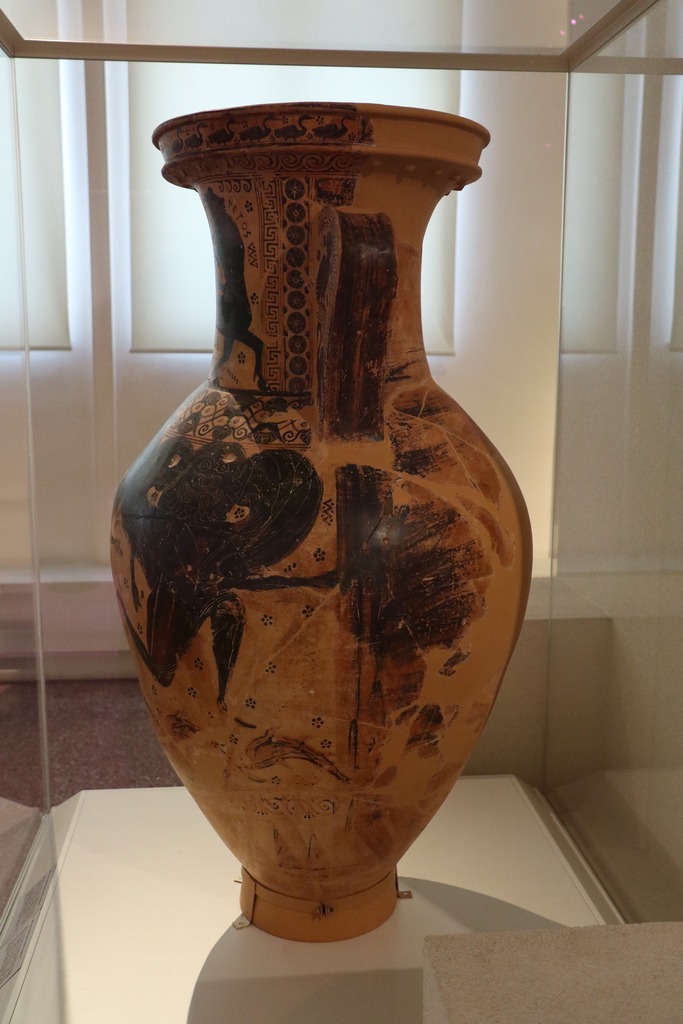
George E. Koronaios / Wikimedia Commons / CC BY-SA 4.0, CC BY-SA 4.0. Prepared model input from the cited source; see original source for its unmodified file.
- Option 1: Neither handle; Image 2 shows a completely unpainted vessel with no matching figures
- Option 2: The right-hand handle of Image 1, with the painted scene from Image 1 appearing to the left of the handle in Image 2
- Option 3: The left-hand handle of Image 1, with the painted scene from Image 1 appearing to the left of the handle in Image 2
- Option 4: The left-hand handle of Image 1, with the painted scene from Image 1 appearing to the right of the handle in Image 2
VB0090 Insufficient evidence
The lower line of the white roadside nameplate is partly covered by vegetation. Which of these complete names can be uniquely established from the visible lettering?
Use only the visible image. Do not use the source title, a map, location knowledge or an inferred completion of covered letters.
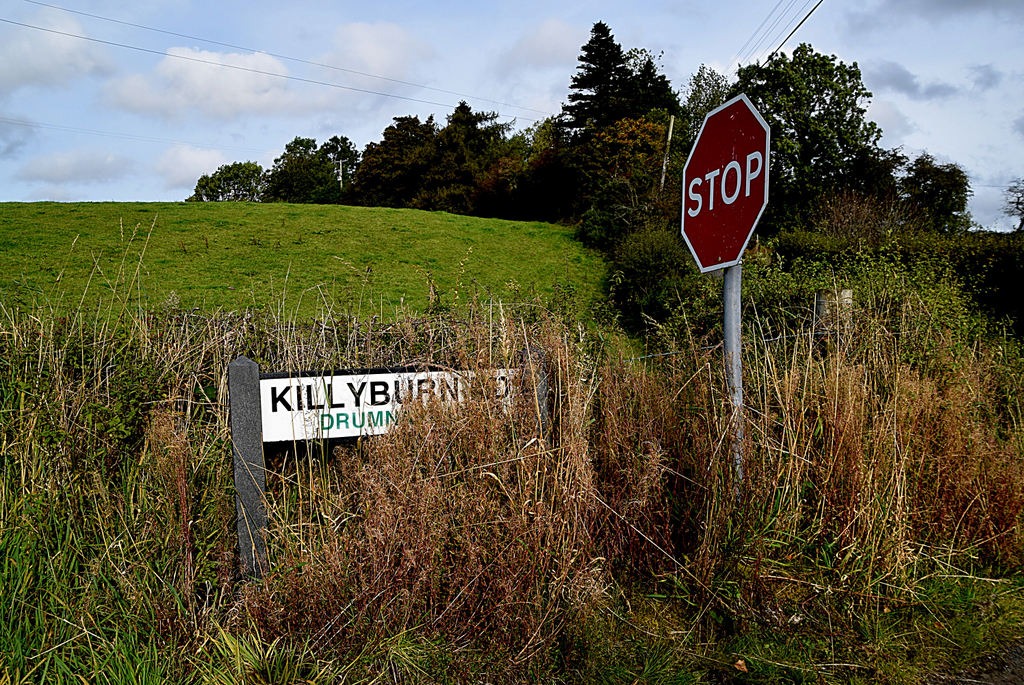
Kenneth Allen / Geograph Britain and Ireland / Wikimedia Commons / CC BY-SA 2.0, CC BY-SA 2.0. Prepared model input from the cited source; see original source for its unmodified file.
- Option 1: DRUMNACROSS
- Option 2: DRUMNAHOE
- Option 3: DRUMNAKILLY
- Option 4: None can be uniquely established because distinguishing letters are covered
VB0091 Insufficient evidence
Which royal cypher can be established from the visible features of the red postbox in this photograph?
Use only a readable emblem on the postbox itself. Do not infer a monarch from the location, casing style, source caption or surrounding buildings.
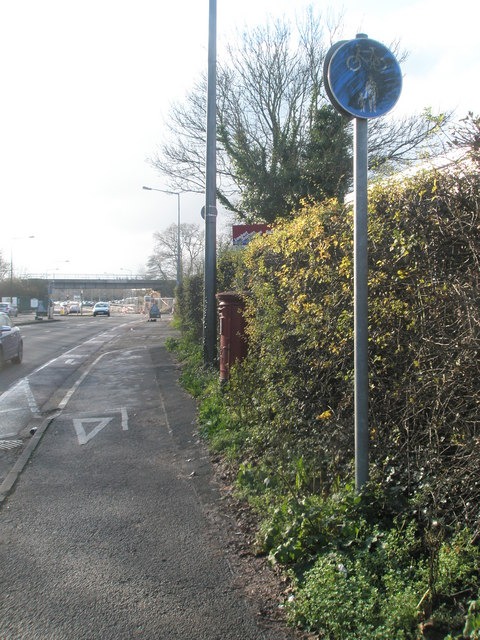
Geograph 1623572 / Wikimedia Commons / CC BY-SA 2.0 (author verification pending), CC BY-SA 2.0. Prepared model input from the cited source; see original source for its unmodified file.
- Option 1: GR VI
- Option 2: EIIR
- Option 3: No particular cypher can be established from the visible image
- Option 4: VR
VB0092 Perspective and knowledge tracking
In this polar visibility chart around a haul truck (where 0 degrees is straight ahead, angles increase clockwise around the outer circle, dashed circles mark distances from 10 ft to 50 ft, grey regions show where the operator cannot see a 6-foot-tall person, and white regions show where the person is visible), at a distance of 40 feet from the center, at which pair of bearings can the operator see a 6-foot-tall person?
Read the bearing angles around the 50-foot outer circle and locate the intersection with the 40-foot dashed concentric circle. Both bearings in the chosen pair must lie in a white (visible) region.
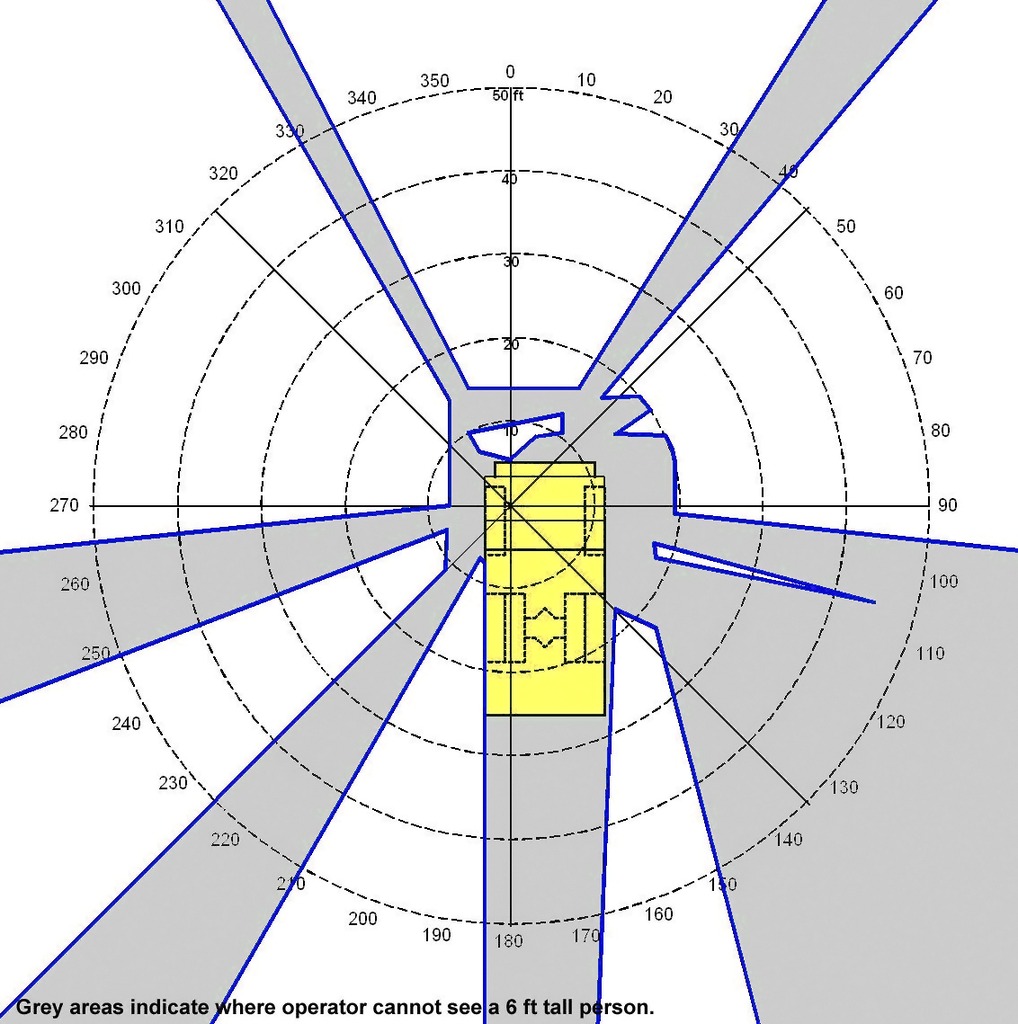
CDC / NIOSH / Public Domain, Public domain. Prepared model input from the cited source; see original source for its unmodified file.
- Option 1: 0 degrees and 280 degrees
- Option 2: 120 degrees and 180 degrees
- Option 3: 140 degrees and 260 degrees
- Option 4: 90 degrees and 130 degrees
VB0093 Attribute binding and set logic
Which object is below the haystack and to the left of the large upright spoked wheel?
Use image directions. Both position requirements must describe the same object.
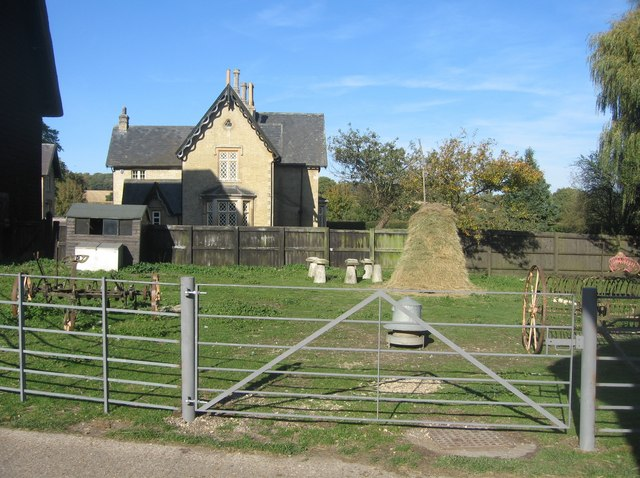
Sebastian Ballard; File:Assortment of farm implements - geograph.org.uk - 1012935.jpg; CC BY-SA 2.0; via Wikimedia Commons, CC BY-SA 2.0. Prepared model input from the cited source; see original source for its unmodified file.
- Option 1: The small white box at the far left
- Option 2: The red spoked wheel near the right edge
- Option 3: The house chimney
- Option 4: The grey cylindrical metal container with a conical lid
VB0094 Conditional counting
Compare the blue circles with all the red and orange circles combined. Which group is larger, and by how many circles?
Count both shades of red in the red group. Count each circle once; the printed 99 is not a color-group count.
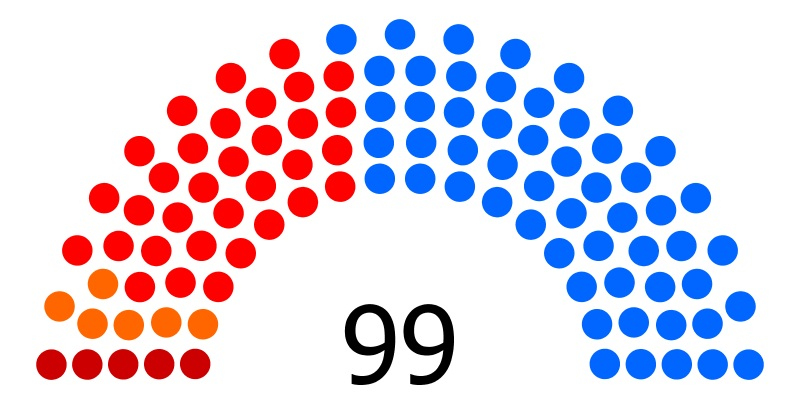
Lluket24; File:Corts 2011.jpg; CC BY-SA 3.0; via Wikimedia Commons, CC BY-SA 3.0. Prepared model input from the cited source; see original source for its unmodified file. Re-encoded for the tested C1 input variant.
- Option 1: Blue by17
- Option 2: Red and orange combined by11
- Option 3: The groups are equal
- Option 4: Blue by11
VB0095 Spatial relationships
What is the minimum number of unit grid steps from the white king to the black rook farthest to the image left?
A step moves one square horizontally or vertically. Ignore chess movement rules, other pieces and obstacles. Use the printed coordinates, including negative numbers.
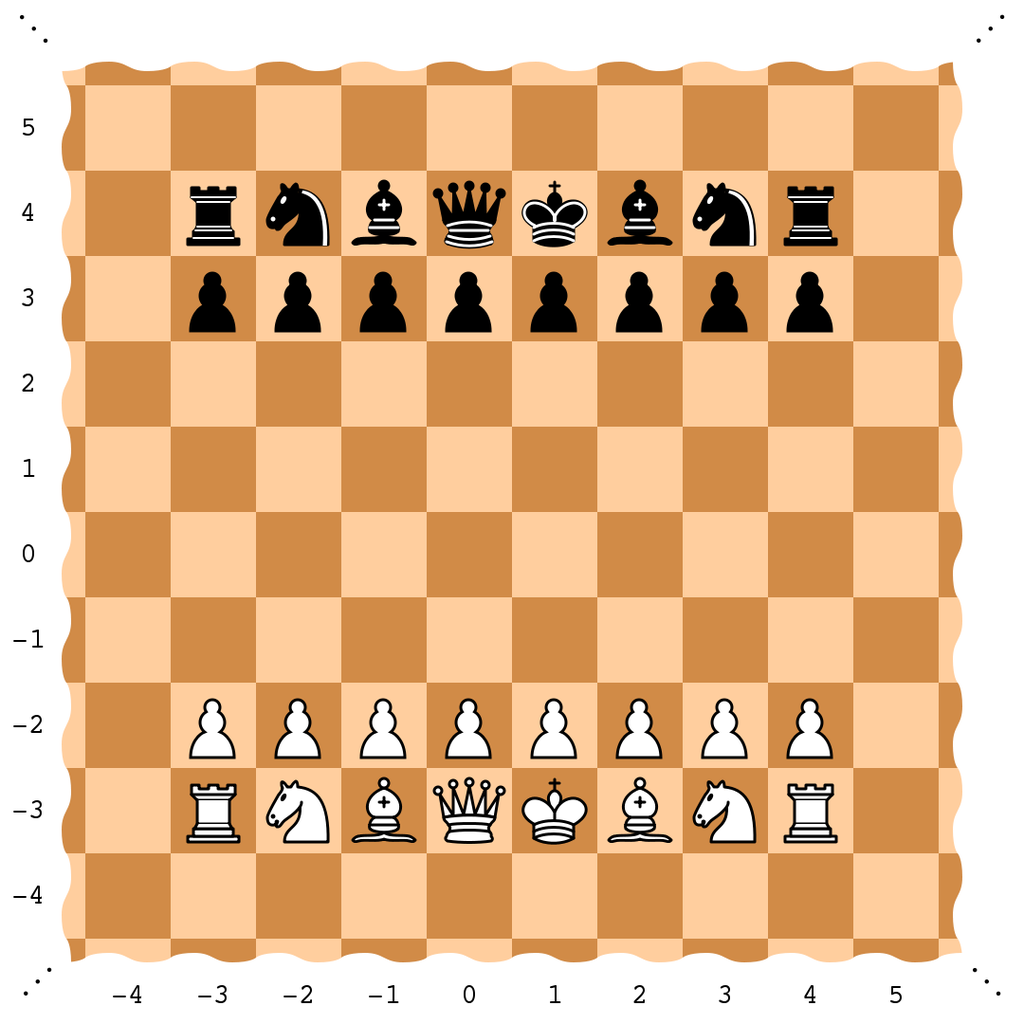
LaundryPizza03; File:Infinite chess.png; CC BY-SA 3.0; via Wikimedia Commons, CC BY-SA 3.0. Prepared model input from the cited source; see original source for its unmodified file. Re-encoded for the tested C1 input variant.
- Option 1: 9
- Option 2: 10
- Option 3: 11
- Option 4: The distance is not established by the image
VB0096 Rotation and reflection
Imagine rotating the whole photograph 90 degrees clockwise. Relative to the cream cube marked K near the upper-right, where would the red cube with the large 8 be after that rotation?
Use positions on the rotated image. Rotate both dice together; do not turn either die separately.
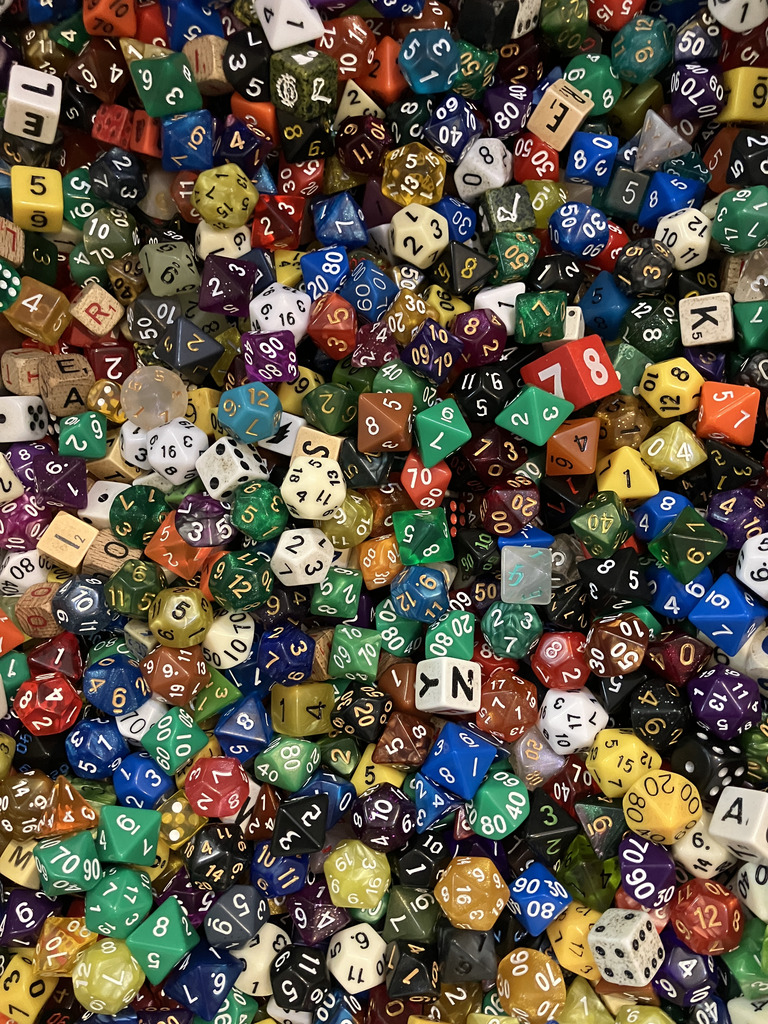
Ironmaidenfun; File:Assorted dice for games, 2024.jpg; CC BY-SA 4.0; via Wikimedia Commons, CC BY-SA 4.0. Prepared model input from the cited source; see original source for its unmodified file. Re-encoded for the tested C1 input variant. Lossy image encoding was visually reviewed before testing.
- Option 1: Below and right
- Option 2: Below and left
- Option 3: Above and right
- Option 4: Above and left
VB0097 Inspection against a reference
Compared with the soft shadows around the reference capsules in Image 1, which capsule in Image 2 has an irregular, sharply bounded black patch extending around its lower edge?
Identify the visible pattern only. Do not infer leakage, chemical contents or product safety.
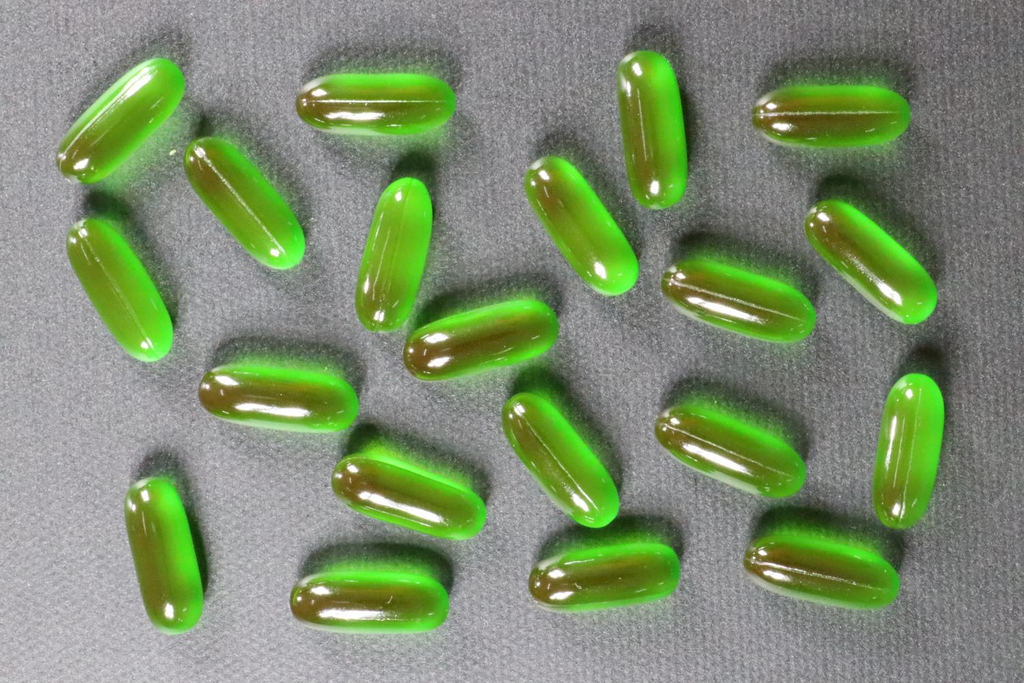
VisA dataset, Yang Zou, Jongheon Jeong, Latha Pemula, Dongqing Zhang and Onkar Dabeer, 2022, CC BY 4.0. Prepared model input from the cited source; see original source for its unmodified file. Re-encoded for the tested C1 input variant.
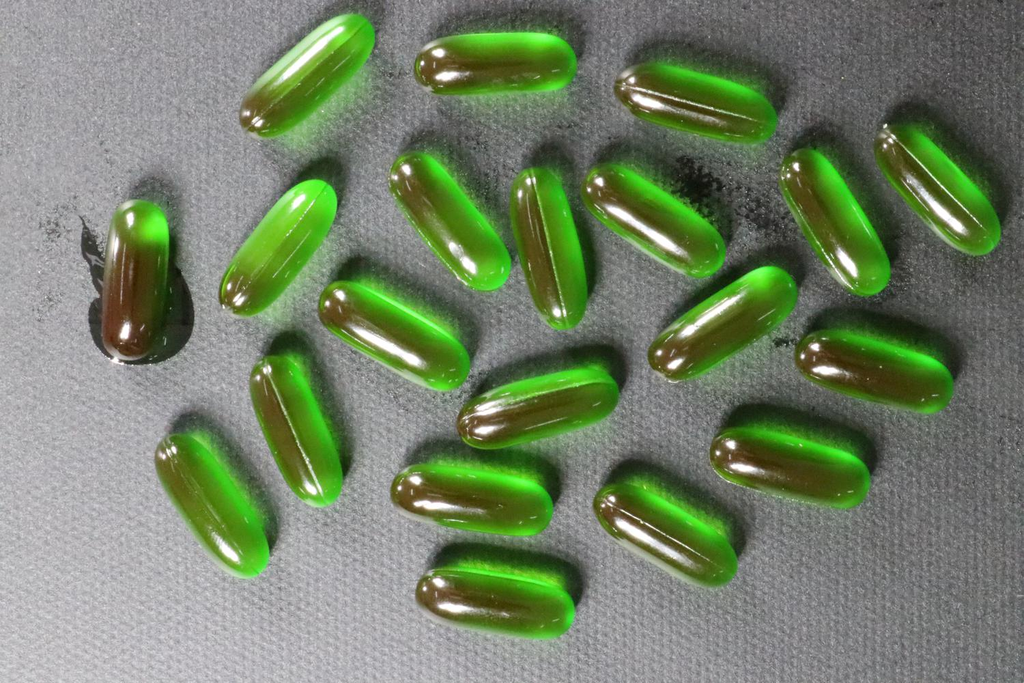
VisA dataset, Yang Zou, Jongheon Jeong, Latha Pemula, Dongqing Zhang and Onkar Dabeer, 2022, CC BY 4.0. Prepared model input from the cited source; see original source for its unmodified file. Re-encoded for the tested C1 input variant.
- Option 1: The far-left nearly upright capsule
- Option 2: The nearly upright capsule near the center
- Option 3: The uppermost horizontal capsule
- Option 4: No capsule has such a patch
VB0098 Inspection against a reference
After matching the printed T and R labels between the two photographs, which visible part is missing in Image 2 compared with Image 1?
The board orientations differ. Match the labels, not just the image-left and image-right positions. Do not infer electrical function.
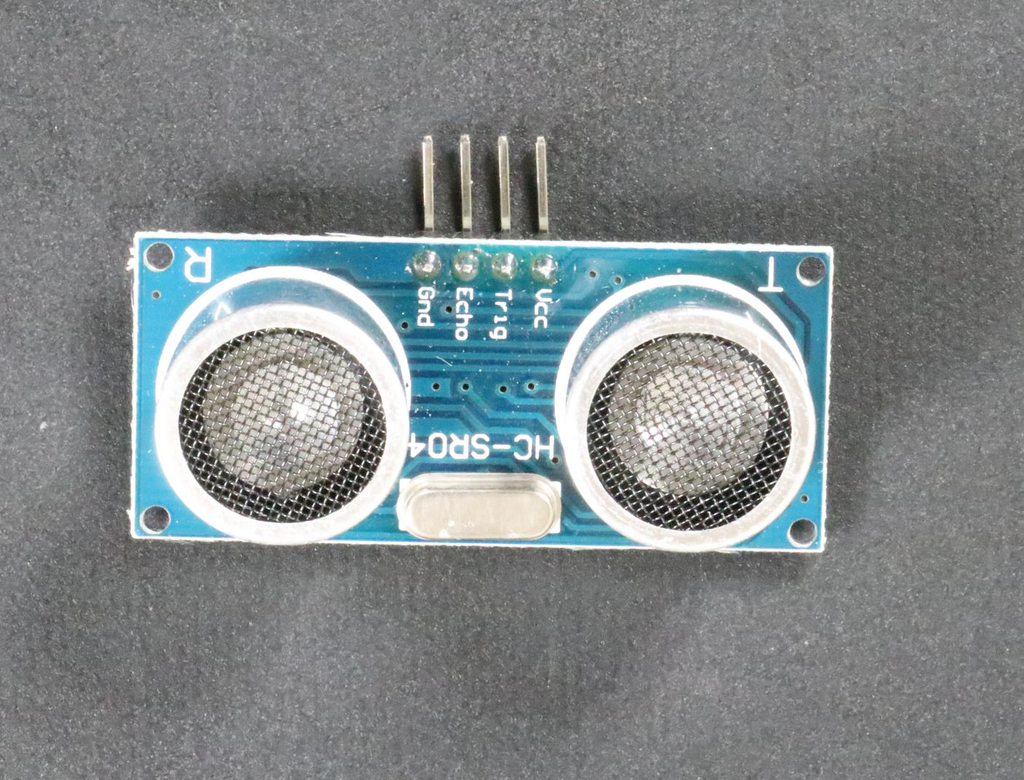
VisA dataset, Yang Zou, Jongheon Jeong, Latha Pemula, Dongqing Zhang and Onkar Dabeer, 2022, CC BY 4.0. Prepared model input from the cited source; see original source for its unmodified file. Re-encoded for the tested C1 input variant.
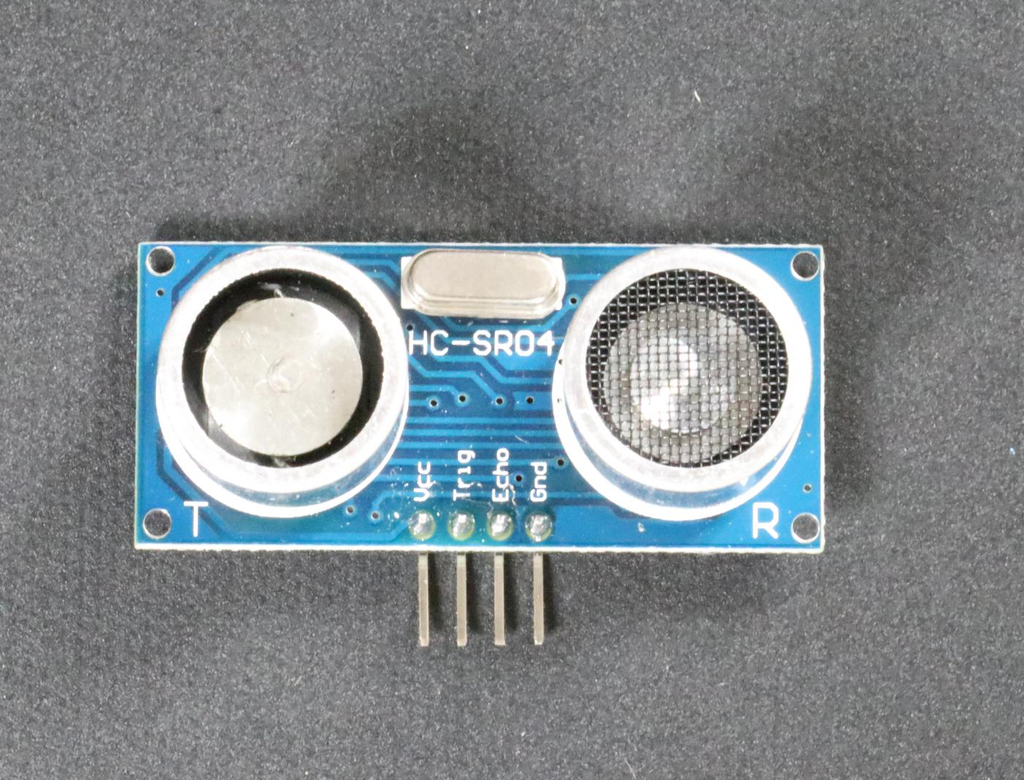
VisA dataset, Yang Zou, Jongheon Jeong, Latha Pemula, Dongqing Zhang and Onkar Dabeer, 2022, CC BY 4.0. Prepared model input from the cited source; see original source for its unmodified file. Re-encoded for the tested C1 input variant.
- Option 1: The outer metal ring of the R-labeled circular unit
- Option 2: The mesh cover of the T-labeled circular unit
- Option 3: The mesh cover of the R-labeled circular unit
- Option 4: The outer metal ring of the T-labeled circular unit
VB0099 Inspection against a reference
Which region of the object in Image 2 has a rough pit that is not present on the smooth reference object in Image 1?
Judge the visible surface, not a proposed cause or whether the object is safe to use.
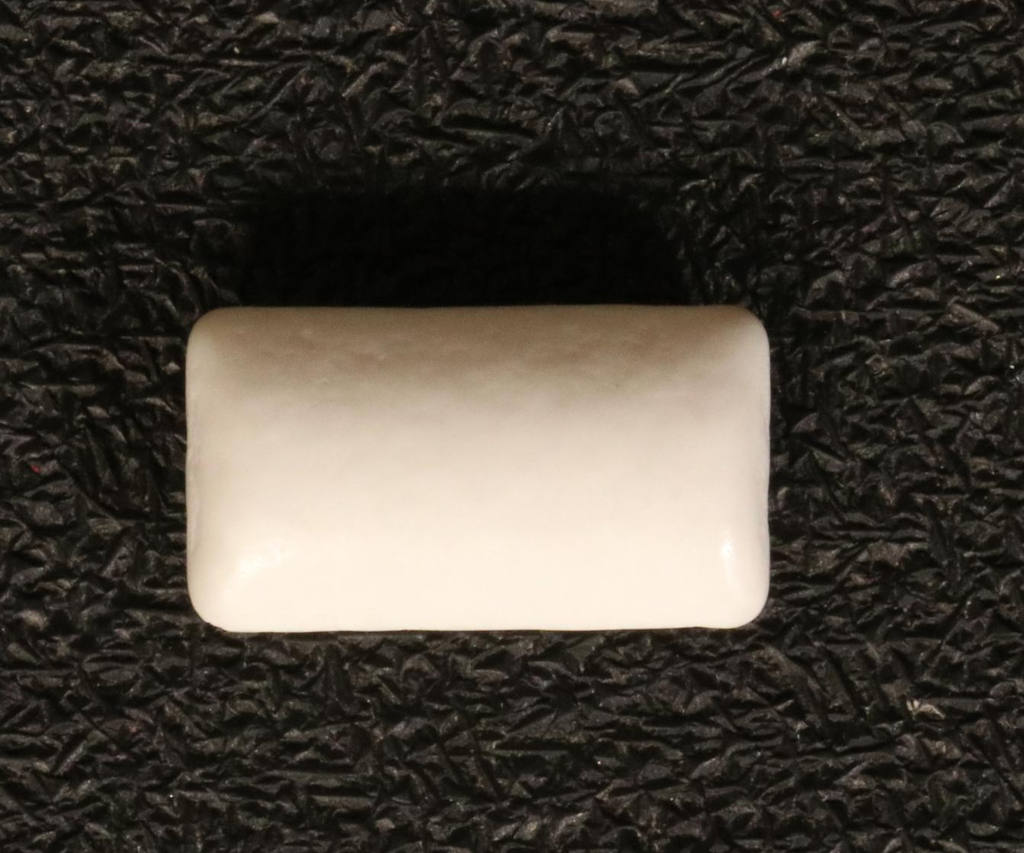
VisA dataset, Yang Zou, Jongheon Jeong, Latha Pemula, Dongqing Zhang and Onkar Dabeer, 2022, CC BY 4.0. Prepared model input from the cited source; see original source for its unmodified file. Re-encoded for the tested C1 input variant.
VisA dataset, Yang Zou, Jongheon Jeong, Latha Pemula, Dongqing Zhang and Onkar Dabeer, 2022, CC BY 4.0. Prepared model input from the cited source; see original source for its unmodified file. Re-encoded for the tested C1 input variant.
- Option 1: The central area of the broad face
- Option 2: Only the far-left outside edge
- Option 3: No rough pit is visible
- Option 4: Only the far-right outside edge
VB0100 Inspection against a reference
For Image 2, which pair of observations is supported when compared with the reference wheel in Image 1?
Check these separately: whether the outside rim has a break, and whether an additional fragment crosses the openings inside the wheel. Ignore ordinary rotation.
VisA dataset, Yang Zou, Jongheon Jeong, Latha Pemula, Dongqing Zhang and Onkar Dabeer, 2022, CC BY 4.0. Prepared model input from the cited source; see original source for its unmodified file. Re-encoded for the tested C1 input variant.
VisA dataset, Yang Zou, Jongheon Jeong, Latha Pemula, Dongqing Zhang and Onkar Dabeer, 2022, CC BY 4.0. Prepared model input from the cited source; see original source for its unmodified file. Re-encoded for the tested C1 input variant.
- Option 1: Rim broken; additional fragment crosses openings
- Option 2: Rim intact; additional fragment crosses openings
- Option 3: Rim intact; no additional fragment
- Option 4: Rim broken; no additional fragment
VB0101 Inspection against a reference
Which pasta piece in Image 2 has a clear pale fracture line crossing its curved body, unlike the unfractured reference pieces in Image 1?
Positions refer to the two-by-two arrangement in Image 2. A change in orientation alone is not a fracture.
VisA dataset, Yang Zou, Jongheon Jeong, Latha Pemula, Dongqing Zhang and Onkar Dabeer, 2022, CC BY 4.0. Prepared model input from the cited source; see original source for its unmodified file. Re-encoded for the tested C1 input variant.
VisA dataset, Yang Zou, Jongheon Jeong, Latha Pemula, Dongqing Zhang and Onkar Dabeer, 2022, CC BY 4.0. Prepared model input from the cited source; see original source for its unmodified file. Re-encoded for the tested C1 input variant.
- Option 1: Top-left
- Option 2: Bottom-left
- Option 3: Top-right
- Option 4: Bottom-right
VB0102 Inspection against a reference
Which component has changed orientation relative to the circuit board in Image 2?
Match the blue square adjuster and the three-pin header first. Compare component directions relative to the board, not the camera. Do not infer electrical performance.
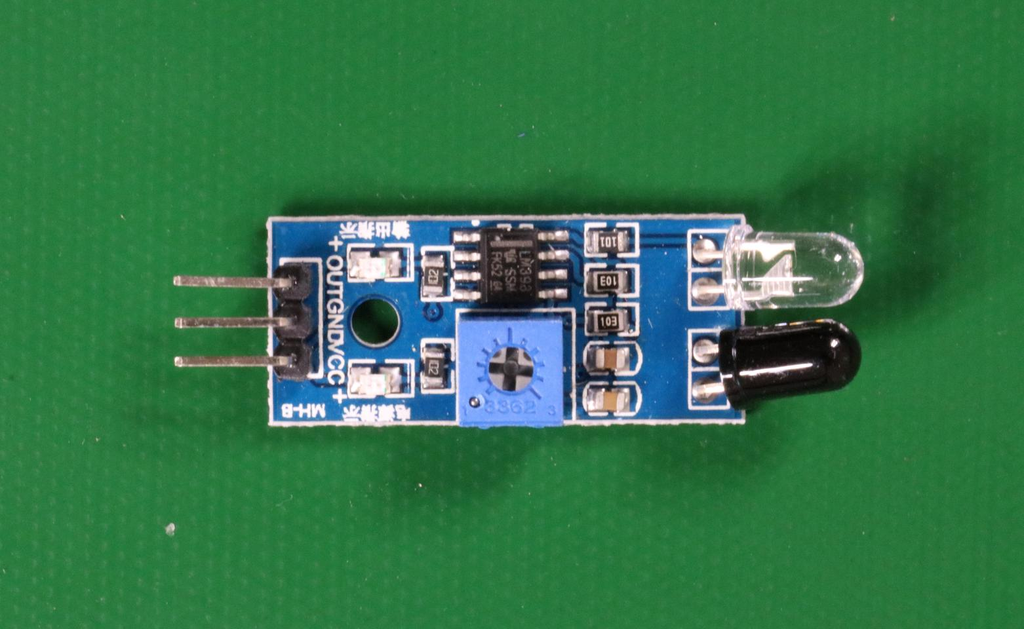
VisA dataset, Yang Zou, Jongheon Jeong, Latha Pemula, Dongqing Zhang and Onkar Dabeer, 2022, CC BY 4.0. Prepared model input from the cited source; see original source for its unmodified file. Re-encoded for the tested C1 input variant.
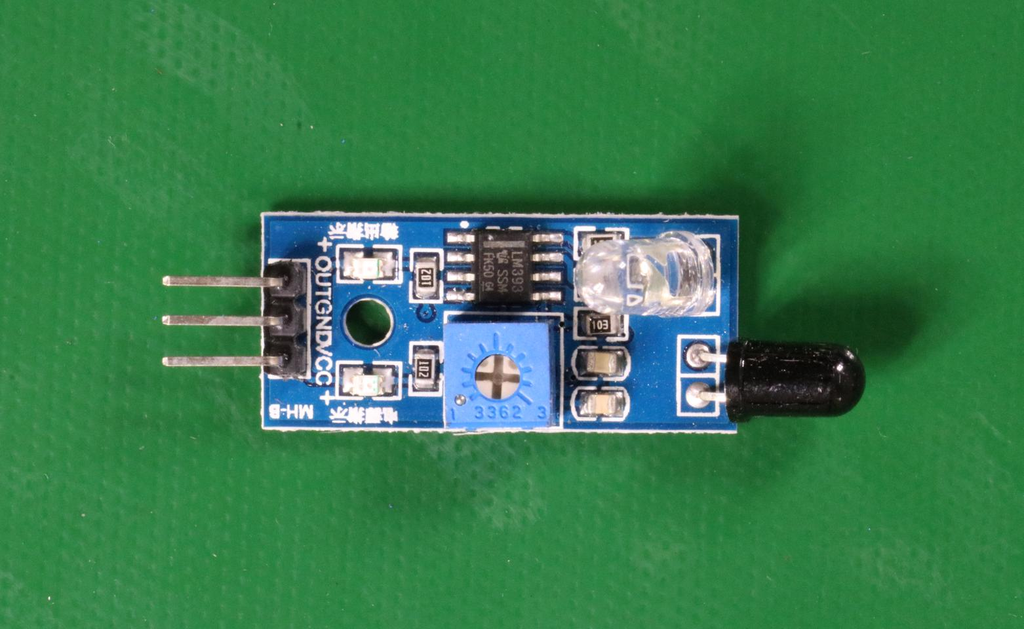
VisA dataset, Yang Zou, Jongheon Jeong, Latha Pemula, Dongqing Zhang and Onkar Dabeer, 2022, CC BY 4.0. Prepared model input from the cited source; see original source for its unmodified file. Re-encoded for the tested C1 input variant.
- Option 1: The three-pin header
- Option 2: The lower black LED
- Option 3: The blue square adjuster
- Option 4: The upper clear LED
VB0103 Inspection against a reference
Which pair of parts is present in the reference board in Image 1 but absent in Image 2?
Align the boards using the USB connector and the IN+/IN- labels. Count visible components, not their empty solder pads.
VisA dataset, Yang Zou, Jongheon Jeong, Latha Pemula, Dongqing Zhang and Onkar Dabeer, 2022, CC BY 4.0. Prepared model input from the cited source; see original source for its unmodified file. Re-encoded for the tested C1 input variant.
VisA dataset, Yang Zou, Jongheon Jeong, Latha Pemula, Dongqing Zhang and Onkar Dabeer, 2022, CC BY 4.0. Prepared model input from the cited source; see original source for its unmodified file. Re-encoded for the tested C1 input variant.
- Option 1: The right-hand tan rectangular component and the small bottom resistor marked 221 in Image 1
- Option 2: The USB connector and the upper R400 resistor
- Option 3: The eight-pin black chip and the right-hand tan rectangular component
- Option 4: The left-hand tan rectangular component and the USB connector
VB0104 Inspection against a reference
Which wall difference is visible in Image 2 compared with the reference tube in Image 1?
Inspect the visible sidewall only. Do not infer hidden damage or how the opening was made.
VisA dataset, Yang Zou, Jongheon Jeong, Latha Pemula, Dongqing Zhang and Onkar Dabeer, 2022, CC BY 4.0. Prepared model input from the cited source; see original source for its unmodified file. Re-encoded for the tested C1 input variant.
VisA dataset, Yang Zou, Jongheon Jeong, Latha Pemula, Dongqing Zhang and Onkar Dabeer, 2022, CC BY 4.0. Prepared model input from the cited source; see original source for its unmodified file. Re-encoded for the tested C1 input variant.
- Option 1: Only a circular dark surface spot, with no opening
- Option 2: A triangular opening with a lifted flap near the lower-right sidewall
- Option 3: No visible difference beyond position
- Option 4: A complete end-to-end split into two separate tube halves
VB0105 Sequential state tracking
Across Images 1, 2 and 3 in that order, how does the visible illuminated fraction of the solar disk change?
Compare the fraction of the disk that is lit, not color, exposure or the amount of black margin around each crop. These are ordered crops from one existing photographic sequence.
Douglas Duncan/IAU OAE (CC BY 4.0); File:Smartphone Partial Eclipse Combined (ann23043r).jpg; CC BY 4.0; via Wikimedia Commons, CC BY 4.0. Prepared model input from the cited source; see original source for its unmodified file. Re-encoded for the tested C1 input variant.
Douglas Duncan/IAU OAE (CC BY 4.0); File:Smartphone Partial Eclipse Combined (ann23043r).jpg; CC BY 4.0; via Wikimedia Commons, CC BY 4.0. Prepared model input from the cited source; see original source for its unmodified file. Re-encoded for the tested C1 input variant.
Douglas Duncan/IAU OAE (CC BY 4.0); File:Smartphone Partial Eclipse Combined (ann23043r).jpg; CC BY 4.0; via Wikimedia Commons, CC BY 4.0. Prepared model input from the cited source; see original source for its unmodified file. Re-encoded for the tested C1 input variant.
- Option 1: It decreases and then increases
- Option 2: It increases and then decreases
- Option 3: It increases at both transitions
- Option 4: It decreases at both transitions
VB0106 Geometry, folding and fit
When this net is folded into its closed convex solid, how many vertices does the solid have?
Every drawn polygon becomes one face. Every completed edge is shared by exactly two faces. You may use V - E + F = 2. Count the actual panels and their sides; no panel disappears or splits.
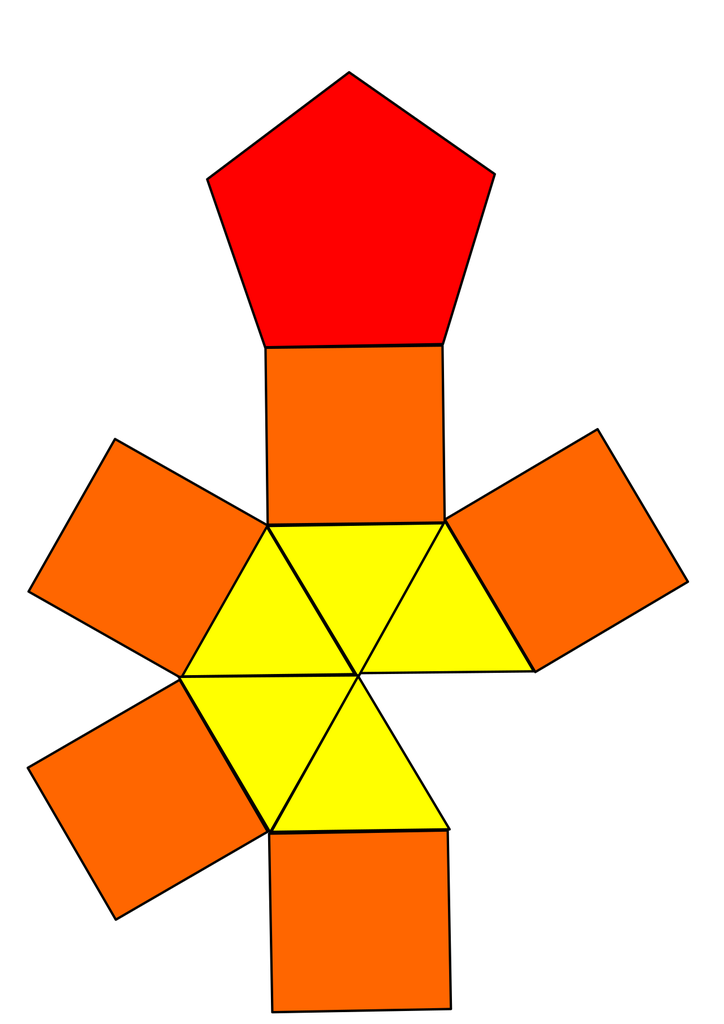
Timeroot; File:Elongated Pentagonal Pyramid Net.svg; CC BY-SA 3.0; via Wikimedia Commons, CC BY-SA 3.0. Prepared model input from the cited source; see original source for its unmodified file.
- Option 1: 8
- Option 2: 10
- Option 3: 11
- Option 4: 12
VB0107 Geometry, folding and fit
After folding the pictured net, how many yellow triangular faces meet at each vertex on a grey base?
The grey polygons form disjoint parallel bases. The equal yellow triangles close into the repeating band between them, with no additional vertices away from the bases.
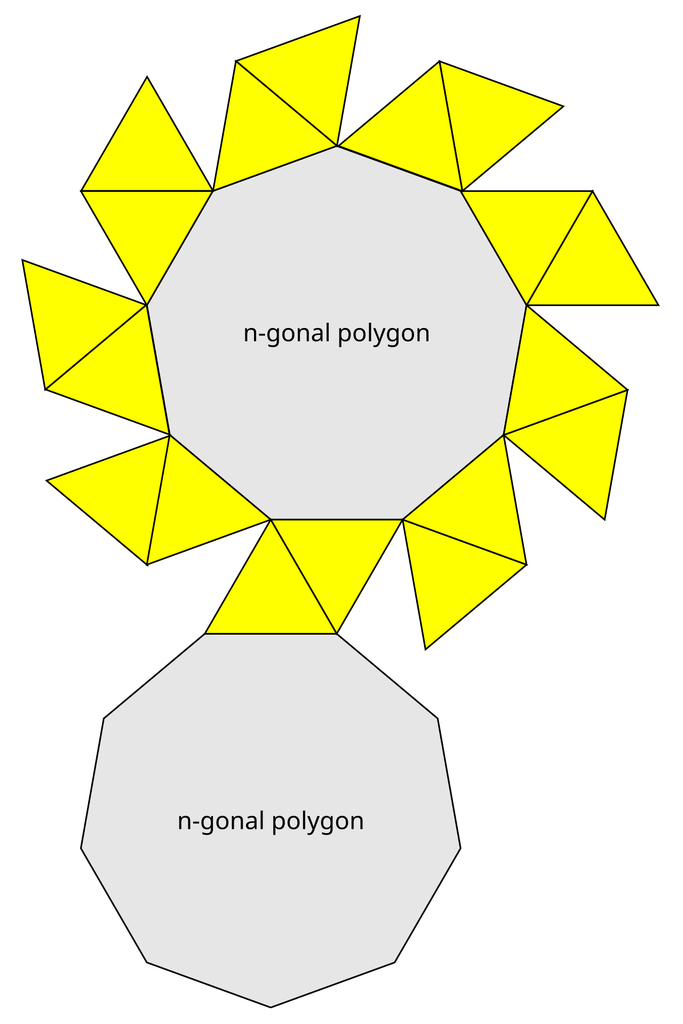
Timeroot; File:Generalized antiprisim net.svg; Public domain; via Wikimedia Commons, Public domain. Prepared model input from the cited source; see original source for its unmodified file.
- Option 1: 2
- Option 2: 3
- Option 3: 4
- Option 4: 6
VB0108 Geometry, folding and fit
How many pairs of cut boundary edges must be joined to close this one-piece net?
Every black shared edge between two panels is already a hinge. Each remaining outside boundary edge must be joined to exactly one other boundary edge. Do not count a hinge as a new join.
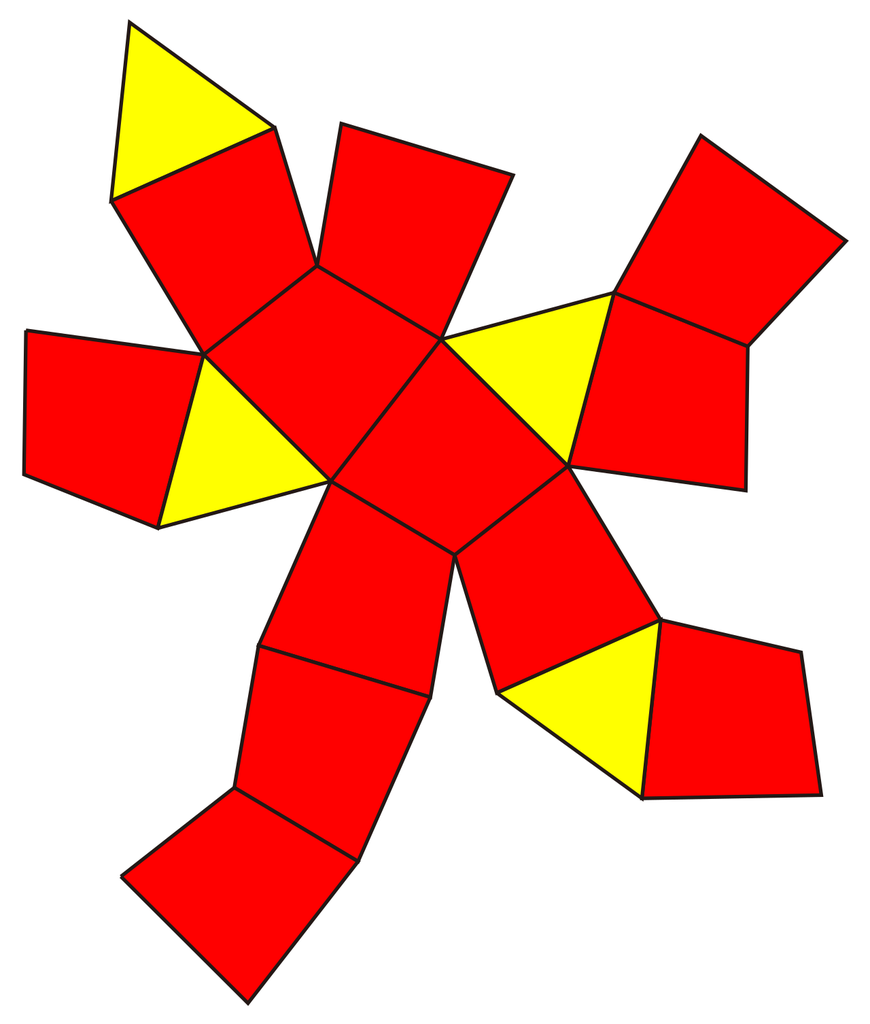
A2569875; File:Net of self-dual form tetrahedrally diminished dodecahedron.svg; CC BY-SA 4.0; via Wikimedia Commons, CC BY-SA 4.0. Prepared model input from the cited source; see original source for its unmodified file. Re-encoded for the tested C1 input variant.
- Option 1: 12
- Option 2: 14
- Option 3: 15
- Option 4: 30
VB0109 Rotation and reflection
Imagine rotating the whole net 180 degrees in the image plane. Relative to the red pentagon that is currently bottommost, where would the red pentagon that is currently topmost lie after the rotation?
Track the same two faces through the rotation. Use directions on the resulting image, not directions on a folded solid.
Cmglee; File:Polyhedron truncated 20 net compact.svg; CC BY-SA 4.0; via Wikimedia Commons, CC BY-SA 4.0. Prepared model input from the cited source; see original source for its unmodified file. Re-encoded for the tested C1 input variant.
- Option 1: Above and left
- Option 2: Above and right
- Option 3: Below and left
- Option 4: Below and right
VB0110 Constraint satisfaction
Starting at the king symbol, which route satisfies all three conditions: exactly four moves, no square visited twice, and a sum of 11 across the numbered squares entered?
Each named direction moves one square, including diagonals. Up is image-up. The starting square counts as visited but contributes zero. Remain inside the drawn grid.
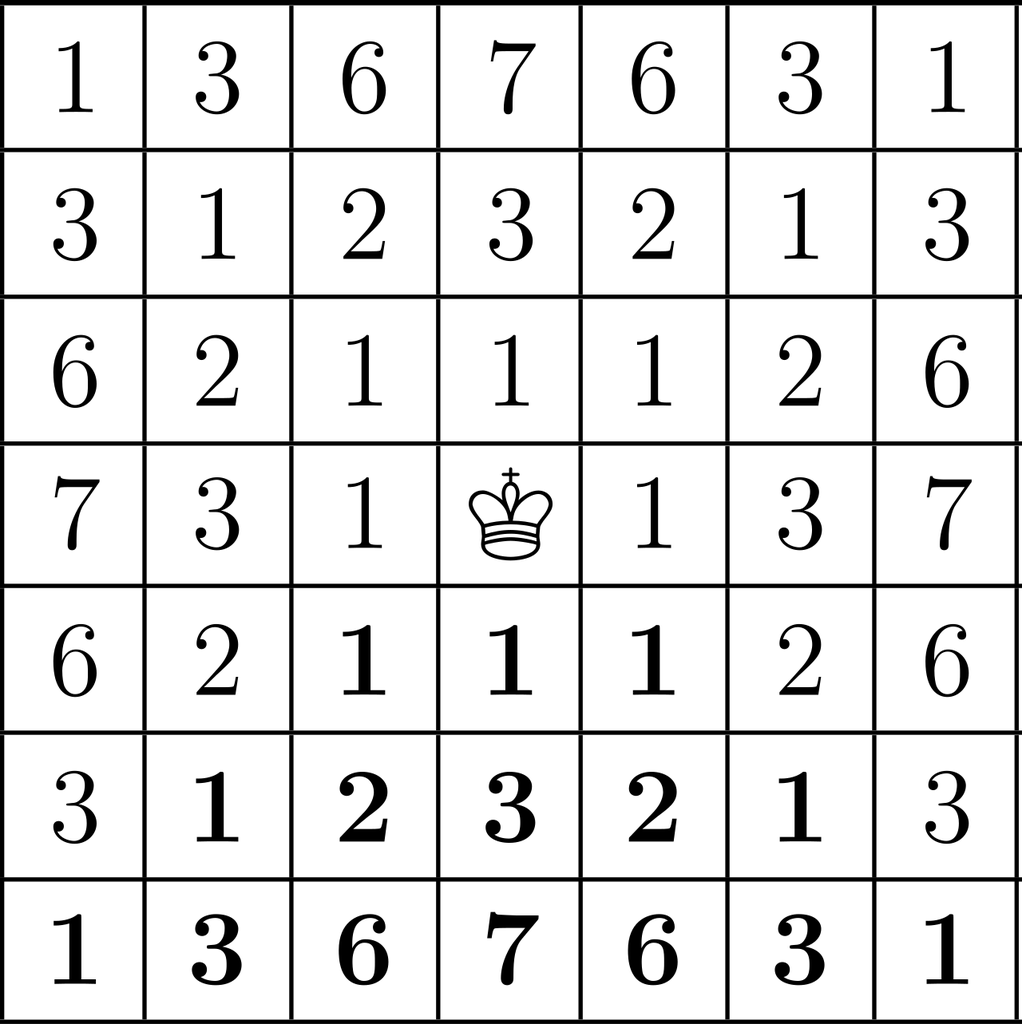
w:de:Benutzer:Gunther; File:King walks.svg; Public domain; via Wikimedia Commons, Public domain. Prepared model input from the cited source; see original source for its unmodified file. Re-encoded for the tested C1 input variant.
- Option 1: Up, up, right, down-right, up-right
- Option 2: Up, up, up, right
- Option 3: Up, up-right, up, down
- Option 4: Up-left, up-left, up-right, down-right
VB0111 Perspective and knowledge tracking
Initially every watcher knows that all three sites display red flags. The rightmost watcher then changes that site to green. A watcher at each tower base observes continuously, with no messages. Which watchers can know that the rightmost flag is now green?
A straight segment between two tower bases is visible only if it does not cross grey terrain. Watchers learn later changes only by seeing or performing them and remember earlier observations. Ignore the green radio-link lines.
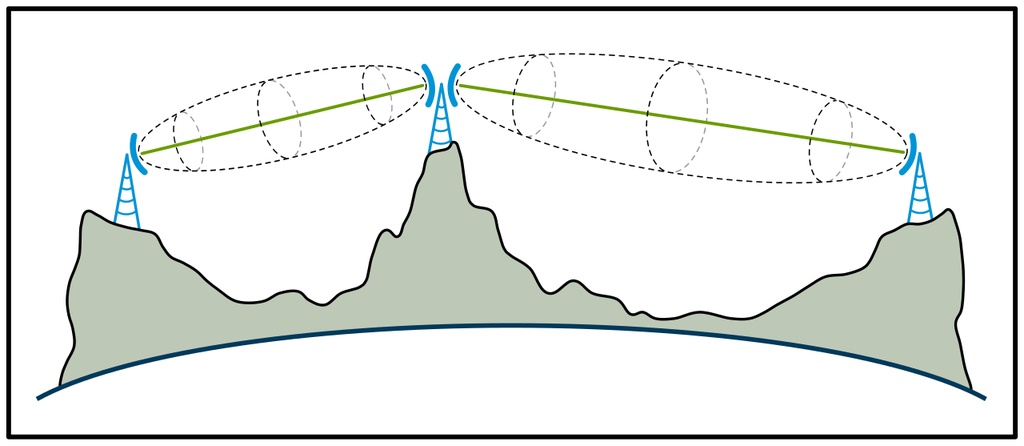
Micogen; File:Line of sight mw transmission.svg; CC BY-SA 3.0; via Wikimedia Commons, CC BY-SA 3.0. Prepared model input from the cited source; see original source for its unmodified file.
- Option 1: Left and right
- Option 2: Middle and right
- Option 3: Left and middle
- Option 4: All three
VB0112 Inspection against a reference
Which pair of pieces in Image 2 both has conspicuous dark purple or black spots on the broad curved surfaces, unlike the reference pieces in Image 1?
Compare visible surface marks. Do not count background texture, shadows or the dark hollow cut ends. Positions refer to Image 2.
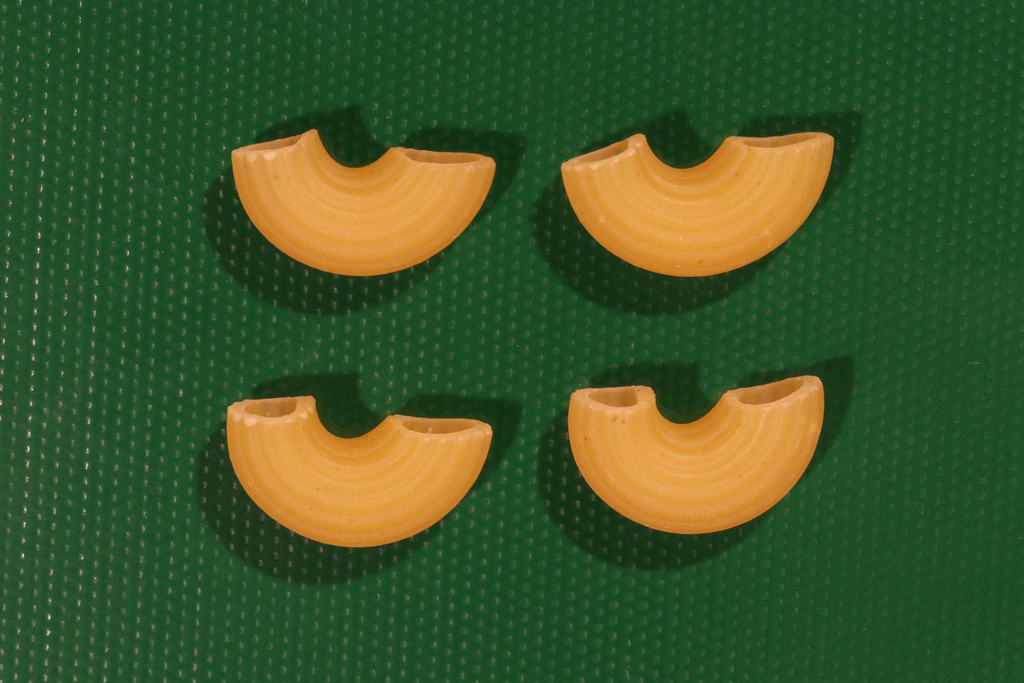
VisA dataset, Yang Zou, Jongheon Jeong, Latha Pemula, Dongqing Zhang and Onkar Dabeer, 2022, CC BY 4.0. Prepared model input from the cited source; see original source for its unmodified file. Re-encoded for the tested C1 input variant.
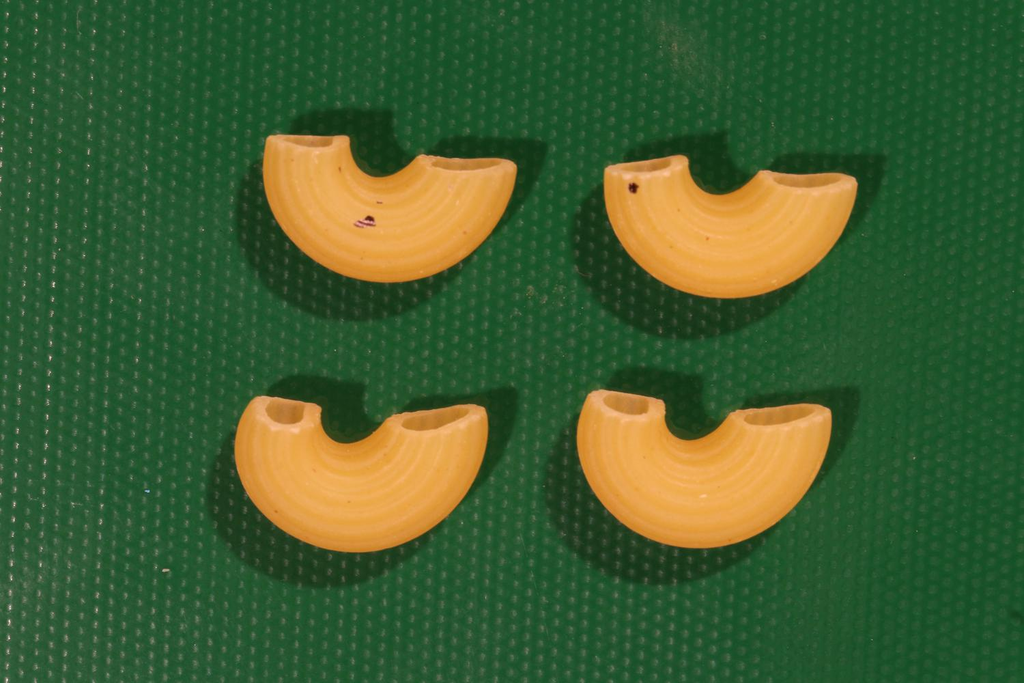
VisA dataset, Yang Zou, Jongheon Jeong, Latha Pemula, Dongqing Zhang and Onkar Dabeer, 2022, CC BY 4.0. Prepared model input from the cited source; see original source for its unmodified file. Re-encoded for the tested C1 input variant.
- Option 1: The left column
- Option 2: The bottom row
- Option 3: The right column
- Option 4: The top row
VB0113 Sequential state tracking
Which visible change occurs between Images 2 and 3 in this ordered frog-jump sequence?
Track the main frog. Describe the pictured limb and body positions only; do not predict forces or infer an unseen frame.
Li et al;; File:Frame-Sequence-of-Rana-dybowskii-Jump.jpg; CC BY 4.0; via Wikimedia Commons, CC BY 4.0. Prepared model input from the cited source; see original source for its unmodified file. Re-encoded for the tested C1 input variant.
Li et al;; File:Frame-Sequence-of-Rana-dybowskii-Jump.jpg; CC BY 4.0; via Wikimedia Commons, CC BY 4.0. Prepared model input from the cited source; see original source for its unmodified file. Re-encoded for the tested C1 input variant.
Li et al;; File:Frame-Sequence-of-Rana-dybowskii-Jump.jpg; CC BY 4.0; via Wikimedia Commons, CC BY 4.0. Prepared model input from the cited source; see original source for its unmodified file. Re-encoded for the tested C1 input variant.
- Option 1: Hind legs move under the body while the front of the body rises
- Option 2: Hind legs move under the body while the front of the body lowers
- Option 3: Hind legs move above the back while the front of the body rises
- Option 4: Hind legs move from roughly behind the body to above its back while the front of the body lowers
VB0114 Sequential state tracking
Which sequence describes the main frog's visible hind-leg configurations across Images 1, 2 and 3?
Use the supplied image order and the coarse pictured configurations, not exact joint angles or inferred contact with the floor.
Li et al;; File:Frame-Sequence-of-Xenopus-Laevis-Jump.jpg; CC BY 4.0; via Wikimedia Commons, CC BY 4.0. Prepared model input from the cited source; see original source for its unmodified file. Re-encoded for the tested C1 input variant.
Li et al;; File:Frame-Sequence-of-Xenopus-Laevis-Jump.jpg; CC BY 4.0; via Wikimedia Commons, CC BY 4.0. Prepared model input from the cited source; see original source for its unmodified file. Re-encoded for the tested C1 input variant.
Li et al;; File:Frame-Sequence-of-Xenopus-Laevis-Jump.jpg; CC BY 4.0; via Wikimedia Commons, CC BY 4.0. Prepared model input from the cited source; see original source for its unmodified file. Re-encoded for the tested C1 input variant.
- Option 1: Folded under body; split in different directions; extended back in roughly similar directions
- Option 2: Extended back in roughly similar directions; folded under body; split in different directions
- Option 3: Folded under body; extended back in roughly similar directions; split with one leg angled upward
- Option 4: Split in different directions; extended back in roughly similar directions; folded under body
VB0115 Rotation and reflection
Keeping the narrow projecting neck at the top, which transformation best matches the outline of the left seal photograph to the outline of the right one?
Allow translation and small scale differences. Compare the asymmetric outer silhouette, not the surface cracks or the ruler. Do not turn the neck downward.
Birmingham Museums Trust, Caroline Johnson, 2007-07-05 13:48:13; File:Medieval - Post Medieval bag seal (front and back views) (FindID 182369).jpg; CC BY-SA 2.0; via Wikimedia Commons, CC BY-SA 2.0. Prepared model input from the cited source; see original source for its unmodified file. Re-encoded for the tested C1 input variant.
- Option 1: An up-down reflection
- Option 2: A 180-degree rotation
- Option 3: Translation only, with no reflection
- Option 4: A left-right reflection
VB0116 Matching across images
Which region in the right drawing corresponds to the broad layered hat crown at the top of the left drawing?
Match the concentric curved bands and the irregular straw fringe. Do not match by the color of the long hanging ribbons alone.
Auguste Félix; File:Two Views (Side and Front) of a Hat on a Stand (IA mma two views side and front of a hat on a stand 387445).jpg; Public domain; via Wikimedia Commons, Public domain. Prepared model input from the cited source; see original source for its unmodified file. Re-encoded for the tested C1 input variant. Lossy image encoding was visually reviewed before testing.
- Option 1: The oval spiral-banded form above the fringe
- Option 2: The crossed pale ribbons at the bottom
- Option 3: The small side bow beside the post
- Option 4: The narrow brown turned post in the center
VB0117 Conditional counting
How many of the bird's feet are visibly in contact with the branch?
Count feet, not individual toes. Use visible contact only; do not infer flight, motion or hidden legs.
Francis C. Franklin; File:Blue tit front and back-lit.jpg; CC BY-SA 3.0; via Wikimedia Commons, CC BY-SA 3.0. Prepared model input from the cited source; see original source for its unmodified file. Re-encoded for the tested C1 input variant. Lossy image encoding was visually reviewed before testing.
- Option 1: 0
- Option 2: 1
- Option 3: 2
- Option 4: The photograph does not establish the number
VB0118 Geometry, folding and fit
After this net is folded into its closed solid, what do the red and yellow-green triangular faces share?
Fold along the polygon edges without cutting, stretching or overlapping panels. The two colored triangles remain distinct faces.
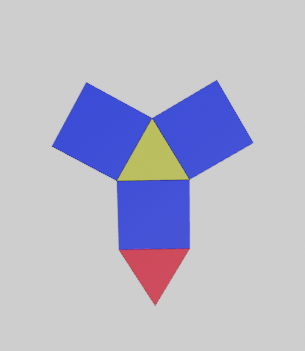
IcosaMarty343; File:Triangular prism net.png; CC0; via Wikimedia Commons, CC0. Prepared model input from the cited source; see original source for its unmodified file. Re-encoded for the tested C1 input variant.
- Option 1: Neither an edge nor a vertex
- Option 2: One vertex but no edge
- Option 3: A whole edge
VB0119 Geometry, folding and fit
After folding, how many yellow faces share an edge with both green faces?
Close the pictured prism without overlapping panels. Blue outlines define face edges; ignore faint white rendering hairlines inside a green panel.
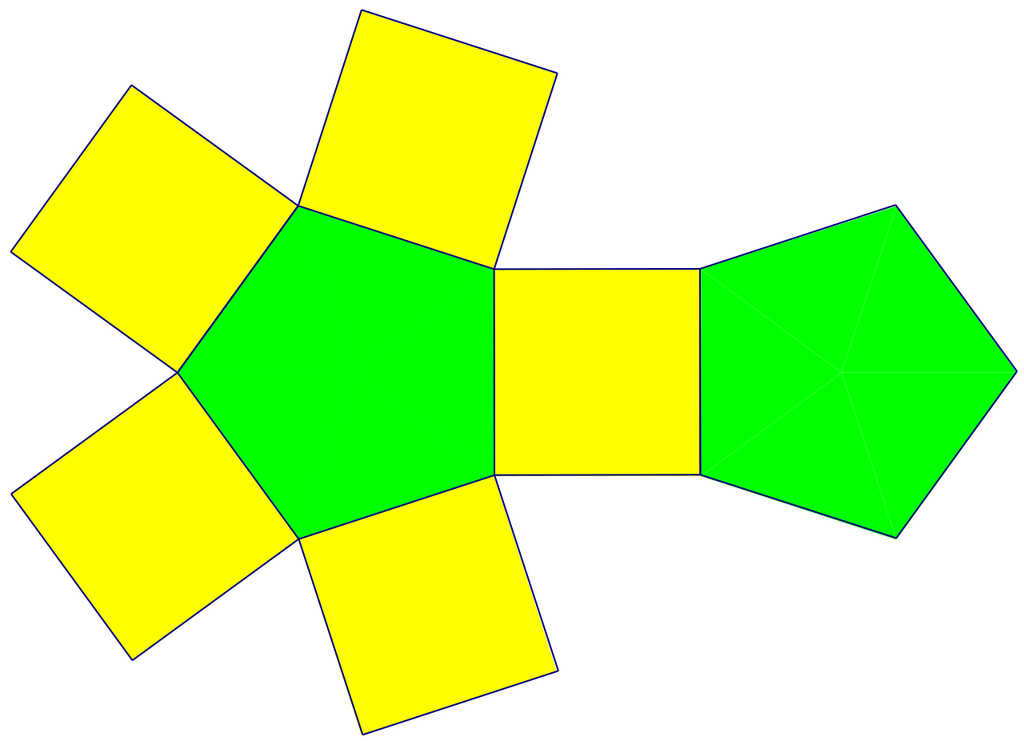
A2569875; File:Net of pentagonal prism.svg; Public domain; via Wikimedia Commons, Public domain. Prepared model input from the cited source; see original source for its unmodified file. Re-encoded for the tested C1 input variant.
- Option 1: 1
- Option 2: 2
- Option 3: 3
- Option 4: 5
VB0120 Geometry, folding and fit
When this net is folded, how does the total yellow surface area compare with the total pink surface area?
All pictured triangular faces are congruent. No face overlaps another in the completed solid.
David Eppstein; File:Triaugmented triangular prism (symmetric net).svg; CC0; via Wikimedia Commons, CC0. Prepared model input from the cited source; see original source for its unmodified file. Re-encoded for the tested C1 input variant.
- Option 1: Yellow is three times pink
- Option 2: Yellow is six times pink
- Option 3: Yellow is twice pink
- Option 4: The areas are equal
VB0121 Geometry, folding and fit
Using other pieces from this dissection, which choice can exactly cover the central purple square?
Pieces may be moved, rotated and reflected, but not cut, stretched or overlapped. Match both area and shape, not area alone.
Sarang; File:Tangram diagram.svg; Public domain; via Wikimedia Commons, Public domain. Prepared model input from the cited source; see original source for its unmodified file.
- Option 1: The yellow and pink small triangles together
- Option 2: The red parallelogram alone
- Option 3: The yellow small triangle and the golden triangle together
- Option 4: The large golden triangle at bottom-right alone
VB0122 Perspective and knowledge tracking
The watcher at the white point initially records both flags as red. Flag A at(10% width,15% height) changes to green; flag B at(50% width,25% height) changes to blue. With no messages, what colors remain in the watcher's record?
Coordinates start at the image top-left. Yellow is visible to the white point; grey is hidden by the black barriers. A recorded color changes only when the watcher sees that flag change.
Dllu; File:Visibility polygon for a point among segments.svg; CC0; via Wikimedia Commons, CC0. Prepared model input from the cited source; see original source for its unmodified file. Re-encoded for the tested C1 input variant.
- Option 1: A red, B red
- Option 2: A green, B blue
- Option 3: A green, B red
- Option 4: A red, B blue
VB0123 Perspective and knowledge tracking
At moment1 a marker at(50% width,20% height) is red. At moment2 it is at(75%,20%) and turns blue. At moment3 it is at(50%,80%) and remains blue. When can the watcher at the white point first record it as blue?
Coordinates start at the top-left. The watcher observes only at the three stated moments, with no observations between them. Yellow is visible and grey hidden. Only a visible marker can update its recorded color.
Dllu; File:Visibility polygon for a point in a simple polygon 1.svg; CC0; via Wikimedia Commons, CC0. Prepared model input from the cited source; see original source for its unmodified file.
- Option 1: Moment2
- Option 2: At none of these moments
- Option 3: Moment1
- Option 4: Moment3
VB0124 Matching across images
Which side wall of the building-like case in Image1 is revealed in Image2, in addition to its front?
Define the front by the large central lower door and curved balcony in Image1. Left and right refer to that front-on view. Match those features before deciding.
National Museum of American History; perfume case, CC0. Prepared model input from the cited source; see original source for its unmodified file. Re-encoded for the tested C1 input variant. Lossy image encoding was visually reviewed before testing.
National Museum of American History; perfume case, CC0. Prepared model input from the cited source; see original source for its unmodified file. Re-encoded for the tested C1 input variant. Lossy image encoding was visually reviewed before testing.
- Option 1: The back wall
- Option 2: The right side wall
- Option 3: Only the front is shown; no side wall is revealed
- Option 4: The left side wall
VB0125 Matching across images
Which button in the horizontal row of six in Image2 matches the detailed button in Image1?
Count positions from image-left. Match the arrangement of carved fruit, flower and leaves, not just the ivory color or the rim.
Cooper Hewitt, Smithsonian Design Museum; Button, CC0. Prepared model input from the cited source; see original source for its unmodified file. Re-encoded for the tested C1 input variant. Lossy image encoding was visually reviewed before testing.
Cooper Hewitt, Smithsonian Design Museum; Button, CC0. Prepared model input from the cited source; see original source for its unmodified file. Re-encoded for the tested C1 input variant. Lossy image encoding was visually reviewed before testing.
- Option 1: First
- Option 2: Fifth
- Option 3: Second
- Option 4: Fourth
VB0126 Matching across images
Which of the four figures in Image2 belongs to the object shown alone in Image1?
Order the figures by their head positions from image-left to image-right. Match the raised arm, cup position and surrounding scrollwork; do not rely on ceramic color alone.
Cooper Hewitt, Smithsonian Design Museum; Taperstick (One of Four), CC0. Prepared model input from the cited source; see original source for its unmodified file. Re-encoded for the tested C1 input variant.
Cooper Hewitt, Smithsonian Design Museum; Taperstick (One of Four), CC0. Prepared model input from the cited source; see original source for its unmodified file.
- Option 1: Fourth
- Option 2: Third
- Option 3: Second
- Option 4: First
VB0127 Attribute binding and set logic
What color is the large oval painted mark that is above the protruding face and between the upper red roundel and the handle?
Use image positions and bind all location requirements to the same painted mark. Do not count the many small leaf-shaped marks as large medallions.
Cooper Hewitt, Smithsonian Design Museum; Jug, CC0. Prepared model input from the cited source; see original source for its unmodified file. Re-encoded for the tested C1 input variant.
- Option 1: Purple
- Option 2: Black
- Option 3: Red
- Option 4: Turquoise green
VB0128 Insufficient evidence
Which geographic compass direction does the flower's stem extend toward in this photograph?
Geographic north/east/south/west are not image-up/right/down/left. Use only the supplied picture, not a source location, metadata or an assumed camera heading.
Sharon Mollerus; File:Rose in Three Views (Close) (2536313844).jpg; CC BY 2.0; via Wikimedia Commons, CC BY 2.0. Prepared model input from the cited source; see original source for its unmodified file. Re-encoded for the tested C1 input variant. Lossy image encoding was visually reviewed before testing.
- Option 1: North
- Option 2: West
- Option 3: South
- Option 4: East
- Option 5: The geographic direction is not established
VB0129 Conditional counting
How many elongated brown basket-weave pendants with gold tips are visible across the pair of earrings?
Exclude the nearly round brown connector directly under each pair of leaves, the metal leaf mounts, and the hooks. Count each elongated pendant once.
Cooper Hewitt, Smithsonian Design Museum; Pair of earrings, CC0. Prepared model input from the cited source; see original source for its unmodified file. Re-encoded for the tested C1 input variant.
- Option 1: 8
- Option 2: 10
- Option 3: 12
- Option 4: 14
VB0130 Matching across images
Which part in Image2 corresponds to the small curl projecting to the left of the coil at mid-height in Image1?
Match the physical attachment to the coil and distinguish the short curl from the long outer arm and the feet. Camera direction changes between photographs.
Cooper Hewitt, Smithsonian Design Museum; Candle holder, CC0. Prepared model input from the cited source; see original source for its unmodified file. Re-encoded for the tested C1 input variant.
Cooper Hewitt, Smithsonian Design Museum; Candle holder, CC0. Prepared model input from the cited source; see original source for its unmodified file. Re-encoded for the tested C1 input variant.
- Option 1: The curled foot at bottom-left
- Option 2: The curl at the lower end of the long outer arm
- Option 3: The short curl beside the upper-middle coil, projecting right
- Option 4: The curled foot at bottom-right
VB0131 Matching across images
In Image2, which image direction leads from the two threaded posts toward the dial face shown front-on in Image1?
Match the circular dial rim to the rim in the side view. Use image directions, not a compass heading. No judgment about instrument operation is required.
National Air and Space Museum; Indicator, Cylinder Head Temperature, Japanese, CC0. Prepared model input from the cited source; see original source for its unmodified file. Re-encoded for the tested C1 input variant.
National Air and Space Museum; Indicator, Cylinder Head Temperature, Japanese, CC0. Prepared model input from the cited source; see original source for its unmodified file. Re-encoded for the tested C1 input variant.
- Option 1: Right
- Option 2: Left
- Option 3: Up
- Option 4: Down
VB0132 Matching across images
Which figure in Image2 matches the figure in Image1 in both clothing and pose?
Match visible garment shapes, leg positions and arm positions. Similar colors alone do not establish a match; a no-match answer is allowed.
Cooper Hewitt, Smithsonian Design Museum; Pleated fan, CC0. Prepared model input from the cited source; see original source for its unmodified file.
Cooper Hewitt, Smithsonian Design Museum; Pleated fan, CC0. Prepared model input from the cited source; see original source for its unmodified file.
- Option 1: The standing red-and-blue figure left of center
- Option 2: None of those figures matches both clothing and pose
- Option 3: The seated figure at the far right
- Option 4: The seated figure at the far left
VB0133 Matching across images
Which description correctly matches features between these two spoon photographs?
Compare shapes and decoration separately from apparent brightness. A dark reflection is not by itself evidence that a feature disappeared.
Cooper Hewitt, Smithsonian Design Museum; Tea Caddy Spoon, CC0. Prepared model input from the cited source; see original source for its unmodified file. Re-encoded for the tested C1 input variant. Lossy image encoding was visually reviewed before testing.
Cooper Hewitt, Smithsonian Design Museum; Tea Caddy Spoon, CC0. Prepared model input from the cited source; see original source for its unmodified file. Re-encoded for the tested C1 input variant. Lossy image encoding was visually reviewed before testing.
- Option 1: The bird-and-reeds decoration is on the handle in both; the nested teardrop ridges are on the bowl in both
- Option 2: The bird decoration moves from the handle to the bowl
- Option 3: The bowl ridges are present only in Image1 and the bird only in Image2
- Option 4: The handle is undecorated in Image1 but decorated in Image2
VB0134 Conditional counting
How many large tassels hang from the two outermost vertical cords combined?
Use the single far-left cord and single far-right cord. Exclude tassels on inner cords, the short fringe along the upper valance, and small architectural ornaments.
Cooper Hewitt, Smithsonian Design Museum; Window shade, CC0. Prepared model input from the cited source; see original source for its unmodified file. Re-encoded for the tested C1 input variant. Lossy image encoding was visually reviewed before testing.
- Option 1: 4
- Option 2: 6
- Option 3: 8
- Option 4: 10
VB0135 Insufficient evidence
How many painted flower groupings are there in total on the saucer's inner surface?
Count groupings on the saucer, not on the cup. Use this photograph alone. Do not assume that hidden decoration repeats visible decoration or that the cup is transparent.
Cooper Hewitt, Smithsonian Design Museum; Cup and Saucer, CC0. Prepared model input from the cited source; see original source for its unmodified file. Re-encoded for the tested C1 input variant.
- Option 1: 3
- Option 2: 4
- Option 3: 5
- Option 4: The total cannot be uniquely determined from this photograph
VB0136 Rotation and reflection
Imagine rotating this entire image 90 degrees counterclockwise. In which direction from the shield-shaped head would the long handle then extend?
Rotate the image in its plane, not the object in depth. Use directions on the rotated image.
Cooper Hewitt, Smithsonian Design Museum; Handscreen, CC0. Prepared model input from the cited source; see original source for its unmodified file.
- Option 1: Down
- Option 2: Right
- Option 3: Left
- Option 4: Up
VB0137 Attribute binding and set logic
Which motif is above the green bird on the right of the verse and to the left of the pale blue hanging bell-shaped flowers?
Bind both position requirements to the same complete motif. Use image directions and ignore small border ornaments.
Cooper Hewitt, Smithsonian Design Museum; Sampler, CC0. Prepared model input from the cited source; see original source for its unmodified file. Re-encoded for the tested C1 input variant. Lossy image encoding was visually reviewed before testing.
- Option 1: The yellow bird at lower-left
- Option 2: The tan butterfly on the right
- Option 3: The large central flower basket
- Option 4: The blue flowers at upper-left
VB0138 Insufficient evidence
Which route from node4 to node1 is guaranteed to have the least total cost?
Every drawn connection is undirected and has a fixed but unreported strictly positive cost. Route cost is the sum of its edge costs; node labels are names, not costs. Do not assume equal costs.
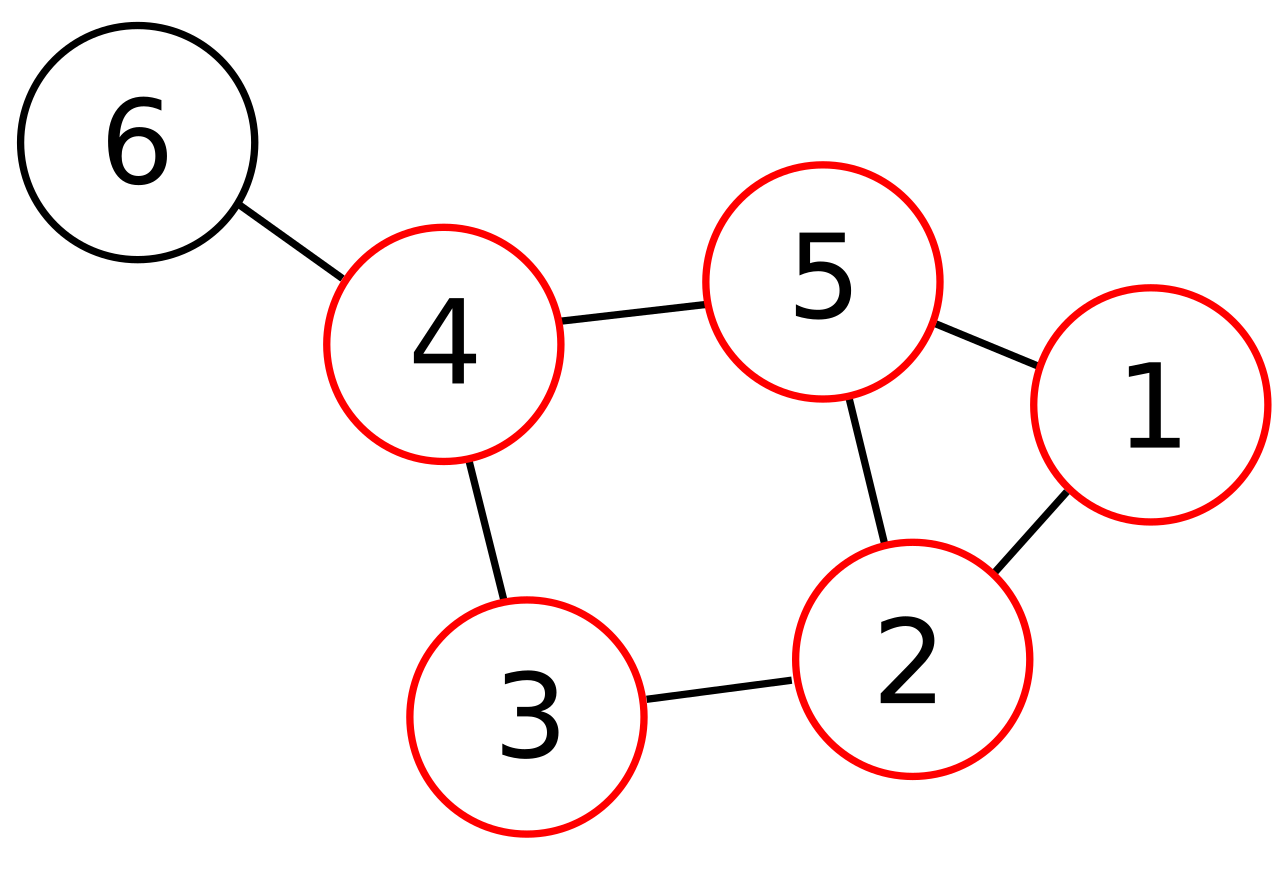
Tavin, Public domain, via Wikimedia Commons (File:6n-graf-2-clique.svg); credit: File:6n-graf-clique.svg, Public domain. Prepared model input from the cited source; see original source for its unmodified file.
- Option 1: 4 to3 to2 to1
- Option 2: 4 to5 to1
- Option 3: 4 to5 to2 to1
- Option 4: The least-cost route is not established
VB0139 Insufficient evidence
The observed outputs are S=1 and Cout=0. What does that establish about input A?
Inputs are binary. A gate with the extra curved input line is XOR; the other gates are AND. A black dot connects crossing wires; an unmarked crossing does not. No gate is faulty and all shown connections apply.
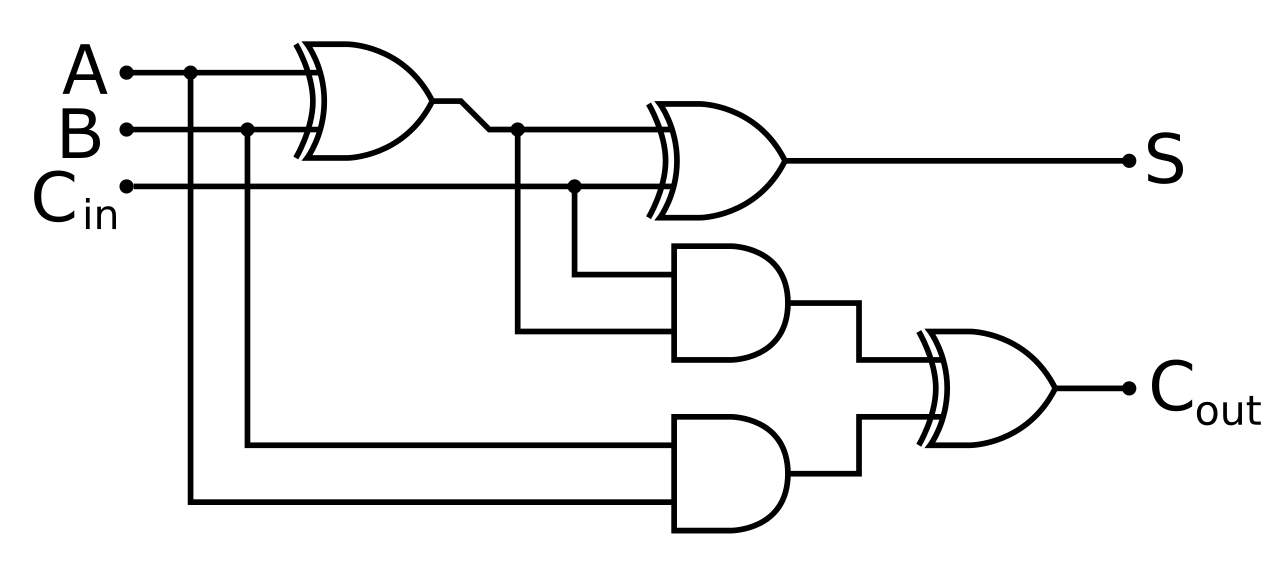
inductiveload, Public domain, via Wikimedia Commons (File:Full Adder XOR.svg); credit: Own drawing, Inkscape 0.43, Public domain. Prepared model input from the cited source; see original source for its unmodified file. Re-encoded for the tested C1 input variant.
- Option 1: A is not uniquely determined
- Option 2: A must be1
- Option 3: A must be0
- Option 4: A must equal Cin
VB0140 Insufficient evidence
Starting at q0, three inputs produce the output sequence000. Which state must the machine be in after the third input?
An edge label input/output emits the shown output while taking that transition. The input sequence contains only a and b and is not given. Follow arrowheads.
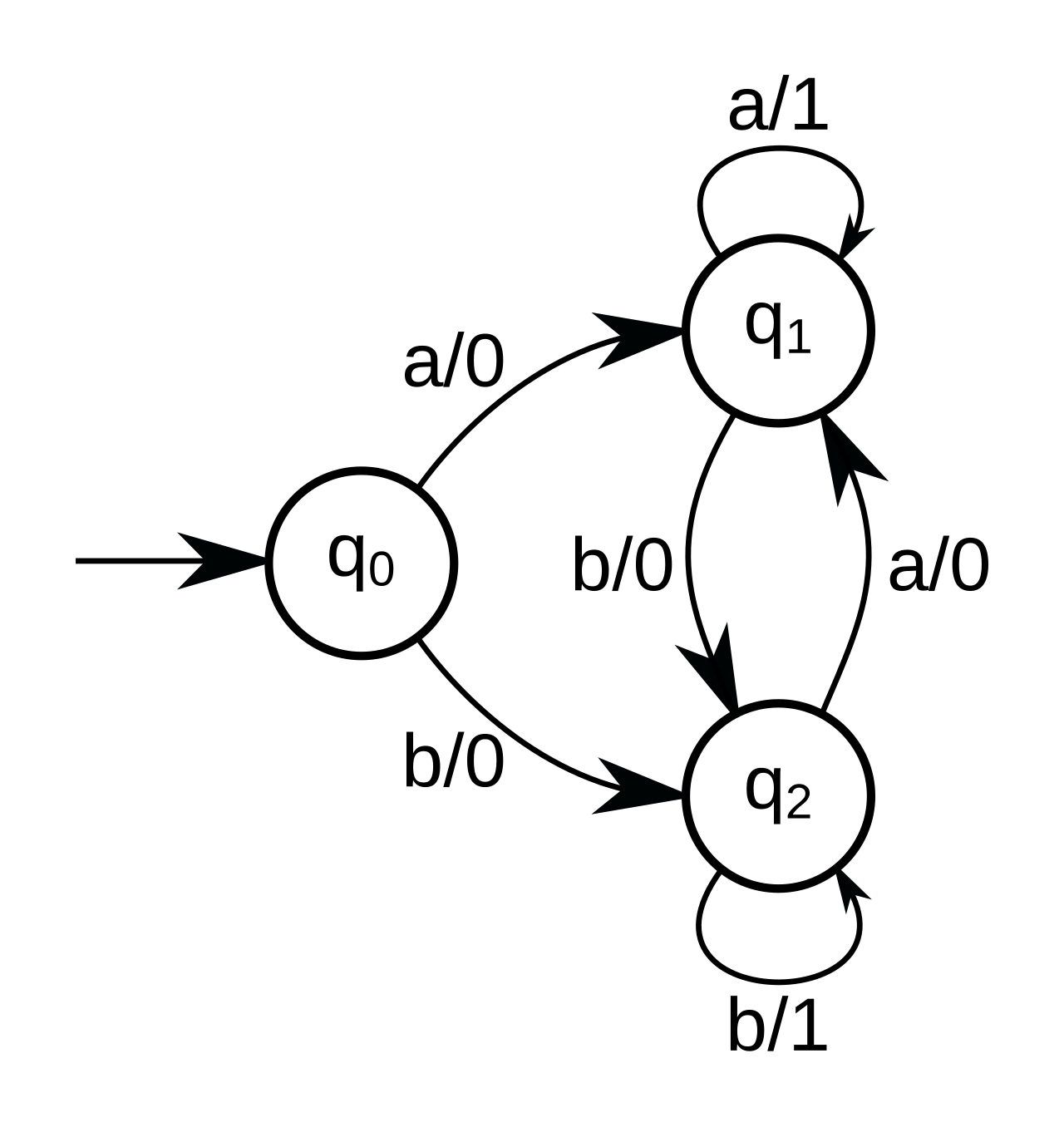
Aritzh, CC BY-SA 4.0, via Wikimedia Commons (File:MealyMachine.svg); credit: Own work, CC BY-SA 4.0. Prepared model input from the cited source; see original source for its unmodified file.
- Option 1: The final state is not uniquely determined
- Option 2: q0
- Option 3: q1
- Option 4: q2
VB0141 Perspective and knowledge tracking
Alice sees the first decision answered Yes, then sees nothing more. Bob sees only the final Replace bulb box reached. Who can know that the lamp was plugged in?
Both know this chart is followed exactly once from its start, without changing any answer during the traversal. They exchange no messages and have no other observations. Knowledge means true in every traversal compatible with that observer's evidence.
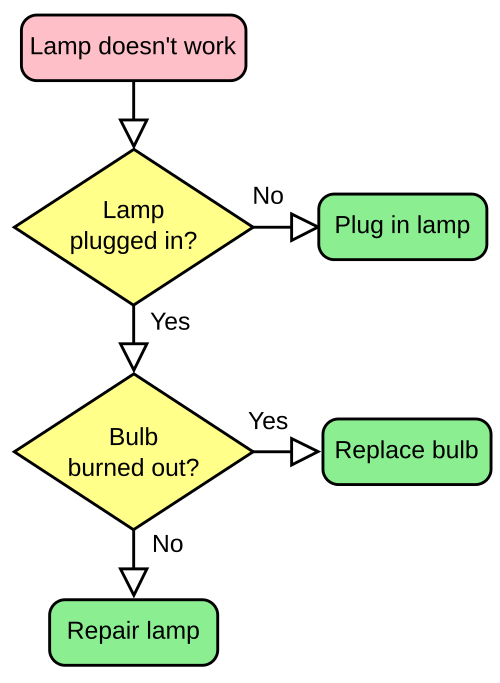
svg by Booyabazookaoriginal png by Wapcaplet, CC BY-SA 3.0, via Wikimedia Commons (File:LampFlowchart.svg); credit: vector version of Image:LampFlowchart.png, CC BY-SA 3.0. Prepared model input from the cited source; see original source for its unmodified file.
- Option 1: Alice only
- Option 2: Bob only
- Option 3: Neither observer
- Option 4: Both Alice and Bob
VB0142 Sequential state tracking
From panel4 through panel5 to panel6, which movement sequence does the grey tool make relative to the two pads?
Track the grey tool, not the yellow wire or panel positions on the page. Compare its location relative to the left and right pads in each stage.
Retired electrician; File:Ball-wedge sequence.svg; CC0; via Wikimedia Commons, CC0. Prepared model input from the cited source; see original source for its unmodified file. Re-encoded for the tested C1 input variant.
- Option 1: From above the right pad to down at the left pad, then up above the left pad
- Option 2: It remains above the left pad throughout
- Option 3: From above the left pad to down at the right pad, then up above the right pad
- Option 4: It moves up above the right pad, then down onto that pad
VB0143 Geometry, folding and fit
After this net is folded into its closed prism, what is the fewest number of colors needed so that faces sharing an edge always have different colors?
You may recolor every face; the current yellow and green are only panel identifiers. Faces meeting only at a vertex may share a color. Count the actual lateral faces and how they join when folded.
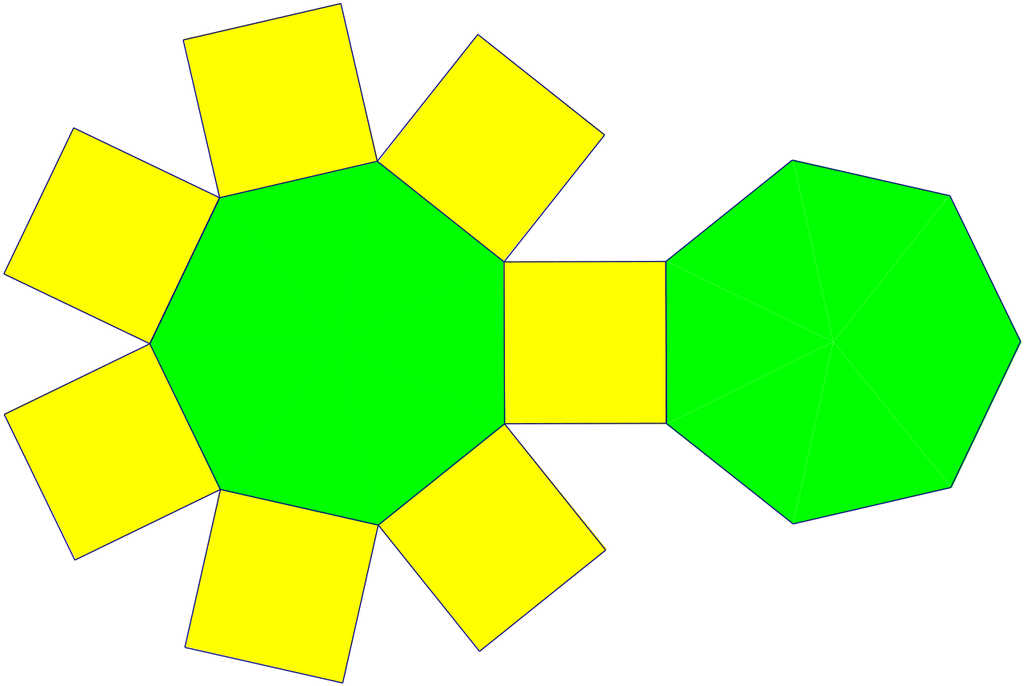
A2569875; File:Net of heptagonal prism.svg; Public domain; via Wikimedia Commons, Public domain. Prepared model input from the cited source; see original source for its unmodified file. Re-encoded for the tested C1 input variant.
- Option 1: 2
- Option 2: 3
- Option 3: 4
- Option 4: 5
VB0144 Rotation and reflection
To make a left-right mirror arrangement of this rabbit, which colored shape has a mirrored outline that cannot be obtained by rotating that piece in the table plane?
Treat the cutouts as ideal standard tangram pieces and ignore hand-cut roughness, shading and crayon strokes. Pieces may move and rotate but cannot be turned over. Compare each piece with the mirror of its own outline.
Cecilia2611; File:Coniglio Tangram.jpg; CC BY-SA 4.0; via Wikimedia Commons, CC BY-SA 4.0. Prepared model input from the cited source; see original source for its unmodified file. Re-encoded for the tested C1 input variant.
- Option 1: The yellow square
- Option 2: The light-blue triangle
- Option 3: The orange triangle
- Option 4: The green parallelogram
VB0145 Rotation and reflection
Can the entire left cube-chain shape be made identical to the entire right one by a rigid rotation in three-dimensional space?
Read the cubes as equal units and the straight runs as perpendicular. Preserve the connected chain, including its unique four-cube end. Rotation is not reflection and pieces cannot be detached.
File:Mental rotation task (diagram) (cropped).jpg / Wikimedia Commons, Public domain. Prepared model input from the cited source; see original source for its unmodified file. Re-encoded for the tested C1 input variant.
- Option 1: The shapes contain different numbers of cubes
- Option 2: Yes, using only a rigid rotation
- Option 3: Neither rotation nor reflection can relate them
- Option 4: No by rotation, but a mirror reflection can relate them
VB0146 Insufficient evidence
Which of the location-requesting apps have actually been granted location permission?
Standort means location. Use the displayed permission summary alone; do not assume app names, alphabetical order, installation order or which apps normally need location.
Futurwiki, Public domain, via Wikimedia Commons (File:App berechtigung.png); credit: Screenshot, Public domain. Prepared model input from the cited source; see original source for its unmodified file. Re-encoded for the tested C1 input variant.
- Option 1: The identities of the permitted apps are not established
- Option 2: All25 requesting apps
- Option 3: The first seven apps alphabetically
- Option 4: The last seven apps alphabetically
VB0147 Perspective and knowledge tracking
The interval is4. Alice and Bob record the start and three completed decrement steps. A kick occurs after decrement2 and before Sleep3, but only Alice sees it. What counter values do their records contain after decrement3?
Each observer updates a record using only operations they see, with the effects defined by the chart. Both see all three decrements, Alice also sees the kick, and there are no other operations. Ask for recorded values, not whether Bob's record is currently true.
Lambtron, CC BY-SA 4.0, via Wikimedia Commons (File:Software watchdog timer flowchart.svg); credit: Own work, CC BY-SA 4.0. Prepared model input from the cited source; see original source for its unmodified file. Re-encoded for the tested C1 input variant.
- Option 1: Alice3, Bob3
- Option 2: Alice4, Bob2
- Option 3: Alice3, Bob1
- Option 4: Alice1, Bob1
VB0148 Perspective and knowledge tracking
Who can establish that the shortest-route cost from d to b is at most20: Alice, who reads only d-c and c-b, or Bob, who reads only d-c, c-a and a-b?
Both know the full undirected topology and that all costs are positive. Each knows only the numeric edge costs they personally read from this image; unread costs remain unknown to that observer. They exchange no messages. A known route of cost20 or less is enough to establish the upper bound.
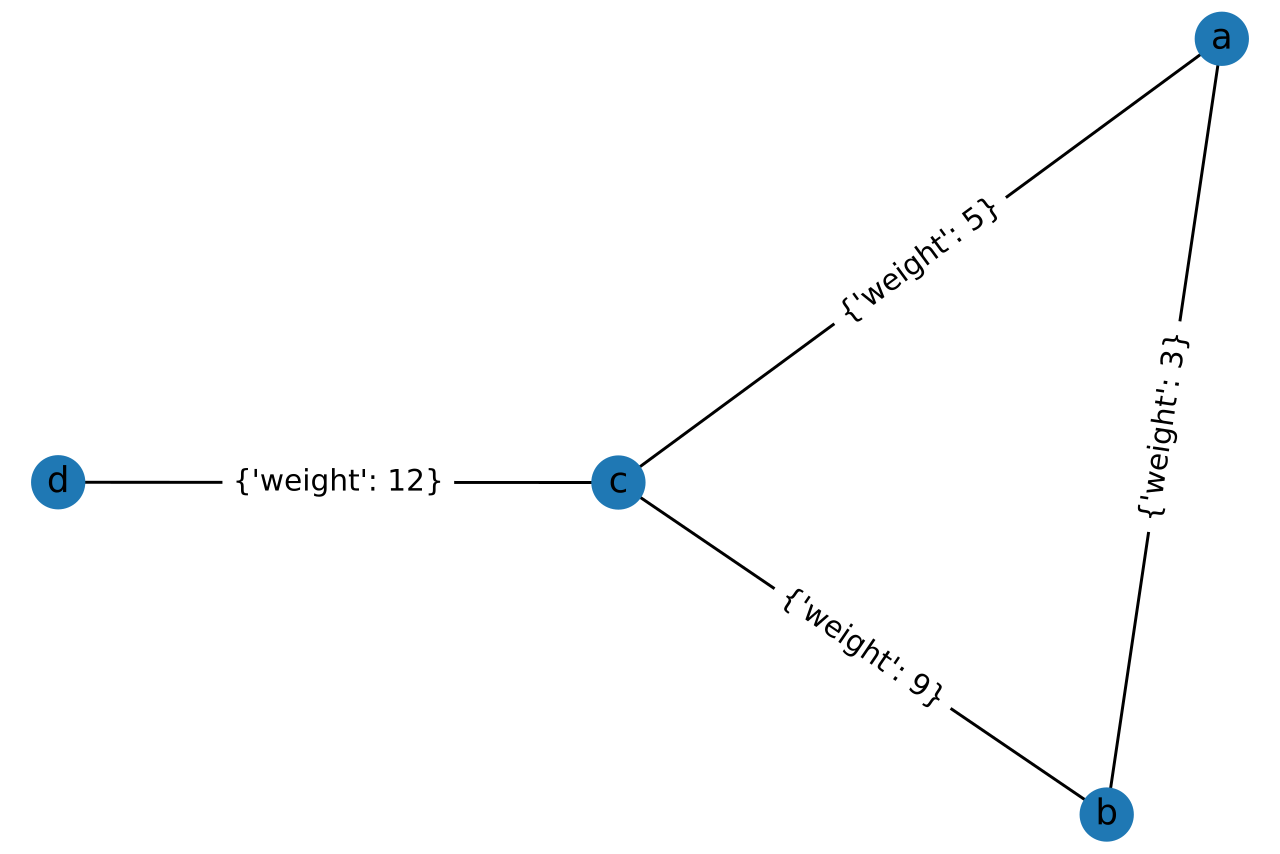
Daniel Mietchen, CC0, via Wikimedia Commons (File:Simple graph example for illustration of Bellman-Ford algorithm.svg); credit: Own work, CC0. Prepared model input from the cited source; see original source for its unmodified file.
- Option 1: Neither observer
- Option 2: Bob only
- Option 3: Both observers
- Option 4: Alice only
VB0149 Perspective and knowledge tracking
A run starts at S0 and takes exactly three transitions. Alice sees only that the first input was10. Bob sees only that the third output was0. Who can know the final state is S5?
Labels are input/output. Each observer knows the whole diagram and the run length, but only the stated observation from this run. They do not exchange messages. Knowledge must hold for every allowed three-transition run consistent with that observer's evidence.
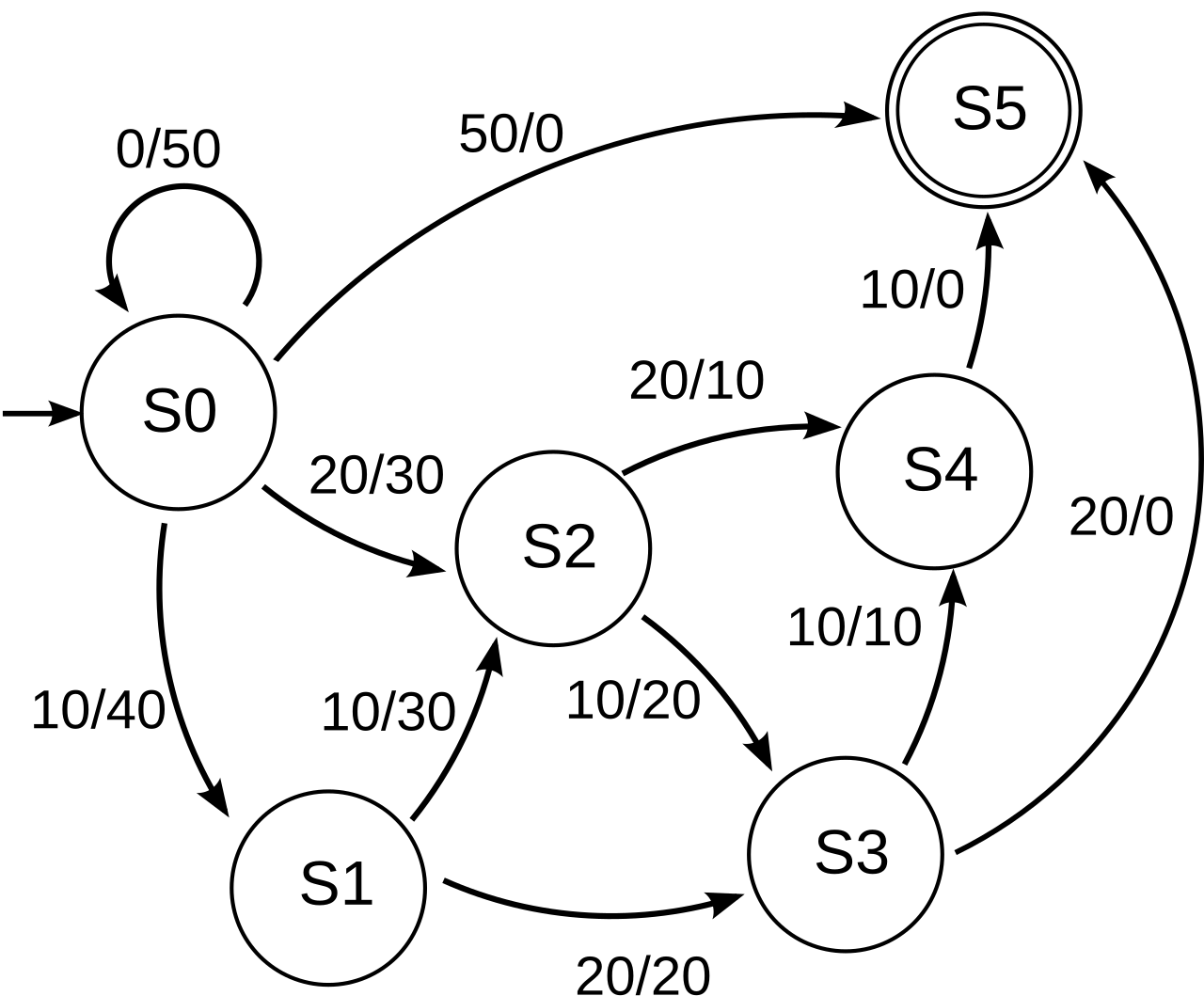
Pluke, CC0, via Wikimedia Commons (File:CPT-FSM-Mealy-02.svg); credit: Own work, CC0. Prepared model input from the cited source; see original source for its unmodified file. Re-encoded for the tested C1 input variant.
- Option 1: Both observers
- Option 2: Bob only
- Option 3: Neither observer
- Option 4: Alice only
VB0150 Attribute binding and set logic
Which fruit is above the large round fruit near the center and horizontally between the two prominent pear-shaped fruits?
Use image positions. The left pear is high on the left and the other pear is on the right; bind both relations to one object.
AnonymousUnknown author; File:Bowl of Fruit.png; Public domain; via Wikimedia Commons, Public domain. Prepared model input from the cited source; see original source for its unmodified file. Re-encoded for the tested C1 input variant. Lossy image encoding was visually reviewed before testing.
- Option 1: The low round fruit at the right
- Option 2: The pineapple
- Option 3: The grapes hanging below the bowl
- Option 4: The pear on the far right
VB0151 Conditional counting
How many orange-colored round fruits are visible in the bowl?
Exclude green and brown-green fruits even where partly hidden. Count each visible orange-colored fruit once, not each bright patch on a fruit.
PaulCharlesSmith; File:Bowl of fruit.jpg; CC BY-SA 3.0; via Wikimedia Commons, CC BY-SA 3.0. Prepared model input from the cited source; see original source for its unmodified file. Re-encoded for the tested C1 input variant. Lossy image encoding was visually reviewed before testing.
- Option 1: 4
- Option 2: 5
- Option 3: 6
- Option 4: 7
VB0152 Rotation and reflection
Imagine rotating this whole photograph90 degrees counterclockwise. Relative to the center of the brown onion pile, where would the Spanish Onions label then be?
Rotate the image in its plane without reflecting it. Track the same pile and front label. Use directions on the rotated photograph.
Andy Li; File:Spanish Onions - The Fruit Bowl, Brighton 2024-03-21.jpg; CC0; via Wikimedia Commons, CC0. Prepared model input from the cited source; see original source for its unmodified file. Re-encoded for the tested C1 input variant. Lossy image encoding was visually reviewed before testing.
- Option 1: Below
- Option 2: Above
- Option 3: Right
- Option 4: Left
VB0153 Spatial relationships
From the center of the orange carrot toward the center of the large dark-green courgette, which pair of robot-relative directions applies?
For this task the robot's forward direction is image-right, and its right direction is image-down. Use the centers of the visible objects, not their long-axis directions.
Salicyna; File:Allium cepa Karmen and other vegetables 2023-07-20 8383.jpg; CC BY-SA 4.0; via Wikimedia Commons, CC BY-SA 4.0. Prepared model input from the cited source; see original source for its unmodified file. Re-encoded for the tested C1 input variant. Lossy image encoding was visually reviewed before testing.
- Option 1: Forward and right
- Option 2: Backward and right
- Option 3: Backward and left
- Option 4: Forward and left
VB0154 Spatial relationships
At the crossing near the image center-right, what is the visible depth order of the basket handle and the pale vegetable?
Judge the local overlap where the upright handle crosses the large pale vegetable. Do not infer the order of objects elsewhere in the basket.
George Chernilevsky; File:Basket with vegetables 2017 G1.jpg; Public domain; via Wikimedia Commons, Public domain. Prepared model input from the cited source; see original source for its unmodified file. Re-encoded for the tested C1 input variant. Lossy image encoding was visually reviewed before testing.
- Option 1: Their visible silhouettes never overlap
- Option 2: The pale vegetable is in front of the handle
- Option 3: The photograph gives no overlap cue there
- Option 4: The handle is in front of the pale vegetable
VB0155 Attribute binding and set logic
Which tool lies below the circuit board and above the notebook, rather than being held in the person's hand?
Bind the two position conditions and the not-held condition to the same object. Use image directions; no claim about whether this is a sensible repair method is required.

Shixart1985; File:Person working on a computer circuit board with tools at a desk.jpg; CC BY 2.0; via Wikimedia Commons, CC BY 2.0. Prepared model input from the cited source; see original source for its unmodified file. Re-encoded for the tested C1 input variant.
- Option 1: The stethoscope chest piece
- Option 2: The black cup at the back
- Option 3: The red-and-yellow screwdriver
- Option 4: The pen on the notebook
VB0156 Attribute binding and set logic
Which mounted artifact lies directly below the left leaf-shaped arrowhead and directly to the right of the large pale circular scraper?
The leaf-shaped arrowheads are the two narrow pieces at the upper-right. Use the left one of those two, not either forked arrowhead at the upper-left.
The Portable Antiquities Scheme, Chris Edbury, 2012-06-15 15:29:25; File:An old collection of arrowheads, knives and scrapers mounted on card (FindID 507979).jpg; CC BY-SA 2.0; via Wikimedia Commons, CC BY-SA 2.0. Prepared model input from the cited source; see original source for its unmodified file. Re-encoded for the tested C1 input variant.
- Option 1: The pale circular scraper on the left
- Option 2: The dark circular scraper on the right
- Option 3: The short bottom-right knife
- Option 4: The long bottom-left knife
VB0157 Sequential state tracking
Scanning the displayed stages from left to right, which transition first introduces a visible white fluffy center?
Compare the pictured stages in their given order, not a remembered botanical life cycle. A pale green fuzzy outside on an unopened bud is not a white fluffy center.
DrunkBicyclist; File:Creosote Bush Flower Stages.jpg; CC0; via Wikimedia Commons, CC0. Prepared model input from the cited source; see original source for its unmodified file. Re-encoded for the tested C1 input variant.
- Option 1: From the opening yellow bud to the fully spread yellow flower
- Option 2: From the small green bud to the larger green bud
- Option 3: Only the transition into the final stage at the far right
- Option 4: From the fully spread yellow flower to the brown petal cup immediately to its right
VB0158 Sequential state tracking
Reading just the six hanging-case pictures left-to-right across the upper small row, then the lower small row, which is the first whose broad lower section is mostly dark rather than pale and striped?
Ignore the large caterpillar picture and the final spread-wing adult. Compare the broad lower section of each hanging case, not the orange spots on its narrow upper body.
Nick Hobgood; File:Acraea zetes caterpillar to pupae to butterfly metamorphosis by Nick Hobgood.jpg; CC BY-SA 3.0; via Wikimedia Commons, CC BY-SA 3.0. Prepared model input from the cited source; see original source for its unmodified file. Re-encoded for the tested C1 input variant.
- Option 1: The middle picture in the lower small row
- Option 2: The last picture in the upper small row
- Option 3: The first picture in the lower small row
- Option 4: The first picture in the upper small row
VB0159 Geometry, folding and fit
At stage3, one outer paper flap is opened to form the cone in stage4. How many paper layers are on the two sides of that cone?
Start with the single paper sheet drawn at stage1. Follow the shown folds, each placing one half over the other. Open one outer flap, not a separation through the middle of the layer stack. Do not tear or add paper.
Percy Cyril Lesley Thorne; File:Paper filter folding and filtration.JPG; Public domain; via Wikimedia Commons, Public domain. Prepared model input from the cited source; see original source for its unmodified file. Re-encoded for the tested C1 input variant.
- Option 1: 2 layers and2 layers
- Option 2: 1 layer and2 layers
- Option 3: 1 layer and3 layers
- Option 4: 1 layer and1 layer
VB0160 Insufficient evidence
Which of the two square faces is closer to the observer in the depicted three-dimensional wireframe cube?
The two squares are the lower-left square and the upper-right square linked by diagonal edges. Use depicted depth cues, not a habitual preferred interpretation of a familiar drawing.
BenFrantzDale; File:Necker cube.svg; CC BY-SA 3.0; via Wikimedia Commons, CC BY-SA 3.0. Prepared model input from the cited source; see original source for its unmodified file. Re-encoded for the tested C1 input variant.
- Option 1: The nearer face is not uniquely established
- Option 2: The upper-right square must be closer
- Option 3: Both squares must be at the same depth
- Option 4: The lower-left square must be closer
VB0161 Perspective and knowledge tracking
A pilot first sees a red beacon at B=(95% width,84% height). It moves to A=(75%,78%) and turns green there. A shore observer sees the whole event. With the beacon still at A, who can know its light is green?
Coordinates start at the top-left. For this task the red water area is hidden from the pilot and other water is visible. The pilot cannot see through the ship, receives no messages and does not know a color change occurred while hidden. Both observers initially know the light was red.
Blind_spot_(watercraft).JPG: KVDP
derivative work: Blleininger (talk); File:Blind spot (watercraft-2).svg; Public domain; via Wikimedia Commons, Public domain. Prepared model input from the cited source; see original source for its unmodified file.
- Option 1: Neither observer
- Option 2: Both observers
- Option 3: The pilot only
- Option 4: The shore observer only
VB0162 Perspective and knowledge tracking
Mira initially sees a white spot at the center of the glossy black face shown on the left. The fragment is then turned to the right-hand photograph's orientation. The spot turns blue while it stays in that orientation. What remains in Mira's color record?
The spot is a hypothetical mark at the center of that face. The fragment is opaque; Mira sees only the surface presented in the photograph and cannot look around its edges. She receives no message and updates her record only when she sees the spot.
Birmingham Museums Trust, Caroline Johnson, 2006-05-08 14:03:17; File:Post Medieval vessel sherd (front and back) (FindID 131739).jpg; CC BY-SA 2.0; via Wikimedia Commons, CC BY-SA 2.0. Prepared model input from the cited source; see original source for its unmodified file. Re-encoded for the tested C1 input variant.
- Option 1: White
- Option 2: Red
- Option 3: Blue
- Option 4: No initial color was recorded
VB0163 Attribute binding and set logic
Which bathtub both has an obvious break in its near rim and contains greenish liquid?
Bind both visible conditions to the same bathtub. Positions are ordered by distance from the camera; do not infer whether a tub is usable or safe.
Mick Garratt; File:Assortment of Baths, Redpoint Farm - geograph.org.uk - 531611.jpg; CC BY-SA 2.0; via Wikimedia Commons, CC BY-SA 2.0. Prepared model input from the cited source; see original source for its unmodified file.
- Option 1: The nearest bathtub
- Option 2: The second-nearest bathtub
- Option 3: The tub at the far end
- Option 4: The narrow side-facing tub near the middle
VB0164 Attribute binding and set logic
Which label identifies the two long folded pieces directly beside the pair of narrow flat center strips in the lower assembly layout?
Use all three properties: long, folded, and immediately outside the central flat strips. Read the labels from the pictured layout, not from clothing terminology.
HLHJ; File:Kosode assembly, exploded view.svg; CC BY-SA 4.0; via Wikimedia Commons, CC BY-SA 4.0. Prepared model input from the cited source; see original source for its unmodified file. Re-encoded for the tested C1 input variant.
- Option 1: O
- Option 2: M
- Option 3: E
- Option 4: S
VB0165 Conditional counting
How many rounded reddish-brown end ornaments are visible on this purse in total?
Count only the ball-like ornaments attached to green leafy extensions at the two outer ends. Exclude tiny flower centers across the mesh and the two sliding rings at the middle.
Cooper Hewitt, Smithsonian Design Museum; Miser's purse, CC0. Prepared model input from the cited source; see original source for its unmodified file.
- Option 1: 4
- Option 2: 5
- Option 3: 6
- Option 4: 8
VB0166 Conditional counting
How many pips are on the large front-facing faces of the two purple cubes with yellow pips, in total?
Ignore printed numerals, other-colored dice and the white spherical die. Each face uses a standard1-to6 die pip pattern. Include a partly hidden corner pip if the remaining pattern forces it, but do not invent a hidden center pip.
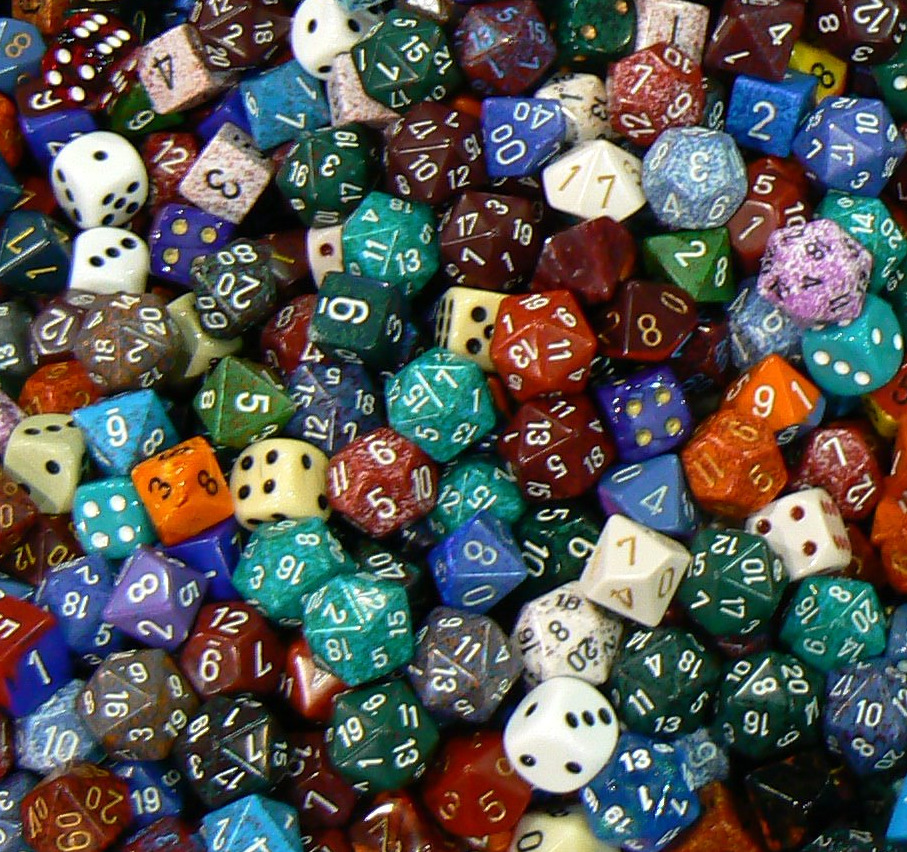
Benny Mazur; File:Assorted dice for games at GenCon 2009.jpg; CC BY 2.0; via Wikimedia Commons, CC BY 2.0. Prepared model input from the cited source; see original source for its unmodified file. Re-encoded for the tested C1 input variant. Lossy image encoding was visually reviewed before testing.
- Option 1: 7
- Option 2: 8
- Option 3: 9
- Option 4: 10
VB0167 Spatial relationships
Can the two rings be completely separated by moving and rotating them in three-dimensional space without opening either ring?
Both rings are physically closed and cannot pass through solid material. White gaps at the crossings indicate which ring is hidden behind the other, not actual cuts. Read both crossings before deciding.

Lorc; File:Linked-rings - Lorc - game-icons.svg; CC BY 3.0; via Wikimedia Commons, CC BY 3.0. Prepared model input from the cited source; see original source for its unmodified file. Re-encoded for the tested C1 input variant.
- Option 1: Yes, by rotating one ring without opening it
- Option 2: They are already separate, with no interlocking
- Option 3: Yes, by translating one ring straight away
- Option 4: No; at least one ring must be opened
VB0168 Spatial relationships
In the lower illustration, how are the large foreground boat and the smaller distant boat viewed?
End-on means looking approximately along a boat's length; broadside means seeing its length from the side. Judge hull shape and symmetry, not apparent size alone. The two illustrations need not show the same individual boat.
La Perouse, Jean-Francois de Galaup, comte de, 1741-1788
Blondela
Heath; File:(Two views). Japanese Boat(s). Published as the Act directs Novr. 1st 1798, by G.G. & J. Robinson, Pater Noster Row (IA dr two-views-japanese-boats-published-as-the-act-directs-novr-1st-1798-0414059).jpg; Public domain; via Wikimedia Commons, Public domain. Prepared model input from the cited source; see original source for its unmodified file. Re-encoded for the tested C1 input variant. Lossy image encoding was visually reviewed before testing.
- Option 1: The large boat is end-on; the small boat is more nearly broadside
- Option 2: Both are viewed broadside
- Option 3: The large boat is broadside; the small boat is end-on
- Option 4: Both are viewed end-on
VB0169 Sequential state tracking
A visual gate triggers after seven consecutive pictured ball positions whose centers are in the upper half of the photograph. Which bounce arc triggers the gate?
Test the taller left arc and shorter right arc separately, in left-to-right order. Use ball centers, not their upper edges, and the horizontal middle of the whole photograph. The overlapping positions near a peak still count separately. Do not infer unpictured positions.
MichaelMaggs Edit by Richard Bartz; File:Bouncing ball strobe edit.jpg; CC BY-SA 3.0; via Wikimedia Commons, CC BY-SA 3.0. Prepared model input from the cited source; see original source for its unmodified file. Re-encoded for the tested C1 input variant.
- Option 1: Both arcs
- Option 2: Neither arc
- Option 3: The taller left arc only
- Option 4: The shorter right arc only
VB0170 Sequential state tracking
At the highest pictured position in the moving diver's sequence, which body configuration is shown before the later head-down entry?
Track the diver in striped blue-and-white trunks, not the stationary people. Compare the actual pose at the greatest height; different diving styles could plausibly use the other configurations, so do not choose from a generic remembered dive sequence.
Chris Hunkeler from Carlsbad, California, USA; File:Diving Sequence (41497552975).jpg; CC BY-SA 2.0; via Wikimedia Commons, CC BY-SA 2.0. Prepared model input from the cited source; see original source for its unmodified file. Re-encoded for the tested C1 input variant. Lossy image encoding was visually reviewed before testing.
- Option 1: A compact tuck with bent knees drawn close to the torso
- Option 2: A fully extended body with straight hips and knees
- Option 3: An upright feet-down body with bent knees well below the torso
- Option 4: A pike with straight knees and the torso folded toward the legs
VB0171 Sequential state tracking
A running counter starts at0. Process Images1,2 and3 in order: add1 when the broad flukes are near-black and mottled; reset the counter to0 when they are mostly uniform grey. What is the final counter value?
Classify the broad fluke surfaces, not water, spray or the narrow stalk. Apply the update separately at every frame. The counter describes a visual monitoring rule, not a biological change in skin color.
Jules Verne Times Two; File:Sequence of sperm whale (Physeter macrocephalus) diving, São Miguel Island, Azores, Portugal (PPL1-Corrected).jpg; CC BY-SA 4.0; via Wikimedia Commons, CC BY-SA 4.0. Prepared model input from the cited source; see original source for its unmodified file. Re-encoded for the tested C1 input variant. Lossy image encoding was visually reviewed before testing.
Jules Verne Times Two; File:Sequence of sperm whale (Physeter macrocephalus) diving, São Miguel Island, Azores, Portugal (PPL1-Corrected).jpg; CC BY-SA 4.0; via Wikimedia Commons, CC BY-SA 4.0. Prepared model input from the cited source; see original source for its unmodified file. Re-encoded for the tested C1 input variant. Lossy image encoding was visually reviewed before testing.
Jules Verne Times Two; File:Sequence of sperm whale (Physeter macrocephalus) diving, São Miguel Island, Azores, Portugal (PPL1-Corrected).jpg; CC BY-SA 4.0; via Wikimedia Commons, CC BY-SA 4.0. Prepared model input from the cited source; see original source for its unmodified file. Re-encoded for the tested C1 input variant. Lossy image encoding was visually reviewed before testing.
- Option 1: 0
- Option 2: 1
- Option 3: 2
- Option 4: 3
VB0172 Matching across images
The thin branch ending near the left interior rim in Image2 corresponds to which branch end in Image1?
Use the blue bow and the large flower clusters to align the decorative pattern across the different camera views. Divide Image1 around the center of the dish; do not assume image-left stays object-left.
Cooper Hewitt, Smithsonian Design Museum; Dish (One of Six), CC0. Prepared model input from the cited source; see original source for its unmodified file. Re-encoded for the tested C1 input variant.
Cooper Hewitt, Smithsonian Design Museum; Dish (One of Six), CC0. Prepared model input from the cited source; see original source for its unmodified file. Re-encoded for the tested C1 input variant.
- Option 1: The lower-left flower cluster
- Option 2: The upper-right forked red branch end
- Option 3: The lower-right blue border segment
- Option 4: The upper-left branch end
VB0173 Insufficient evidence
How many whole fruits are inside this bowl in total, including any that are fully hidden?
Use only the photograph. A partly visible fruit counts as one fruit, but do not assume that every fruit must have some part visible from this viewpoint.
Fumikas Sagisavas; File:Bowl of Spider Fruit.jpg; CC0; via Wikimedia Commons, CC0. Prepared model input from the cited source; see original source for its unmodified file. Re-encoded for the tested C1 input variant.
- Option 1: 25
- Option 2: 30
- Option 3: 35
- Option 4: The exact total is not established
VB0174 Spatial relationships
Extend the straight upper boundary of the grey beam to the vertical line at90% of the image width. Where would that extension lie relative to the orange rock shape?
This is a line extrapolation on the drawing, not a claim that a laser passes through rock. Continue the same slope beyond the first rock contact. Use the orange polygon boundary rather than the caption text.
Waikinl; File:Line of sight TLS1.png; CC BY-SA 4.0; via Wikimedia Commons, CC BY-SA 4.0. Prepared model input from the cited source; see original source for its unmodified file. Re-encoded for the tested C1 input variant.
- Option 1: It cannot reach that image-width position
- Option 2: Inside the orange rock shape, below its top boundary
- Option 3: Below the ground line
- Option 4: Above the entire rock shape
VB0175 Spatial relationships
Starting at the black dot, follow the black route through its first two complete straight segments. What is the net displacement in grid cells?
Count each grid cell as one unit. At a crossing keep following the same straight line until the next actual corner; do not turn merely because lines cross. Use image-right and image-down directions.
Created by Ilmari Karonen; File:Knight's tour.svg; Public domain; via Wikimedia Commons, Public domain. Prepared model input from the cited source; see original source for its unmodified file. Re-encoded for the tested C1 input variant.
- Option 1: 3 left and3 down
- Option 2: 3 right and1 down
- Option 3: 1 right and3 down
- Option 4: 3 right and3 down
VB0176 Rotation and reflection
Reflect the long clock hand across the vertical line through the hub, then rotate that reflected hand90 degrees clockwise around the hub. In which image quadrant would its pointed tip finish?
Track the longer hand's far pointed tip, not the short counterweight behind the hub. Transform the hand only; keep the image directions and dial fixed. Reflection happens before rotation.
Colin; File:Big Ben Inner Clock Face.jpg; CC BY-SA 4.0; via Wikimedia Commons, CC BY-SA 4.0. Prepared model input from the cited source; see original source for its unmodified file. Re-encoded for the tested C1 input variant. Lossy image encoding was visually reviewed before testing.
- Option 1: Upper-left
- Option 2: Upper-right
- Option 3: Lower-right
- Option 4: Lower-left
VB0177 Rotation and reflection
First yaw the whole cube90 degrees clockwise as viewed from above. Then, looking straight at its new front face, roll the whole cube90 degrees clockwise. Which visible color from the original photograph finishes on top?
Define the original face on image-left as front, the face on image-right as right, and the upper face as top. After the yaw, front/right/top refer to fixed spatial positions, not original face identities. Turn the whole cube, not an individual layer.
File:Rubiks cube solved.jpg: Mike Gonzalez (TheCoffee)
derivative work: Pbroks13; File:Rubiks cube solved.png; CC BY-SA 3.0; via Wikimedia Commons, CC BY-SA 3.0. Prepared model input from the cited source; see original source for its unmodified file. Re-encoded for the tested C1 input variant.
- Option 1: A hidden color that cannot be identified
- Option 2: Red
- Option 3: White
- Option 4: Blue
VB0178 Spatial relationships
Point A is one positive unit along the x-axis and point B one positive unit along the y-axis. Which colored sheet contains the entire straight segment from A to B?
The colored sheets are the coordinate planes. Use the axis labels in the image. A and B are not at the origin; do not mistake tinted overlaps for additional sheets.
Sakurambo~commonswiki
derivative work: Petrus3743; File:3D coordinate system.svg; CC BY-SA 4.0; via Wikimedia Commons, CC BY-SA 4.0. Prepared model input from the cited source; see original source for its unmodified file. Re-encoded for the tested C1 input variant.
- Option 1: All three sheets
- Option 2: The red horizontal sheet
- Option 3: The green upright sheet
- Option 4: The purple upright sheet
VB0179 Spatial relationships
Under the coordinate convention shown, a rectangle has opposite corners(20,30) and(80,90). Translate the whole rectangle15 units toward image-right and10 units toward image-up. What are the new opposite corners?
Read the directions of increasing coordinates from this diagram. Both maximum coordinate values are at least100. Apply a translation, not a resize or reflection.
Bert Niehaus; File:Graphics coordinate system.svg; CC BY-SA 4.0; via Wikimedia Commons, CC BY-SA 4.0. Prepared model input from the cited source; see original source for its unmodified file.
- Option 1: (5,40) and(65,100)
- Option 2: (35,40) and(95,100)
- Option 3: (35,20) and(95,80)
- Option 4: (5,20) and(65,80)
VB0180 Sequential state tracking
A visual alarm activates only after two consecutive solar positions whose bright regions are partly covered by a foreground boat. By the final position in this composite, has the alarm activated?
Process all six solar positions from upper-left toward lower-right. The smooth Moon-shaped bite and the sea horizon are not boats. Only actual overlap of a boat silhouette with a bright solar region qualifies, not a boat elsewhere in the frame.
Marika Caruana; File:Partial solar eclipse sequence.jpg; CC BY-SA 4.0; via Wikimedia Commons, CC BY-SA 4.0. Prepared model input from the cited source; see original source for its unmodified file. Re-encoded for the tested C1 input variant.
- Option 1: No; the longest qualifying run is one position
- Option 2: Yes; the final three positions all qualify
- Option 3: Yes; all six positions qualify
- Option 4: Yes; the final two positions both qualify
VB0181 Interface state decisions
The goal is Metallic at least0.80, Roughness at most0.40, and Alpha exactly1.00, leaving all other parameters unchanged. Which displayed parameters need changing?
Use the values currently displayed in this property panel. Changing one parameter does not automatically change the other two. Select the complete minimum set; no live application action is requested.
UnnecessaryDecision, CC0, via Wikimedia Commons (File:Blender 4.3.2 screenshot.png); credit: Own work, CC0. Prepared model input from the cited source; see original source for its unmodified file.
- Option 1: Metallic and Roughness only
- Option 2: Metallic only
- Option 3: Roughness only
- Option 4: Metallic, Roughness and Alpha
VB0182 Charts and quantitative comparisons
In which panel do most points follow a broad curved rise-and-fall pattern that the blue straight line misses, rather than the main mismatch being one isolated outlier?
Judge the arrangement of most orange points. A single high or far-right point is not a broad curved pattern. Use panel positions, not an assumption that equal-looking blue lines imply equal data shapes.
Anscombe.svg: Schutz
(label using subscripts): Avenue; File:Anscombe's quartet 3.svg; CC BY-SA 3.0; via Wikimedia Commons, CC BY-SA 3.0. Prepared model input from the cited source; see original source for its unmodified file. Re-encoded for the tested C1 input variant.
- Option 1: Lower-right
- Option 2: Upper-left
- Option 3: Lower-left
- Option 4: Upper-right
VB0183 Charts and quantitative comparisons
Compared with the unshaded share of the middle pie, how does the unshaded share of the result pie on the right differ?
All circles represent the same whole. White is unshaded and grey is shaded. Use the radial partitions to read fractions; do not compare the total size of the circles on the page.
Averater; File:Pie chart example 06.svg; CC BY-SA 3.0; via Wikimedia Commons, CC BY-SA 3.0. Prepared model input from the cited source; see original source for its unmodified file. Re-encoded for the tested C1 input variant.
- Option 1: It is larger by one third of a whole
- Option 2: The unshaded shares are equal
- Option 3: It is smaller by one third of a whole
- Option 4: It is smaller by one quarter of a whole
VB0184 Charts and quantitative comparisons
Using the chart, how does the share of noncitizens in Gwinnett County compare with the share in Georgia?
The bars show citizenship, not noncitizenship. Treat the noncitizen share as100% minus the displayed citizenship share. Compare percentage points and choose the nearest offered magnitude. This concerns the pictured2015 chart, not current populations.
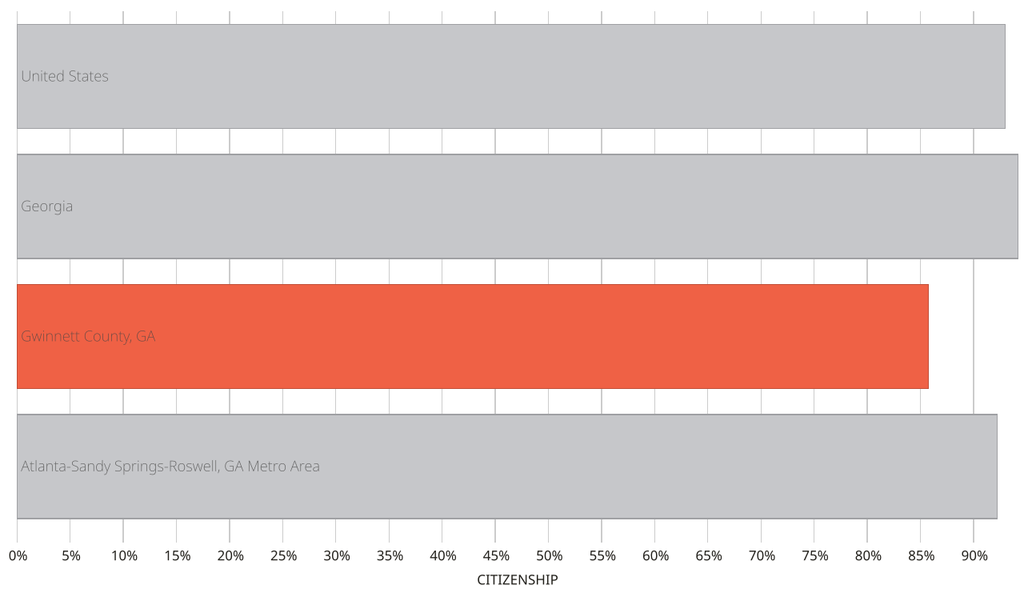
Datawheel; File:Bar Chart of Citizenship in Gwinnett County, GA (2015).svg; CC0; via Wikimedia Commons, CC0. Prepared model input from the cited source; see original source for its unmodified file. Re-encoded for the tested C1 input variant.
- Option 1: Georgia is higher by about8 percentage points
- Option 2: Gwinnett is higher by about8 percentage points
- Option 3: Gwinnett is higher by about2 percentage points
- Option 4: Georgia is higher by about2 percentage points
VB0185 Charts and quantitative comparisons
Which comparison correctly combines a higher median with a smaller interquartile range?
The thick line inside each box is its median. The box height, not the full whisker span, is the interquartile range. Read both properties before choosing.
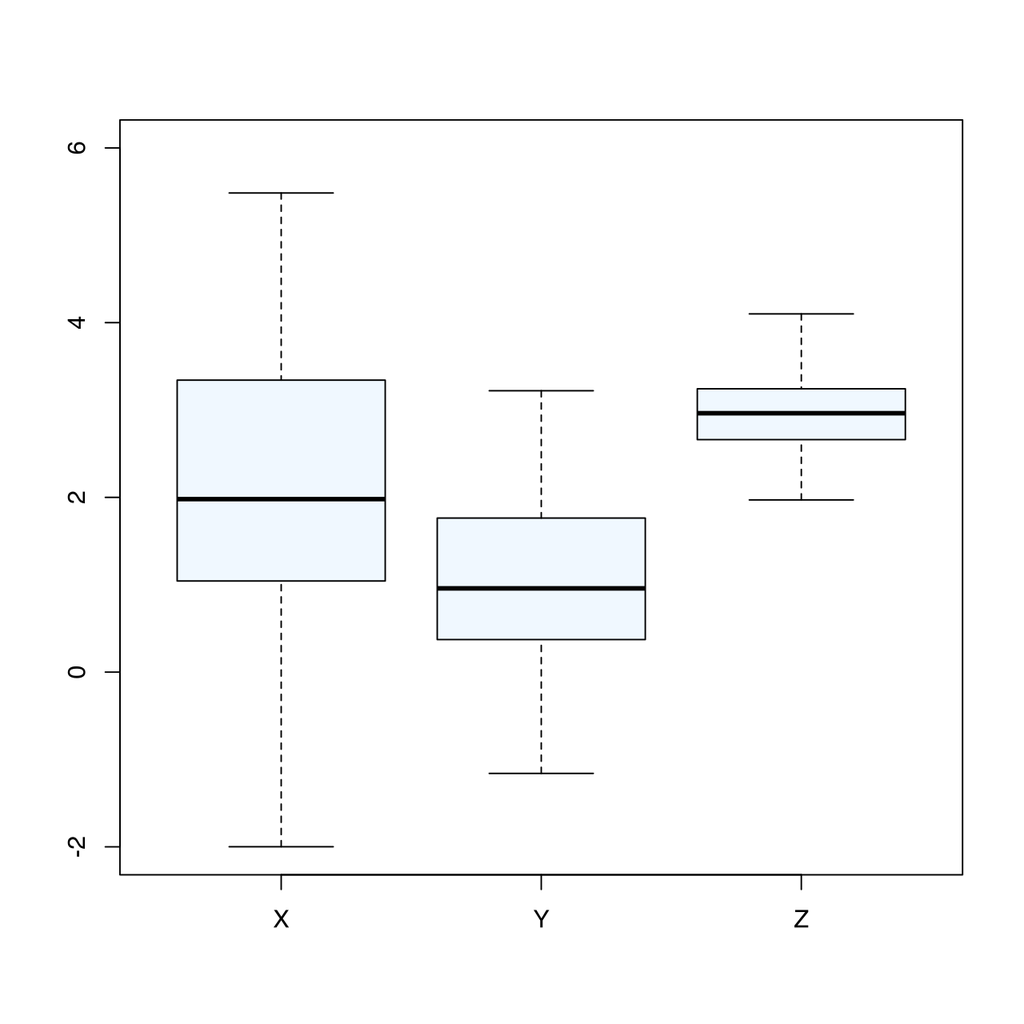
Jojotipe; File:Boxplot XYZ.svg; CC BY-SA 4.0; via Wikimedia Commons, CC BY-SA 4.0. Prepared model input from the cited source; see original source for its unmodified file. Re-encoded for the tested C1 input variant.
- Option 1: Y has a higher median and a smaller interquartile range than Z
- Option 2: Z has a higher median and a smaller interquartile range than X
- Option 3: X has a higher median and a smaller interquartile range than Y
- Option 4: The median and interquartile-range comparison is not established by this chart
VB0186 Causal and counterfactual reasoning
Replace the pictured load with a150N load while keeping the same pulley routing. What free-end pull would balance it in the ideal model?
Use the ratio between the displayed balanced load and the displayed free-end pull. For an unchanged ideal routing that ratio stays constant. Ignore friction and rope weight; do not count the hanging free end as an additional load-supporting strand.
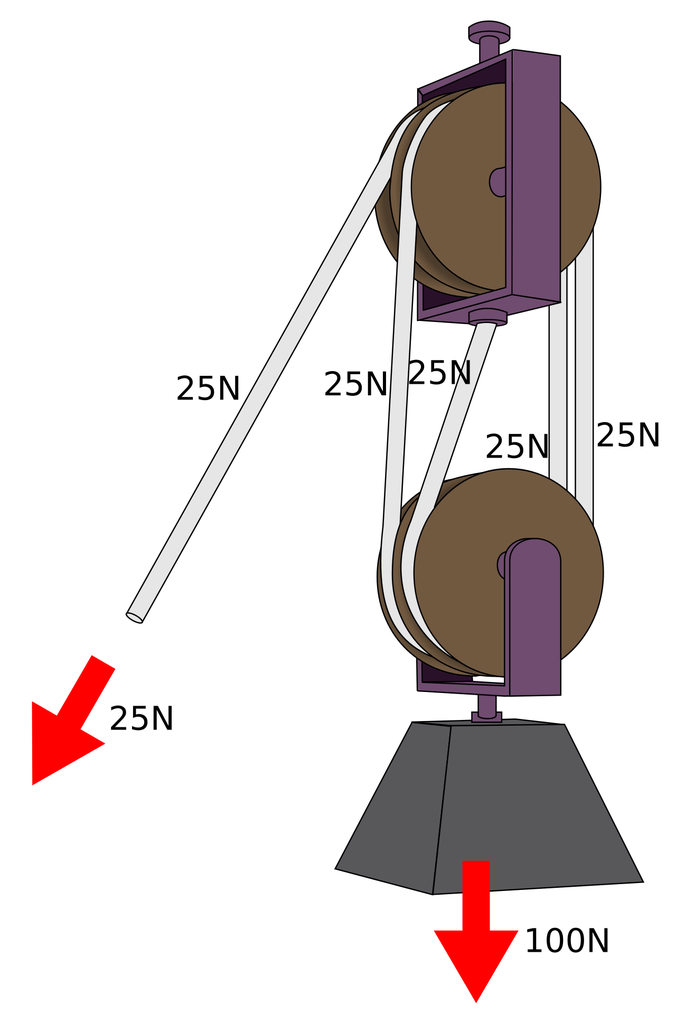
Polispasto2B.jpg: Mindbuilder
derivative work: Arnaud Ramey (talk); File:Compound pulley.svg; CC BY-SA 3.0; via Wikimedia Commons, CC BY-SA 3.0. Prepared model input from the cited source; see original source for its unmodified file.
- Option 1: 25N
- Option 2: 30N
- Option 3: 37.5N
- Option 4: 75N
VB0187 Causal and counterfactual reasoning
Starting from balance, double the mass on the longer arm. Which of these changes would restore balance while leaving both new masses fixed?
Use the mass-times-arm balance relation shown in the picture. In each option change only the named arm length; the other arm and the fulcrum position stay fixed. Choose among the offered actions, not every possible remedy.
Tristanevanslee; File:Lever Principle 3D.svg; CC0; via Wikimedia Commons, CC0. Prepared model input from the cited source; see original source for its unmodified file. Re-encoded for the tested C1 input variant.
- Option 1: The restoring change is not established under the supplied balance rule
- Option 2: Halve b
- Option 3: Double b
- Option 4: Halve a
VB0188 Causal and counterfactual reasoning
Close valve5 while leaving valve4 as drawn. On the next attempted downstroke of piston2, which of chambers1 and3 can receive displaced fluid through an open path from2?
For this diagram a vertical blue valve handle means closed and a diagonal handle means open. Closed valves completely block flow; open ones allow flow in either direction. Ignore leakage, fluid compression and any unpictured connections. Use the numbered chambers in the image.
Wela49, Hydraulic press, CC BY-SA 3.0 via GFDL license migration, via Wikimedia Commons; canonical rasterization and metadata-free input conversion., CC BY-SA 3.0. Prepared model input from the cited source; see original source for its unmodified file.
- Option 1: Neither chamber1 nor chamber3
- Option 2: Chamber1 only
- Option 3: Both chambers1 and3
- Option 4: Chamber3 only
VB0189 Causal and counterfactual reasoning
The red shaft turns clockwise. What are the blue shaft's directions before and after replacing the pictured belt routing with a belt that crosses once?
View both shafts from the same side. In this ideal model an uncrossed belt drives both shafts in the same direction; one crossing reverses their directions. Shafts stay fixed and the belt does not slip. Read the currently drawn routing for the before case.
Pradana Aumars (talk · contribs); File:Belt pulley kinematic scheme.svg; CC0; via Wikimedia Commons, CC0. Prepared model input from the cited source; see original source for its unmodified file.
- Option 1: Counterclockwise before and counterclockwise after
- Option 2: Clockwise before and counterclockwise after
- Option 3: Clockwise before and clockwise after
- Option 4: Counterclockwise before and clockwise after
VB0190 Interface state decisions
Select a partition row whose file system is ext4, whose total Size is at most 100 GiB, and whose Unused space is at least 60 GiB. Which offered row satisfies all three requirements?
Use the table, not the relative widths of the colored blocks. This is a read-only selection question, not a request to change any disk. An extended container is not an ext4 file system.
Pbmacsodak; File:Gparted screen showing partition.png; CC BY-SA 4.0; via Wikimedia Commons, CC BY-SA 4.0. Prepared model input from the cited source; see original source for its unmodified file. Re-encoded for the tested C1 input variant.
- Option 1: Select /dev/sda6
- Option 2: Select /dev/sda5
- Option 3: Select /dev/sda2
- Option 4: Keep the highlighted /dev/sda3 row
VB0191 Interface state decisions
The goal is Always snap for objects, grids and guides, leaving all other settings unchanged. In which groups must the selected radio option change?
A blue filled circle marks the selected radio option. Each group permits one selected option. Choose the complete minimum set of groups that need changing from the pictured state.
Stilfehler; File:Inkscape Document Properties Snap.png; CC BY-SA 4.0; via Wikimedia Commons, CC BY-SA 4.0. Prepared model input from the cited source; see original source for its unmodified file.
- Option 1: Guides only
- Option 2: Objects, grids and guides
- Option 3: Objects and guides only
- Option 4: Objects only
VB0192 Interface state decisions
Starting from the pictured state, export with run-length encoding and an alpha channel, without saving a comment. Which complete set of checkboxes needs toggling?
An empty checkbox is off. A comment is saved only when Save comment to file is on, even if the Comment text field contains text. Leave all unrelated options and field values unchanged.
Gimp team; File:OpenGL Tutorial Gimp export as C.png; CC BY-SA 4.0; via Wikimedia Commons, CC BY-SA 4.0. Prepared model input from the cited source; see original source for its unmodified file.
- Option 1: Run-Length-Encoding and Save alpha channel only
- Option 2: Save alpha channel only
- Option 3: Run-Length-Encoding only
- Option 4: The required checkbox changes are not established by this screenshot
VB0193 Charts and quantitative comparisons
Approximately what fraction of the states are represented by the first three histogram bins combined?
The vertical axis counts states, not land area. Add the counts in the first three adjacent bins, then compare with the total count across every nonempty bin. Choose the nearest offered percentage.
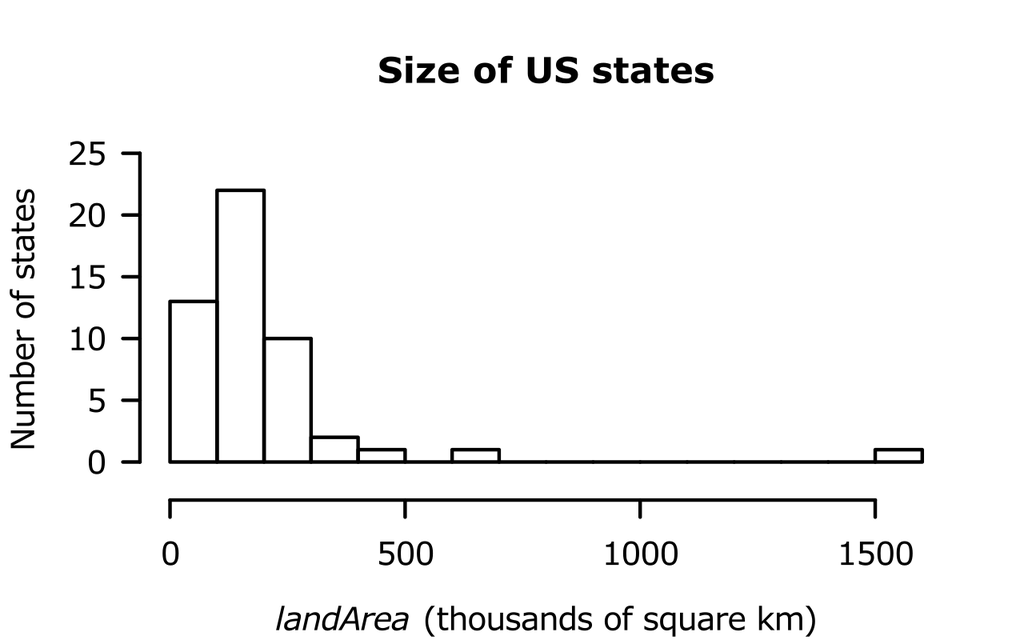
HYanWong; File:R-US state areas-histogram.svg; Public domain; via Wikimedia Commons, Public domain. Prepared model input from the cited source; see original source for its unmodified file. Re-encoded for the tested C1 input variant.
- Option 1: 90%
- Option 2: 10%
- Option 3: 45%
- Option 4: 60%
VB0194 Charts and quantitative comparisons
Combining males and females, the population aged10 to14 is approximately how many times the population aged65 to69?
Use the pictured2022 population, not current estimates. Add the male and female bar magnitudes for each age band; the left side shows positive population magnitudes despite extending leftward. Choose the nearest offered ratio.
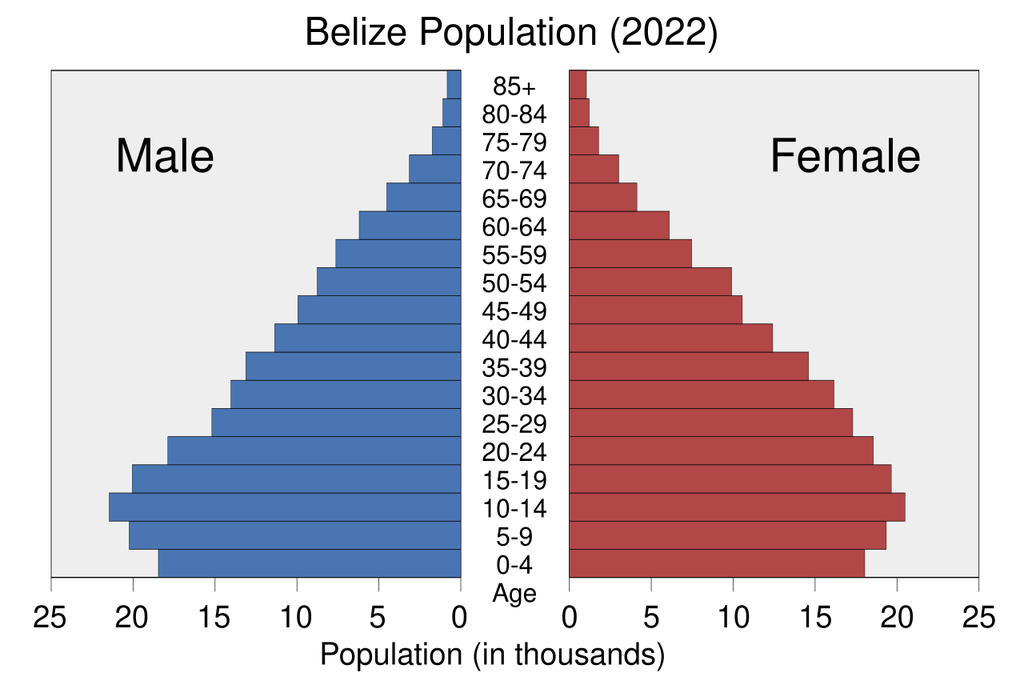
Nosferattus; File:Belize Population Pyramid for 2022.svg; CC0; via Wikimedia Commons, CC0. Prepared model input from the cited source; see original source for its unmodified file.
- Option 1: About3 times
- Option 2: About2 times
- Option 3: About5 times
- Option 4: About10 times
VB0195 Causal and counterfactual reasoning
Disable the bottom-left transition. Starting with exactly the pictured tokens, what is the maximum number of times the bottom-right transition can fire?
Circles hold tokens and black bars are transitions. A firing consumes one token from every incoming arrow and produces one token on every outgoing arrow. Any enabled transition may fire repeatedly. Disabled transitions never fire. There are no hidden tokens or capacity limits.
Msoos, Petri net example, CC BY-SA 2.5, via Wikimedia Commons; canonical rasterization and metadata-free input conversion., CC BY-SA 2.5. Prepared model input from the cited source; see original source for its unmodified file. Re-encoded for the tested C1 input variant.
- Option 1: 3 times
- Option 2: 1 time
- Option 3: An unlimited number of times
- Option 4: 2 times
VB0196 Causal and counterfactual reasoning
Force SPRINKLER to T externally. Under this intervention, what is the probability that GRASS WET is T?
Treat the diagram as the specified causal probability model. Forcing a node replaces its conditional probability table with the forced value and removes its incoming arrows; all other tables stay unchanged. Average over RAIN using its prior, rather than updating RAIN as if SPRINKLER had merely been observed. T and F mean true and false.
AnAj; File:SimpleBayesNet.svg; Public domain; via Wikimedia Commons, Public domain. Prepared model input from the cited source; see original source for its unmodified file. Re-encoded for the tested C1 input variant.
- Option 1: 0.80
- Option 2: 0.90
- Option 3: 0.918
- Option 4: 0.99
VB0197 Navigation and planning
Just inside the upper-left entrance, choose between continuing down and turning right. Which choice can lead to the lower-right exit without returning through that first junction?
Black lines are impassable walls and white corridors are passable. The arrows mark entry and exit, not extra walls. You may follow bends and later junctions, but cannot cross a wall or leave the maze through its outside boundary.
Vystrix Nexoth, Simple Maze, CC BY-SA 3.0 via GFDL license migration, via Wikimedia Commons; canonical rasterization and metadata-free input conversion., CC BY-SA 3.0. Prepared model input from the cited source; see original source for its unmodified file. Re-encoded for the tested C1 input variant.
- Option 1: Continue down only
- Option 2: Neither initial choice
- Option 3: Either initial choice
- Option 4: Turn right only
VB0198 Navigation and planning
Close the straight horizontal connection from the middle-left circle to the right-hand circle. What can be the two endpoints of a walk that uses every remaining connection exactly once?
Each drawn connection is an undirected edge, including each separate curved connection. You may revisit circles but cannot repeat or omit any remaining edge. The printed numbers describe the original graph, not the graph after closure. Either walking direction is allowed.
Sarang; File:Königsberg Bridges graph.svg; Public domain; via Wikimedia Commons, Public domain. Prepared model input from the cited source; see original source for its unmodified file. Re-encoded for the tested C1 input variant.
- Option 1: The middle-left and right-hand circles
- Option 2: The upper-left and lower-left circles
- Option 3: The upper-left and right-hand circles
- Option 4: No such walk is possible
VB0199 Navigation and planning
Start at a, visit every labeled node at least once, and return to a. What is the smallest possible total edge weight?
Connections are undirected. Add each traversed edge weight, including repeated traversals. Repeated nodes and edges are allowed; merely finding the shortest path to e does not meet the visit-all-and-return goal.
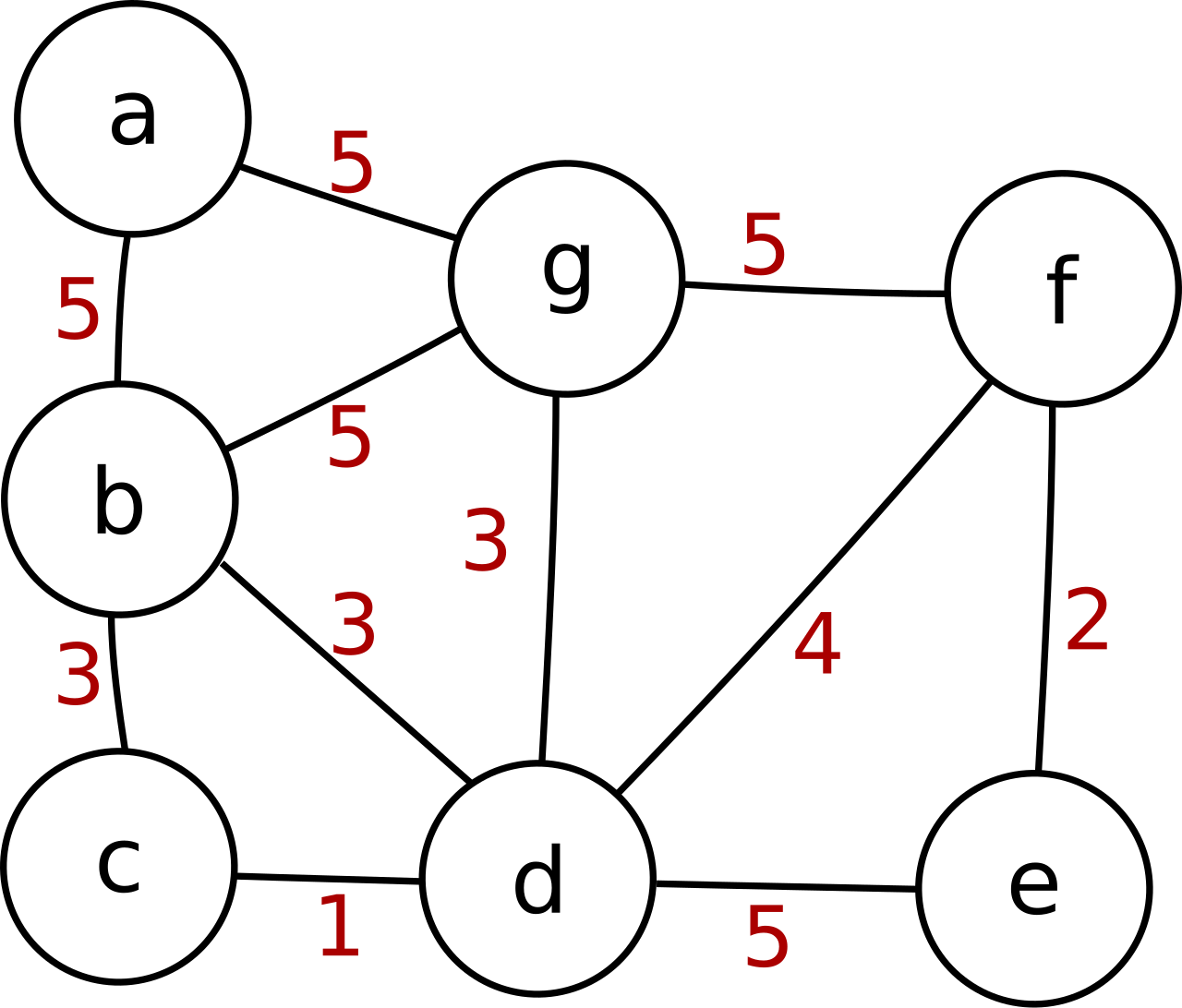
me, Public domain, via Wikimedia Commons (File:Graph weights.svg); credit: Own work, Public domain. Prepared model input from the cited source; see original source for its unmodified file.
- Option 1: 24
- Option 2: 25
- Option 3: 26
- Option 4: 27
VB0200 Navigation and planning
Choose a route from S to T that minimizes its largest single-edge weight, rather than its total weight. Which offered route achieves the best possible bottleneck?
Connections are undirected and each printed number is that edge's weight. A route's bottleneck is the maximum weight of any edge it uses. Smaller is better. Select a globally optimal route among the offered choices.
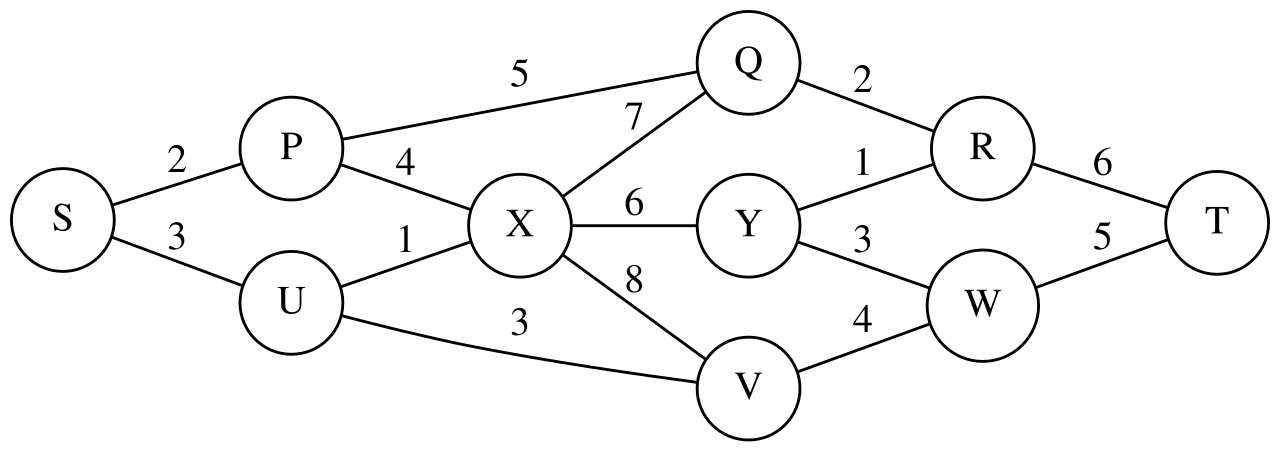
Willprice, CC BY-SA 3.0, via Wikimedia Commons (File:Dijkstra algorithm 1.svg); credit: Own work, CC BY-SA 3.0. Prepared model input from the cited source; see original source for its unmodified file. Re-encoded for the tested C1 input variant.
- Option 1: S-U-X-Y-R-T
- Option 2: S-U-V-W-T
- Option 3: S-P-X-Y-W-T
- Option 4: S-P-Q-R-T


